The Eye That Waited
The specimen room smelled of cold salt and floor wax. Aunt Reba ran her mop in long strokes between the tanks and told them to look but not touch, and then she went back to the part of her job that had nothing to do with them.
Maya found the eye first.
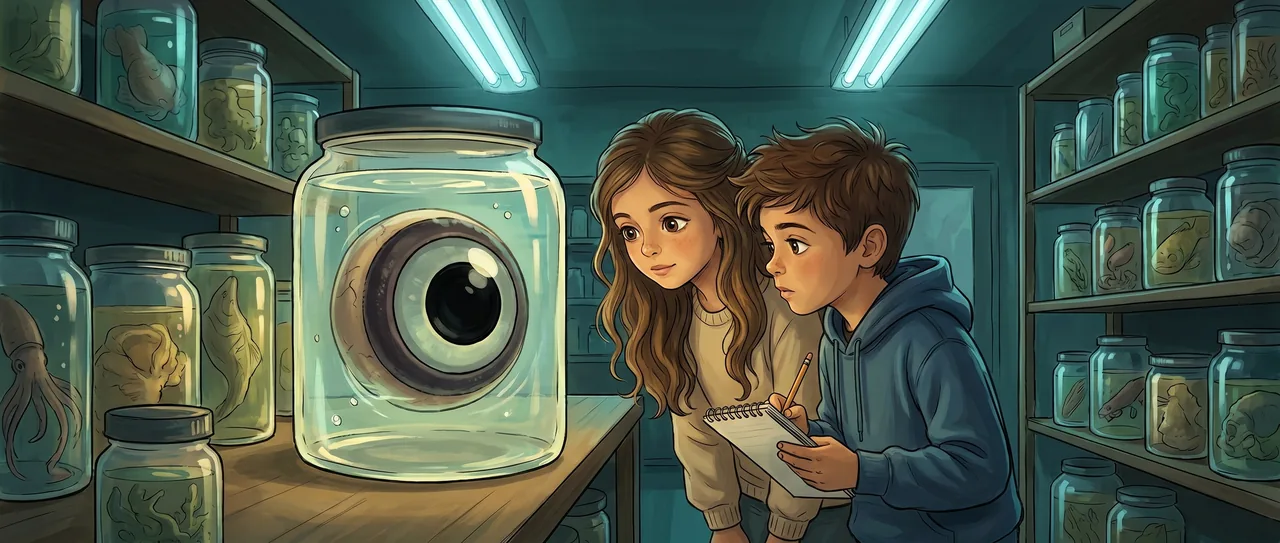
It sat by itself in a squat jar of clear fluid, and it was the size of a dinner plate. Not a picture of an eye. An eye. A dark ring around a lens like a black moon, wider than both of Maya's hands laid flat.
"Soren," she said. "Come here and be quiet."
He came. He put his face close to the glass until his breath fogged it, then wiped the fog with his sleeve.
"Colossal squid," he read off the little card. "Largest eye of any animal that ever lived. Twenty-seven centimeters." He measured it against his memory of a ruler. "That's bigger than my head."
"Why," Maya said. It was not a question the way she said it. It was a thing she had set down on the table to look at.
"Why what."
"Why so big. Everything down there is dark. There's nothing to see." She pressed her nose sideways against the jar, trying to look through the lens the way the squid would have. "You don't grow an eye like a dinner plate to see nothing."
Soren thought about that. He liked the shape of it. A body did not spend that much on an organ unless the organ paid rent.
"Eyes are expensive," he said slowly. "My dad said that once. About deep fish. The ones that live in total dark, a lot of them lose their eyes. Save the energy. If there's no light, an eye is just a soft spot for something to bite."
"So this one kept its eye," Maya said. "Kept it and made it huge. Which means."
They said it at the same time, from two directions.
"There's light down there," said Soren.
"It needs to see something," said Maya.
The overhead lights buzzed. Aunt Reba's mop knocked against a table leg two rows over. Maya cupped her hands around her eyes to block the glare and stared into the lens as if it might still be holding the last thing it saw.
"Okay," Soren said. He had his notebook out. His pencil moved. "Down where it lives, a mile deep, sunlight is basically gone. But it's not gone gone. There's glow. Animals make their own light down there. Little flashes. Sparks."
"Bioluminescence," Maya said, trying the word like a stone in her mouth.
"A tiny bit of it. Way less than a candle. Way less than a star." He stopped. He looked at the eye again, and something in his chest went tight and strange. "An eye that big could catch a tiny bit of it. That's the whole point. It's built to catch almost nothing."
"How little," Maya said. She wanted the number. She always wanted the number.
"I don't know how little."
"Guess."
He hated guessing and he did it anyway, because she asked. "A million times less than we could see. A room this dark, we'd call it pitch black. Nothing. And that eye would be reading it like a book."
Maya went still against the glass.
Then she pulled back so fast her elbow banged the shelf. "But what's it reading. You said it. Eyes are expensive. It didn't grow the biggest eye ever to admire the sparks. It's watching for something specific. Something worth all that."
Soren stared at her, then at the card, then at the eye.
"Sperm whales," he said. His voice had gone quiet. "Sperm whales eat these. They dive down a mile in the black to hunt them."
"A whale doesn't glow."
"No." He was working now, fast, the pencil forgotten in his hand. "But it swims. It's the size of a bus and it's moving through all those little glowing animals. And when it moves"
Maya's hands flew up. "It stirs them. It bumps them. They flash. The whale comes down through the dark and it lights up everything it touches, like" she searched for it, "like footprints. A glowing cloud around the whale. The whale can't help it."
"And the squid," Soren said, "is sitting there in the black with an eye the size of a dinner plate, watching for exactly that. Not the whale. The whale is invisible. It's watching for the shape the whale makes in the light. The disturbance."
They stopped talking.
The room was too bright now. That was the thing Maya felt, standing there under the buzzing tubes with the mop going swish two rows over. All this light, thrown around for free, and here was an eye that had spent its whole life a mile down straining to catch the faintest smear of glow at the edge of a predator. Watching the dark so hard. Waiting to see the one thing that meant run.
Soren put his hand flat on the cold glass without meaning to. He took it off, because Aunt Reba had said not to touch.
"It could see us," he said. "If we were down there. It could see us glowing, from things we bumped, way before we knew anything was there."
"We can't see it back," Maya said. "We'd be standing in the pitch dark thinking there's nothing. And it would be looking right at us."
The idea went into her like cold water. That there was a whole way of seeing the world running underneath the world she stood in, a mile down, in what she had always called nothing. That nothing was full. That an eye could be built to read a book written in light too faint for her to believe existed.
Aunt Reba's mop stopped. "Five minutes," she called. "Then we lock up."
Neither of them moved.
Maya leaned in one more time and looked into the lens, into the black moon of it, and this time she did not try to see through it. She let it be what it was. An instrument for reading the dark. Pointed, right now, at nothing, in a bright room, in a jar.
The fluid in the jar trembled once as a truck went by outside, and the lens swung a slow half-turn, and settled, facing them.
Read the interactive version, listen to the narration, and earn a gold star →
A science-verified short story for curious kids · Curiosity Land