The Counting Problem
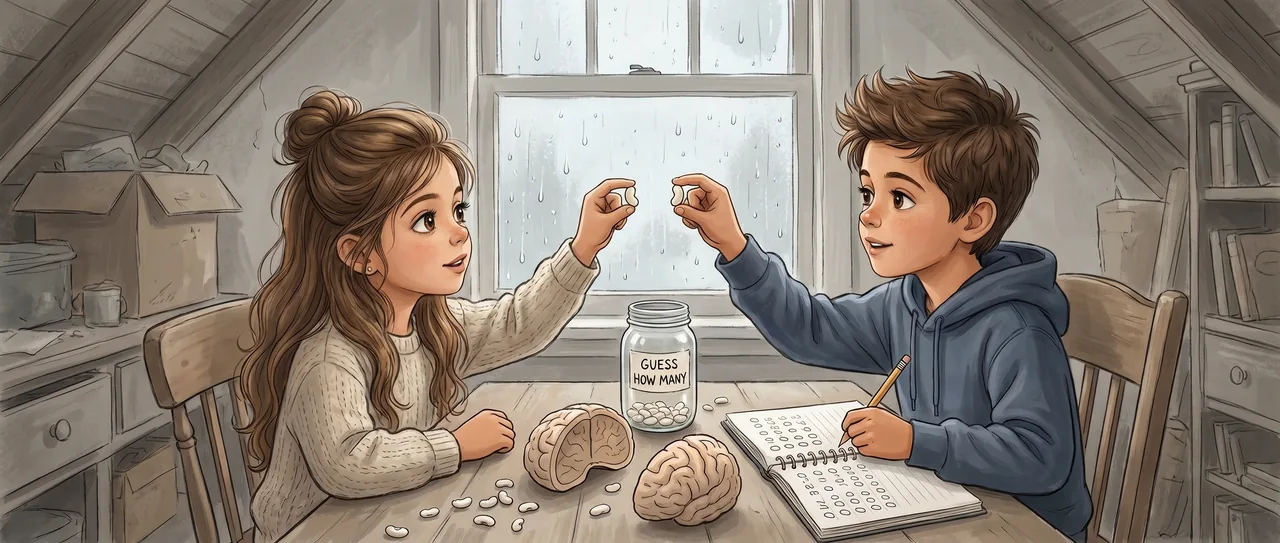
The rain had been going for three hours and the attic smelled like old paper. Maya was holding a plastic brain, the kind that comes apart in halves, and one half kept falling on the floor.
"Your grandmother had a fake brain," she said.
"She taught biology for forty years," said Soren. "She has three."
On the table between them sat a mason jar full of dried white beans, left over from a bean-counting jar somebody was supposed to guess at a fair. Nobody had guessed. The label still said GUESS HOW MANY.
Maya shook it. "How many, do you think."
"In the jar? Maybe four hundred."
"No. In here." She tapped the plastic brain against her own forehead, gently.
Soren pulled out his notebook and wrote a number and turned it around. Eighty-six billion.
"That's neurons," he said. "I read it. Eighty-six billion neurons in a person's brain."
Maya took the jar and counted out beans onto the table. One, two, three, up to ten. Then she stopped.
"Okay," she said. "Ten beans. If ten beans is ten neurons, how big a jar do we need for eighty-six billion."
Soren did the arithmetic on the page, muttering. "These beans are maybe half a centimeter. Eighty-six billion of them would fill. A lot. A swimming pool. A big one."
"A pool of beans in your head." Maya grinned. "That's already too many. That's a good number."
"That's not the number," Soren said.
She looked at him.
"The neurons aren't the number," he said again, slower. "They connect. Each one connects to other ones. Up to ten thousand others, the book said."
Maya went quiet and picked up one bean and held it in the air. "So this bean. This one neuron. It's got ten thousand strings coming off it."
"Going to ten thousand other beans."
"And every one of those has ten thousand strings."
"Yes."
Maya put the bean down very carefully, like it might do something.
"Then counting beans is the wrong game," she said. "It's not how many beans. It's how many ways to string them."
Soren stopped writing.
"Say that again," he said.
"Ways to string them. A brain isn't the beans. It's the pattern of strings. Every different pattern is a different. What. A different way of being a brain."
"A different thought," Soren said. "A different you."
They sat with that for a second while the rain came down on the roof.
"Okay," said Soren. "Let's count the patterns. Small first. Two beans. How many ways to connect two beans."
"One string or no string," said Maya. "Two ways."
"Three beans." He drew dots. "Each pair can have a string or not. Three pairs. So two times two times two. Eight ways."
"Four beans, six pairs. Two to the six." Maya was already ahead, her finger tapping the table. "Sixty-four."
"It's doubling for every new string you could add," Soren said. His pencil was moving fast now. "And the strings pile up way faster than the beans do. Ten beans isn't ten strings. Ten beans is forty-five possible strings."
"So two to the forty-five," said Maya. "For ten measly beans."
Soren wrote it out and stared. "That's already trillions. From ten beans."
Maya reached over and slid the whole jar toward him. "Now do the real one."
"I can't do the real one."
"Try."
He tried. He wrote eighty-six billion. He wrote ten thousand. He started multiplying and the zeros ran off the edge of the page and he turned the notebook sideways and they kept running.
"It's not going to fit on the paper," he said.
"How big does it need to be."
Soren put the pencil down. "Maya. There's a number people use. For the whole universe. The atoms in the whole observable universe. All the stars, all the everything."
"How big."
"It's a one with about eighty zeros."
"Okay. Is our brain number bigger or smaller than that."
Soren looked at the page. He looked at the jar. He looked at the plastic brain sitting there in two halves.
"Bigger," he said. His voice went funny. "It's not close. The number of ways to wire up one person's brain is bigger than the number of atoms in the whole universe. Every star. Every grain of everything. And the brain beats it. It's not even a contest."
Maya didn't say anything for a second. She was looking at the two halves of the plastic brain.
"Wait," she said. "Wait wait wait."
"What."
"There's more atoms in the universe than anybody could ever count. Right. That's the biggest thing anyone points at when they want to say big."
"Right."
"And the ways to be a person are more than that." She pointed at Soren's head. Then her own. "So there has never been. And there could never be. Two of the same."
Soren picked his pencil back up but didn't write anything.
"Every teacher who ever said sit still and be like everybody else," Maya said, and she was starting to laugh, but not a joke laugh. "The universe literally doesn't have enough atoms to make two of us the same. It ran out. It ran out a long way back."
"There aren't enough atoms in existence to build a second one of you," Soren said slowly. "The pattern's too big to copy."
"So the weird ones," said Maya. "The ones who think sideways. The ones who ask too many questions."
"There was never going to be a matching one anyway," said Soren. "Not for anybody. The math doesn't allow it."
Maya picked up one white bean and held it up to the gray light from the attic window, turning it.
"One neuron," she said. "With ten thousand strings."
Soren reached over and took a bean too, and held his up next to hers, and the rain kept knocking on the roof over the two of them and their two beans and the jar with all the rest.
Read the interactive version, listen to the narration, and earn a gold star →
A science-verified short story for curious kids · Curiosity Land