The Color With No Name
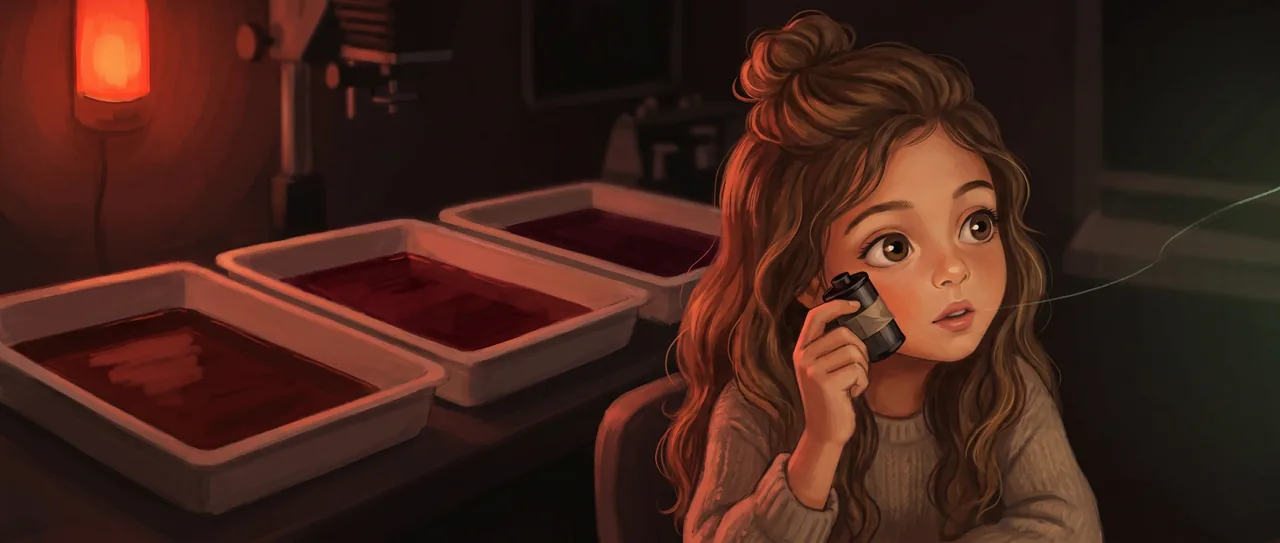
Aunt Rosa's darkroom smelled like vinegar and cold metal, and when she pulled the door shut the black came down so complete that Maya's own hands vanished.
"Give it twenty minutes," Rosa said from somewhere near the sink. She was rinsing trays, half here, half already thinking about tomorrow's prints. "Your eyes take that long to really open. Most people leave before they find out what they can do."
Then she stopped talking, because the water needed her, and Maya was alone inside the dark with the sound of dripping.
At first there was nothing. Nothing so total it pressed on her face. Maya kept her eyes wide anyway, waiting, the way you wait for someone at a station when their train is late but coming.
Slowly the nothing changed. Not into shapes. Into a kind of grain, a soft crawling static, like the dark was made of the tiniest possible dust, each speck flickering on and off. She reached toward it and her hand didn't interrupt anything, because the specks weren't out there. They were in her.
"Rosa," she whispered. "The dark is sparkling."
"That's your own eyes talking to you," Rosa said. "Rod cells firing. In real dark they get so hungry for light they'll answer to almost nothing."
Maya held very still. She thought about that word, almost. Almost nothing was still a something. She wanted to know how small the something could be.
Rosa clicked on the safelight. It wasn't much, a dull red coal in the corner, but after the total black it felt like sunrise. Maya's eyes drank it. And when Rosa said she'd be back in five and slipped out the little curtained door, taking even that red coal's edge with her, Maya did the thing she'd been wanting to do since the black first fell.
She found the film cannister Rosa had shown her, the one with a pinhole taped over. Inside, Rosa said, was a scrap of glow-in-the-dark tape, charged that morning, nearly dead now. Nearly. Through the pinhole it would leak the faintest thread of green a person could still, barely, maybe see.
Maya lifted it to her eye and looked straight at the hole.
Nothing.
She remembered the aurora story Soren always told, how he'd learned to look beside a thing instead of at it, because the edges of your eyes catch the dimmest light. So she looked a little to the side of the pinhole.
And there it was. A green so faint it was less a color than a rumor of one. It didn't sit still. It swam when she chased it and steadied when she looked away, like a shy animal that only came out if you pretended not to watch.
She counted her own heartbeat. The green pulsed with it, brighter on the beat, dimmer between. She was seeing something so small that her own blood, pushing past her eye, changed it.
How little, she thought. How little light is this.
The answer arrived in her chest before her head could catch up. This was almost nothing. This was one grain at a time. Somewhere in that swimming green, a single speck of light, the smallest piece light comes in, was landing on the back of her eye and her eye was saying yes. I felt that. One. She was standing at the very bottom of what a person could see, the last stair, and there was a step below her that had no floor.
She stayed there a long time, breathing slow so her heart wouldn't crowd the green.
Then the tape gave up its last charge and the green thinned to gray and the gray thinned to the sparkle of her own hungry eyes and that was all.
When Rosa came back and raised the safelight, Maya wasn't looking at the pinhole anymore. She was looking at Rosa's developing trays, three of them, red liquid in red light, and she couldn't stop.
"They're all red," Maya said. "But they're not the same red."
Rosa glanced over. "Stop bath, developer, fixer. Different chemicals."
"No." Maya leaned closer, moving her eyes from tray to tray. "I mean I can see they're different. Three reds. And there's no word for what makes them different. I keep reaching for one and there isn't one."
Rosa laughed softly, drying her hands. "There are more colors than words, mija. Way more. Your eyes sort millions of them. We only bothered to name a handful."
Maya looked back and forth between the trays. Now that she was hunting for it, the space between the reds opened up like a hallway with doors she'd never noticed. This red had a weight to it. That one had a cold edge. The third one leaned, just slightly, toward a color she had absolutely no name for, a red that was also almost something else, and the almost-something-else had no name either, and neither did the next one past it, on and on, millions of doors, and behind every door a color no one had ever bothered to call anything.
Her whole life she'd had, what, a dozen crayon words. Red, orange, the usual. And behind those dozen words this. An enormous silent country she'd been walking through the entire time, seeing all of it, naming almost none of it.
"So most of what I see," Maya said slowly, "I can't say."
"Most of what anybody sees," Rosa said. She was already turning back to the sink, half gone again into tomorrow. "You just noticed. Most people don't."
Maya didn't answer. She was moving her gaze along the row of trays, slow, deliberate, from the first red to the second to the third and back, catching each nameless shift as it came, saying none of them out loud because there was nothing to say them with.
Outside the curtain the ordinary house was full of light, full of words, everything labeled and settled. In here she moved her eyes one more time along the reds, hunting the color that had no name, finding it, losing it, finding it again.
Read the interactive version, listen to the narration, and earn a gold star →
A science-verified short story for curious kids · Curiosity Land