The Wall That Keeps the Rain Out
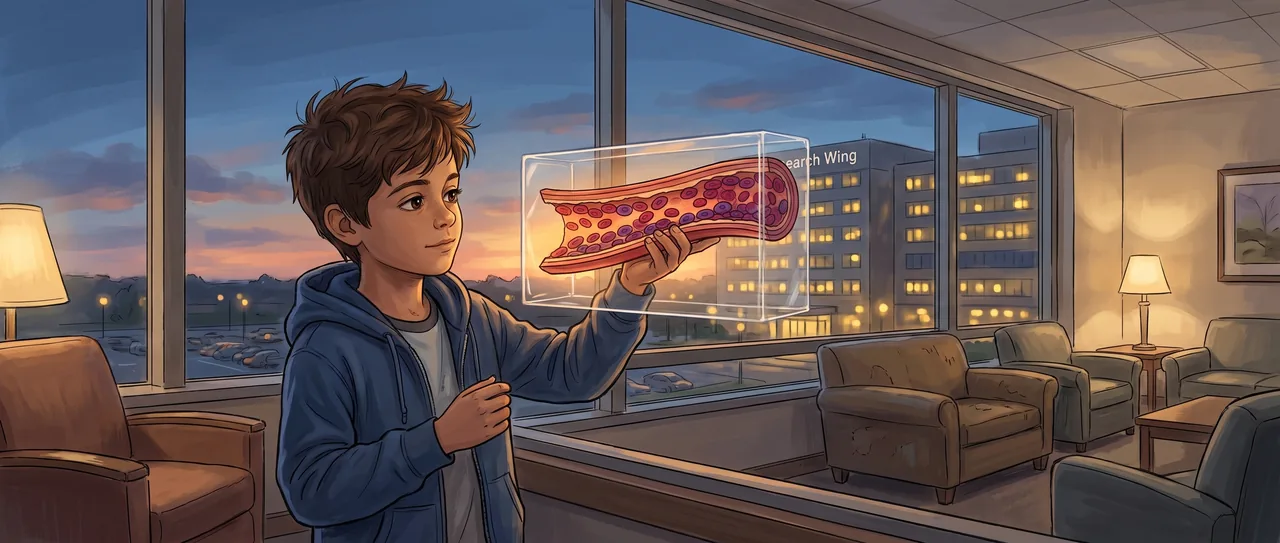
The model sat on the coffee table like somebody had abandoned it. A clear plastic tube, thick as Soren's thumb, with a cutaway window showing the inside. Tiny painted cells lined the wall, pressed together so tight there were no gaps between them.
Soren had been in the lounge for two hours. His mother was down the hall with the doctors and his grandmother, in a room he was too young to sit in, and the vending machine only had two things that were not chips.
So he looked at the model.
There was a card propped beside it. Blood-Brain Barrier, it said, and then a paragraph in the small font adults use when they do not expect children to read.
He read it anyway.
He read it three times, because the third time was when the strange part landed.
Every other part of the body, the card said, let things through the walls of its blood vessels. Sugar, water, medicine, all of it seeped out between the cells to feed the tissue around them. But the vessels feeding the brain were different. The cells there were stitched together with something called tight junctions, so close that almost nothing could squeeze past. The brain got fed through special doors, one substance at a time, each with its own key.
A nurse walked through, saw him looking, slowed down.
"That's the barrier," she said. "Keeps the bad stuff out. Poisons, germs. Your brain's very fussy about visitors."
"Okay," said Soren.
"Pretty amazing, right?" She was already walking again. "Best security system in the body."
Soren did not think it was amazing yet. He thought there was a hole in it, and not a real hole, a hole in the way she said it.
He picked up the model and turned it so the light from the window went through the plastic.
If the wall kept the bad stuff out, then it was good. But his grandmother's problem was inside the wall. The tumor was in her brain, on the far side of all those tight, careful cells. And the medicine had to come from outside, in the blood, in the tube.
He traced the tube with his finger, from where blood would come in, along the painted cells, to where it would leave. He did it slowly, the way he checked a circuit when it would not light, looking for the place the current stopped.
The medicine would ride in the blood. It would reach the wall. And then the wall, the wonderful fussy wall that kept the poisons out, would look at the medicine and not have a key for it.
And it would keep the medicine out too.
Soren put the model down.
He took out his notebook and wrote, the wall cannot tell the medicine from the poison. His pencil pressed a little too hard on the word poison.
That was the thing nobody had said. The barrier was not being cruel and it was not being kind. It was doing exactly the one thing it did, which was doubting everything that tried to come in. It doubted germs. It doubted toxins. And it doubted the very thing that had been made to help.
The doctors were not fighting the tumor. Not first. First they were fighting the wall.
He found the nurse again by the vending machine, filling a paper cup at the water cooler.
"The medicine for my grandmother," Soren said. "Does it get in? Past that?" He pointed back toward the lounge.
The nurse stopped filling the cup. She looked at him properly this time, the way people look when a question is bigger than they expected from the person asking it.
"That," she said, "is the whole problem. That's the whole entire problem, and you just found it faster than most."
She crouched down so they were level.
"Most medicines can't cross," she said. "For a brain like your grandmother's, we don't just need a drug that kills the tumor. We need one small enough, or sneaky enough, or shaped exactly right, to trick a wall that's spent her whole life keeping things out. There are scientists who do nothing else. Their entire job is figuring out how to get past that wall without breaking it."
"Because if you break it," Soren said, "then the poisons get in too."
"Then everything gets in." She nodded. "You can't just knock the wall down. You have to talk it into opening one door."
Soren thought about the special doors on the card. Each one with its own key. Sugar had a key. Certain things the brain wanted had keys.
"So you make the medicine look like something it already has a key for," he said.
The nurse's paper cup had overflowed a little. She did not seem to notice.
"Some of them are trying exactly that," she said quietly. "Dressing the medicine up as sugar. As something the brain lets in on purpose. Getting it to hand over its own key."
Soren went back to the lounge and picked up the model one more time.
He had thought, three hours ago, that a wall around a brain was a simple good thing, the way a fence around a yard is a good thing. He had thought a good wall let the right things in and kept the wrong things out, and that this was what made it good.
But the wall could not tell right from wrong. It could only tell familiar from strange. It had never once in his grandmother's whole life met the medicine she needed now, so to the wall the medicine was a stranger, and strangers did not come in.
Everything that would ever save anyone's brain was, to that wall, a stranger at the door.
Somewhere out there, right now, people were spending their whole lives learning to knock in a way the wall would answer.
He held the tube up to the window again. Through the clear plastic he could see the parking lot, and the cars, and past them the low brick building across the road where a sign said Research Wing, its windows lit even though it was late.
He counted the lit windows. Nine. Then a tenth came on.
Read the interactive version, listen to the narration, and earn a gold star →
A science-verified short story for curious kids · Curiosity Land