The Teaspoon Question
The two bean plants were three feet apart and one of them was dying.
"Same seeds," Soren said. He had the packet in his hand to prove it. "Same day. Same sun. I measured."
"Yours gets watered more," Maya said.
"Mine gets watered exactly the same. I have a schedule." He pulled the notebook out of his back pocket and turned it to show her the little grid, watering times inked in neat columns. His plant, in the raised bed with the bagged soil his dad bought, had four sad leaves the color of weak tea. Her grandmother's plant, growing out of the messy corner nobody weeded, was up past Maya's knee and covered in flowers.
"So it's not the water," Maya said.
"It's not the water."
Maya crouched and pushed her fingers into her grandmother's dirt. It came apart soft and dark and smelled like the woods after rain. Then she reached over into Soren's raised bed. That soil was lighter, drier, and it sort of poured off her fingers like sugar.
"Smell them," she said, and held both hands up.
Soren smelled. "Yours smells like something. Mine smells like nothing."
"That's a thing. That's an actual difference." She wiped her hands on her shorts. "Grandma's never fed this corner. Never. She calls it the lazy corner. She's proud of it."
"My dad feeds mine. There's a fertilizer with three numbers on it." Soren frowned at the bagged soil. "That doesn't make sense. More food, worse plant."
Maya sat back on her heels. "The good dirt smells alive. What if it's alive? Like, with stuff in it."
"Worms," said Soren.
"Smaller than worms. Smaller than you can see."
Soren was quiet, thinking about how you would check that. "We can't see it, so we can't count it."
"We can see what it does, though. Grandma's plant is what it does."
Her grandmother was on the porch shelling peas and not really listening, which was how she liked to sit. "Grandma," Maya called. "Why won't you weed the lazy corner?"
"Because the corner knows what it's doing," her grandmother said, not looking up. "I dug it once, forty years ago. Never again. You dig it, you have to feed it forever after. Leave it, it feeds itself." She cracked a pod. "My mother told me that. I didn't believe her either."
"That's not an answer," Maya said.
"It's the only answer I've got, sweetheart."
Maya looked at Soren. "See. Circular."
"It's not circular," Soren said slowly. "It's just missing the middle. She knows the corner works. She doesn't know why." He crouched by the raised bed again. "The bagged soil got dug up. Made in a factory, poured in a bag. Whatever was in Grandma's corner, this never had it."
"Or had it and lost it."
They got a teaspoon from the kitchen, the actual measuring kind. Maya scooped a level teaspoon of the lazy-corner soil onto a white plate and one of the bagged soil beside it. Under her grandmother's magnifying glass, the reading kind, the corner soil was a whole tangled world, threads and specks and something that might have been a mite the size of a comma. The bagged soil was just tan grit.
"Okay but that's still just the big stuff," Soren said. "The bugs we can see. Grandma's mother didn't have a microscope and she still knew."
"So how much is down there that we can't see." Maya wasn't really asking him. She was asking the teaspoon.
They looked it up on Soren's mom's phone, sitting on the porch step. Soren read it out loud because Maya read too fast and skipped words.
"'A single teaspoon of healthy soil can contain up to one billion bacteria.'" He stopped. "A billion."
"In the teaspoon."
"In the teaspoon." He kept reading. "'Representing as many as ten thousand different species.'" He put the phone down on his knee. "Ten thousand kinds. Maya. There are more kinds of living things in this teaspoon than there are people at our school. Way more. Than in our whole town."
Maya took the phone and read the next part herself, mouth moving. Then she said, "It says farming the normal way, plowing and the three-number stuff, cuts the number of kinds down by almost half."
"Half of ten thousand."
"Gone. Not fewer bugs. Fewer kinds of bugs." She looked at the two teaspoons on the white plate, the alive one and the dead one, and they looked exactly the same to her eyes and she knew now they were not remotely the same. "The bagged one isn't empty. It's just quiet. It's got the same little bit left, over and over, instead of ten thousand jobs getting done."
Soren was writing now, fast, the pen scratching. "Jobs. That's it. If there's ten thousand kinds, they each do a different thing. One kind pulls nitrogen out of the air. One kind unlocks the phosphorus. One kind holds water like a sponge." He looked up at her plant, tall and flowering. "Grandma's not feeding the plant. Grandma's not feeding it because the billion things are feeding it. That's the middle she was missing."
"That's why the fertilizer makes it worse," Maya said. "You pour food on, the little bit that's left goes lazy, the rest never comes back. You've got to feed it forever because you killed the thing that fed it for free."
They both looked at the dying plant. Then at the teaspoon of tan grit that had maybe five hundred kinds where the other one had ten thousand.
"We can't put them back," Soren said. "We can't buy a billion things in a bag."
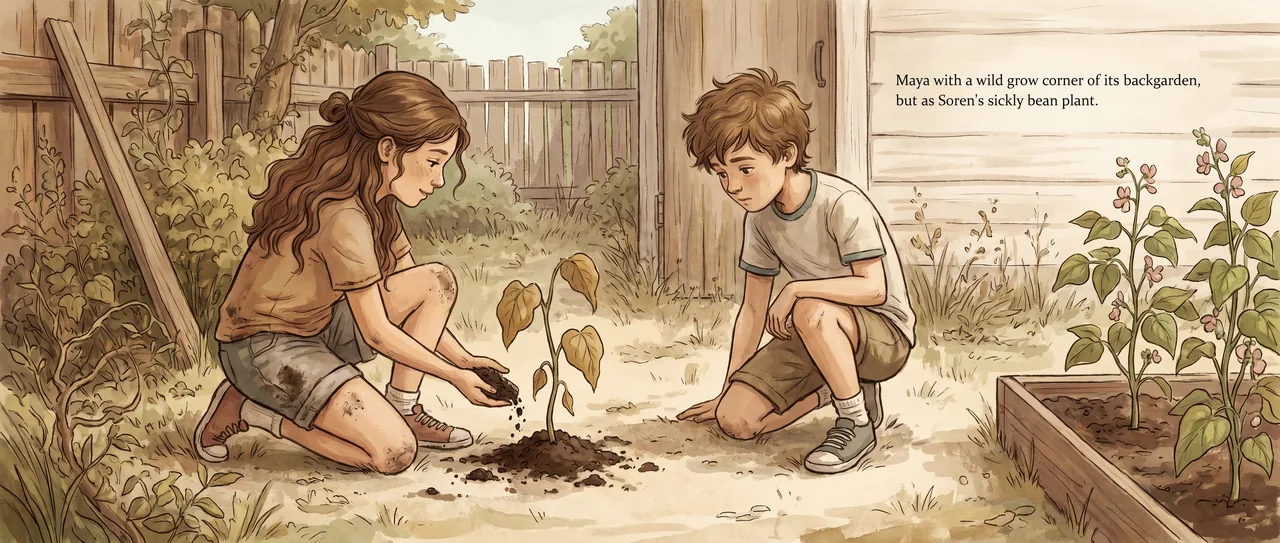
Maya was already up and moving to the lazy corner. She dug her fingers in, careful, and lifted out one small handful of the dark living soil, worms and threads and the comma-sized mite and the billion things she couldn't see and never would.
"You don't buy them," she said. "You invite them."
She carried the handful over and worked it gently into the dead pale bed around Soren's four tea-colored leaves, and patted it down, and did not water it, because for the first time all summer the water was not the point.
Soren crouched beside her and watched the dark crumb of Grandma's corner sink into the pale grit and disappear.
Read the interactive version, listen to the narration, and earn a gold star →
A science-verified short story for curious kids · Curiosity Land