The Slowest Heart in the Sea
The cold came up through the deck and into Maya's boots before it reached the rest of her. It was almost midnight and the sky was still the color of a bruise that would not darken all the way, because this far north the summer sun barely bothered to set.
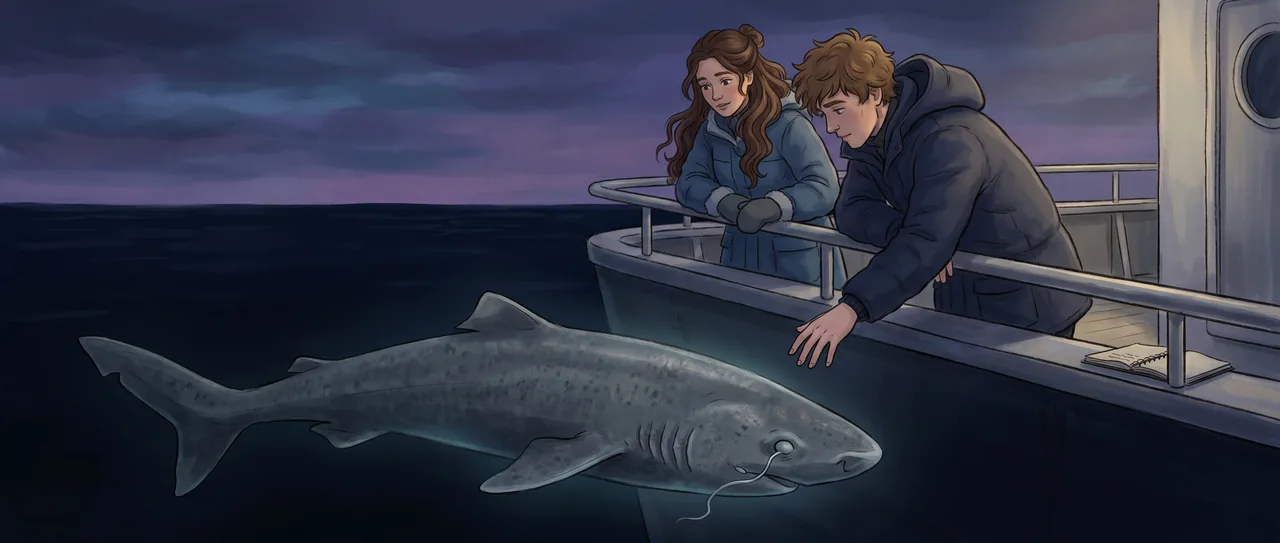
They had a shark alongside the boat. It hung in the black water beside the hull, long as a rowboat, gray as wet stone, moving so slowly that Maya kept thinking it had stopped.
"Watch its gills," said Aunt Priya, leaning over the rail with a measuring tape and a tagging pole. "That's how you know it's alive and not just floating. There. See?"
The gill slits opened. A slow pulse, one, and then a long wait, and then another. Maya counted in her head and lost patience before the second beat came.
Soren had one bare hand pressed against the metal rail and the other tucked in his armpit to keep it warm. He was watching the shark's eye. There was something clinging to it, a pale threadlike thing that trailed in the current like a tiny worm.
"What's on its eye?" he asked.
"A parasite," Priya said. "Almost all of them have it. It hangs off the cornea. These sharks are mostly blind because of it, we think." She reached down with the pole. "Doesn't seem to slow them down. They hunt by smell, by feel. They don't need to see much down there. It's dark all the way down."
Maya put her mittened hand flat on the rail beside Soren's. The metal was so cold it felt almost hot. The shark rolled a fraction, and the eye came around toward them, cloudy, ancient, indifferent.
"How old is it?" Maya asked.
Priya laughed, not unkindly. "That is the question, isn't it. That is exactly the question. Nobody could answer it for two hundred years. They grow about one centimeter a year. One. This one is about four meters. You do the arithmetic."
Soren's lips moved. His breath came out in a slow cloud. "Four meters is four hundred centimeters," he said. "That's four hundred years. That can't be right."
"That," said Priya, "is what everybody said. So they found another way."
The shark pulsed its gills again. The wait between beats was so long that Maya felt her own heartbeat crowding into the gap, three of hers, four, five, before the animal took its next breath of water.
"What way?" Maya said.
Priya set down the pole and pointed at the cloudy eye, at the lens behind the clinging parasite. "The lens. Right there. When a shark is still inside its mother, before it's even born, its eye lens starts to form. A little ball of protein. And here's the strange part. That protein at the very center never gets replaced. Never. Your body swaps out its cells all the time. The center of that lens is the same protein it was on the day the animal was made."
Soren went very still. He pulled his notebook out of his coat, and his cold fingers fumbled the pencil twice before they caught it. He wrote something and underlined it.
"So the middle of its eye," he said slowly, "is older than the rest of it."
"The middle of its eye is exactly as old as the shark," Priya said. "To the day. It's a little clock made of protein, sitting inside a lens, and it has been ticking since before the animal opened its eyes."
Maya was not listening to the rest. She was looking at the eye and doing something in her head, and then she said it before she was sure of it. "You can read it," she said. "Like a tree. Like counting rings."
"Better than a tree," Priya said. "There's carbon in that protein. A special kind. And the amount of it in the ocean changed at certain years, years we know. So if you measure the carbon in the center of the lens, you can find the year the lens started forming. The year the shark began." She paused. "There was one they measured. A big female. The carbon in her lens said she was born somewhere around the year sixteen twenty."
Maya stopped counting gill beats.
Sixteen twenty. She turned the number over. It did not have anything to hold onto. It was before her country. It was before the boat, before the engine, before electric light, before almost every single thing she had ever touched.
"That's," she started. "That was."
"Four hundred years ago," Soren said quietly. "There are people who were born four hundred years ago and they are all gone. Everyone. And this thing." He looked down at the water.
The shark hung there in the black. It had not hurried once. It had never hurried. It had been moving at exactly this speed, one slow gill beat at a time, while whole countries were born and languages changed and every person its own age turned to dust and it just kept going, cold and blind and unbothered, one centimeter a year.
Maya felt the deck under her boots and the boat under the deck and the whole freezing ocean under the boat, going down and down into the dark where this animal had spent every single one of those four hundred years, never once seeing the sky it was under right now.
"It doesn't know," she whispered. "It doesn't know how long it's been. It's just swimming."
"No," Priya said. "It's just swimming. The clock's in there whether it knows or not."
Soren reached down toward the water. Not to touch it. Just reaching, the way you reach toward something you cannot quite believe is real.
"There could be one older," he said. "Right now. Out there. One that started before sixteen twenty. Nobody's found it. Nobody's measured its eye. It could be down there right now, swimming past us, and it would be the oldest living thing anyone's ever looked at, and we wouldn't even know."
Priya was quiet. Then she unclipped the line, and the tag went in with a soft click, and she said, "Let it go."
Maya and Soren leaned over the rail together. The shark did not thrash or bolt. It simply tilted, unhurried, and the pale gray of it slid downward, dimming, dimming, until the black water closed over the last soft glow of it and it was gone into all that dark, carrying its year inside its eye.
Read the interactive version, listen to the narration, and earn a gold star →
A science-verified short story for curious kids · Curiosity Land