The Sixty-Eight
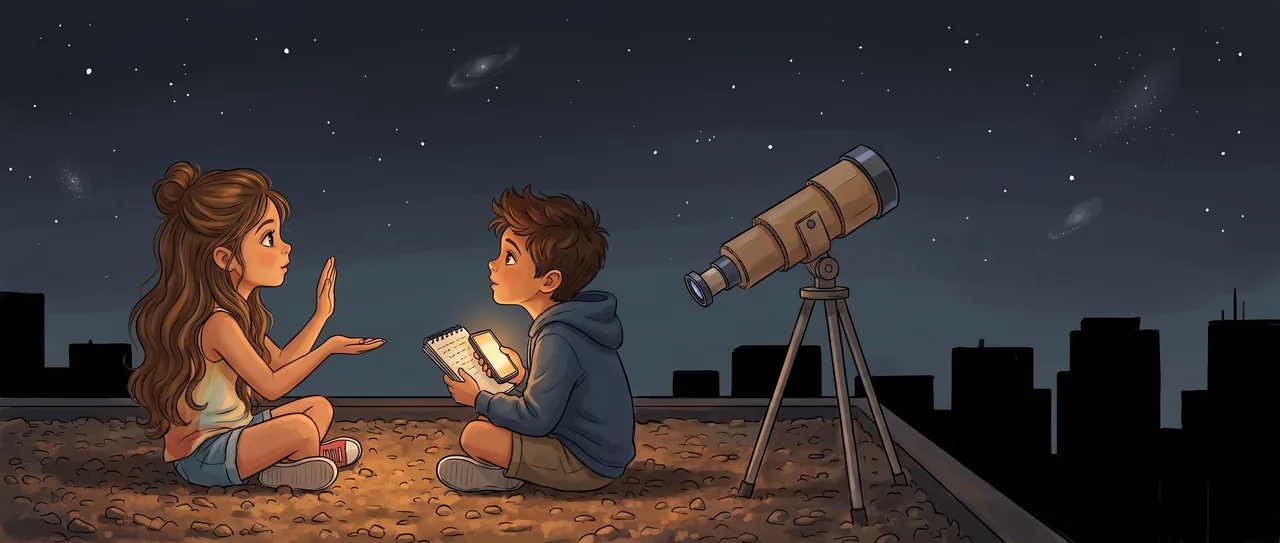
The whole block had gone dark. No streetlights, no windows, no hum from the air conditioner that usually drowned out everything. Just Maya and Soren on the roof with the telescope Soren had spent all summer gluing, aligning, and swearing at quietly.
"Okay," Maya said, "it actually works."
"It focuses," Soren said. "That's different from works." He wrote a line in the notebook balanced on his knee, then looked up. "Try the smudge near the handle of the Dipper."
She put her eye to it. A soft gray oval swam into place.
"That's a galaxy," she said. "That's a whole galaxy and it's just sitting there being a smudge."
"It's not sitting," Soren said. "That's the part I keep getting stuck on. My dad's book says every galaxy out there is moving away from us. And the far ones are moving away faster."
Maya lifted her head. "Faster than the close ones?"
"Faster the farther they are. Doubled the distance, doubled the speed."
She was quiet. Then she said, "That's not an explosion."
"What?"
"If something exploded, the fast bits would already be far and the slow bits would still be near. But that would settle down. It wouldn't keep speeding up." She frowned at the smudge. "Something's still pushing."
Soren stopped writing. "The book doesn't say pushing."
"What does it say?"
He flipped a page by the light of his phone. "It says for a long time everybody thought the expansion was slowing down. Gravity pulls things together, right? So gravity should be putting the brakes on the whole universe."
"Sure," Maya said. "Everything pulls on everything. It should be dragging back in."
"Then in nineteen ninety-eight, two teams measured really far exploding stars, the ones that always burn the same brightness, so you can tell how far away they are. And they were dimmer than they should be."
"Dimmer means farther."
"Farther than the brakes-are-on version. The universe wasn't slowing down." Soren looked at her. "It was speeding up."
Maya sat back against the warm gravel of the roof. "So they were wrong."
"Everybody was wrong. Both teams thought they'd messed up the measurement. They checked it for months. It kept coming out the same."
"I like them," Maya said. "The ones who kept the wrong answer even though it was embarrassing."
Soren almost smiled. "It got them the Nobel Prize."
"For being wrong?"
"For being wrong about which way wrong." He tapped the page. "But here's the thing that gets me. If gravity pulls everything in, and the universe is doing the opposite, something has to be pushing harder than all the gravity of everything combined. Every star. Every galaxy. Every smudge."
Maya looked up at the strip of sky the dark city had finally given back. Without the streetlights there were more stars than she was used to, and behind those, she knew now, the smudges, and behind those, farther out than the telescope could reach, all of it drifting apart.
"How much," she said. "How much pushing."
Soren checked. "The pushing is about sixty-eight percent of everything there is."
"Sixty-eight percent of the universe."
"Of all the energy in it. More than two-thirds. All the stars and planets and people and light and everything you could ever point a telescope at, that's the small part. That's like five percent."
Maya sat up fast. "Wait. What's the rest?"
"Some of it's a kind of matter we can't see either. But the biggest piece, the sixty-eight, that's the pushing thing."
"What is it, though."
Soren was quiet for a moment. "That's what I wanted to tell you." He turned the notebook so she could see, though it was too dark to read. "Nobody knows."
"Nobody as in you don't know."
"Nobody as in nobody. It's got a name. Dark energy. But the name is just a label for the not-knowing. No one has ever caught any. You can't put it in a jar, you can't shine it on anything, you can't detect it directly at all. The only reason anyone knows it's there is the smudges are running away too fast."
Maya stared at him. "So the biggest thing in the universe."
"Is the one thing we've never actually found."
She looked back at the telescope, then past it, at the sky itself. "So when you look up."
"You're looking at the five percent," Soren said. "The lit-up part. The part that's easy."
"And the rest is just." Maya moved her hand through the dark air in front of her, slowly, like she was feeling for a wall.
"Everywhere," Soren said. "Between the galaxies. Between us. It's pushing right now. Space is getting bigger while we sit here."
"Between us," Maya repeated. She held her two hands apart, palms facing, a foot of dark between them.
"Not enough to feel," Soren said. "Gravity wins when things are close. It only shows up over huge distances. Between whole galaxies."
Maya kept her hands where they were anyway.
"You know what I keep thinking," she said. "Everybody who ever looked up, all of them, for all of history, they were looking at the small part. The five percent. And they thought that was the sky. That was everything."
"They didn't know the smudges were running," Soren said.
"Nobody knew until nineteen ninety-eight. That's, like, before we were born but barely." She turned to him. "Somebody's going to figure out what it is. The sixty-eight."
"Maybe," Soren said. "Maybe they haven't been born yet."
"Maybe they have," Maya said.
Down in the street, one by one, the lights came back. First a window, then another, then the hum of the air conditioner, then the streetlamp on the corner buzzing orange, and the faint far smudges dissolved back into a washed-out city sky.
Maya kept her hands apart in the returning light, the foot of dark still held between them, and watched the space there like she expected it to move.
Read the interactive version, listen to the narration, and earn a gold star →
A science-verified short story for curious kids · Curiosity Land