The River That Remembered
The fence post came up out of the water sideways, and that was the wrong direction for a fence post.
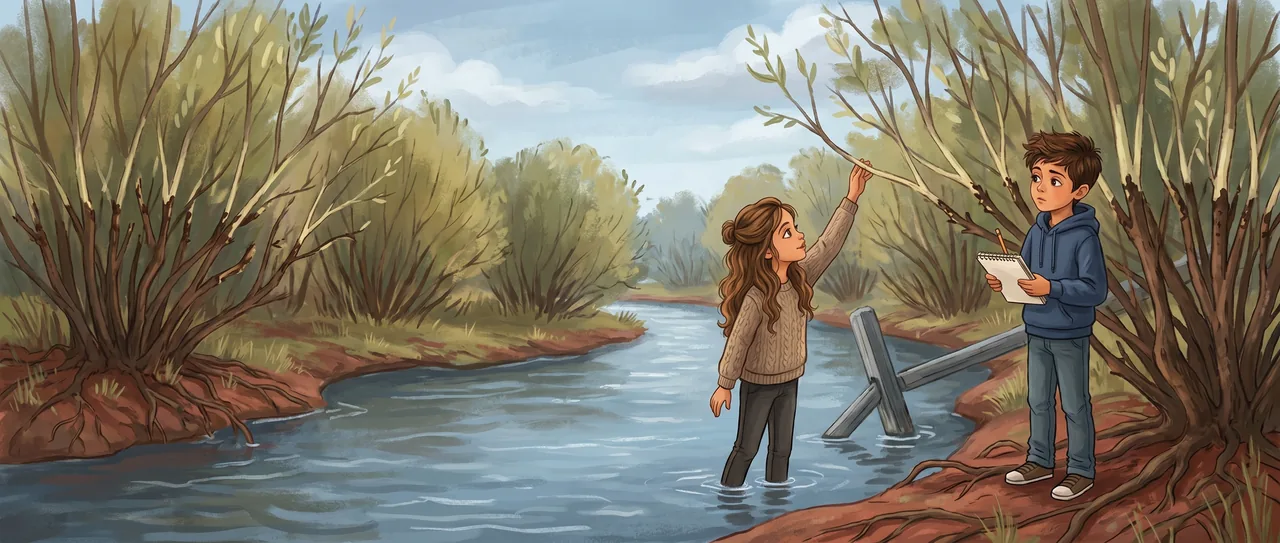
Maya had waded in to her knees to reach it. The creek was July-cold, the kind that bit the ankles and then went numb, and the mud under her feet pulled at her like it wanted her boots. She wrapped both hands around the gray wood and it did not budge. It went down into the streambed and stayed down, tilted, as if the river had grown up around it.
Soren was on the bank with his sleeve pushed up, drawing the bend in his notebook. The pencil scratched. Willows leaned over both of them, so thick that the light came through green.
"A fence goes along the edge of a field," Maya said. She let go of the post. "On dry land. Somebody put this in dry land."
"So the water moved," Soren said. He looked from the drowned post to the far bank, where three more posts made a crooked line straight into the current. "The fence stayed. The river came to it."
Maya climbed out and shook the cold off her legs. Grandpa Reyes had told them the creek used to run wide and shallow and brown, all one lazy smear across the flat, back when he was small. Now it ran narrow and deep and it curled. It went one way, then doubled, then cut back, and the willows crowded every inch of the edge so you had to fight to see the water at all.
"Smell that," Maya said.
Soren lifted his head. Wet leaf. Cold silt. Something green and bruised where their boots had crushed the low plants.
"It smells like a lot of things growing," he said.
"Grandpa said it used to smell like cows and dust."
They walked the bank upstream. The willows thinned in one spot and Maya crouched. The dirt at the water's edge was laced with roots, a whole net of them, red-brown and fine as thread, holding the bank together like stitches in a wound. Where the roots were, the bank stood up tall and firm. Where a gap opened, the earth had slumped into the water in a soft brown collapse.
Soren pressed his thumb into the rooted part. It held. He pressed the bare part and it gave way and slid.
"The plants are the difference," he said. "Roots grab the dirt. No roots, the water eats the bank. More roots, the bank holds, the water gets pushed narrow, it runs deeper and faster and it starts to bend." He frowned at his own thumb. "But why is there so much growing now if there wasn't before?"
Maya was already looking at the willow tips. She reached up and ran her hand along the top of one. The new growth at the very top was pale and soft. Below it, the older branches were blunt, healed over, chewed flat a long time ago.
"Somebody kept eating the tops," she said. "For years. Look. They're all cut off at the same height." She stood on her toes and touched the ceiling of the browse line, dead level above her head, the exact reach of an elk's mouth. "And then they stopped. All at once. The new part is only a few years old."
Soren wrote the height down. He stood back and looked at the whole grove, and now he could see it, the flat line where the eating had ended and the growing had begun, running through every willow like a tide mark.
"Elk," he said slowly. "Elk stand in the open and eat the young willows down to nothing. If they stand here for years, nothing grows tall, no roots, the bank falls apart, the creek stays wide and dumb." He tapped the pencil against his teeth. "So what makes an elk stop standing in one place?"
Maya went very quiet. Then she turned in a slow circle, looking at the willows, at the narrow curling water, at the open meadow beyond where the trees ran out.
"Something that makes it dangerous to stand still in the open," she said. "Something that came back."
Grandpa Reyes had said a word at dinner two nights ago, complaining, the way he complained about weather. He'd said them like a curse. Maya said it now, quiet, like a question instead.
"Wolves."
Soren's pencil stopped.
"Grandpa said they put them back over in the park in ninety-five," Maya went on. "Thirteen of them. He said they've been spreading ever since." She looked at the browse line, that flat ceiling of old chewing, and the fresh green above it. "Nineteen ninety-five. And the willows start growing again right around then."
"Wolves don't eat willows," Soren said. But he said it the way you say a thing to test it, not to argue.
"No. But they eat elk. Or they scare them. The elk can't just stand at the water all day anymore. They have to keep moving, keep watching. So the willows finally get to grow up past an elk's mouth." Maya's hands were moving now, fast, sketching it in the air. "Willows grow, roots come in, banks hold, the creek goes narrow and deep and it starts to bend. The wolves changed the elk and the elk changed the willows and the willows changed the river."
Soren looked down at the fence post drowned in the bend. A fence somebody had built along a bank that used to be dry. The river had come to it. And thirty miles away, six years before either of them was born, someone had opened a crate and let out a wolf, and here was where it had ended up: in the shape of the water, in the reach of a willow, in the cold pulling at Maya's boots.
"You can't see the wolf," he said. "You'll never see the wolf from here."
"No," Maya said. She was grinning now, the cold forgotten. "But you can see where it walked. It's the whole creek."
Read the interactive version, listen to the narration, and earn a gold star →
A science-verified short story for curious kids · Curiosity Land