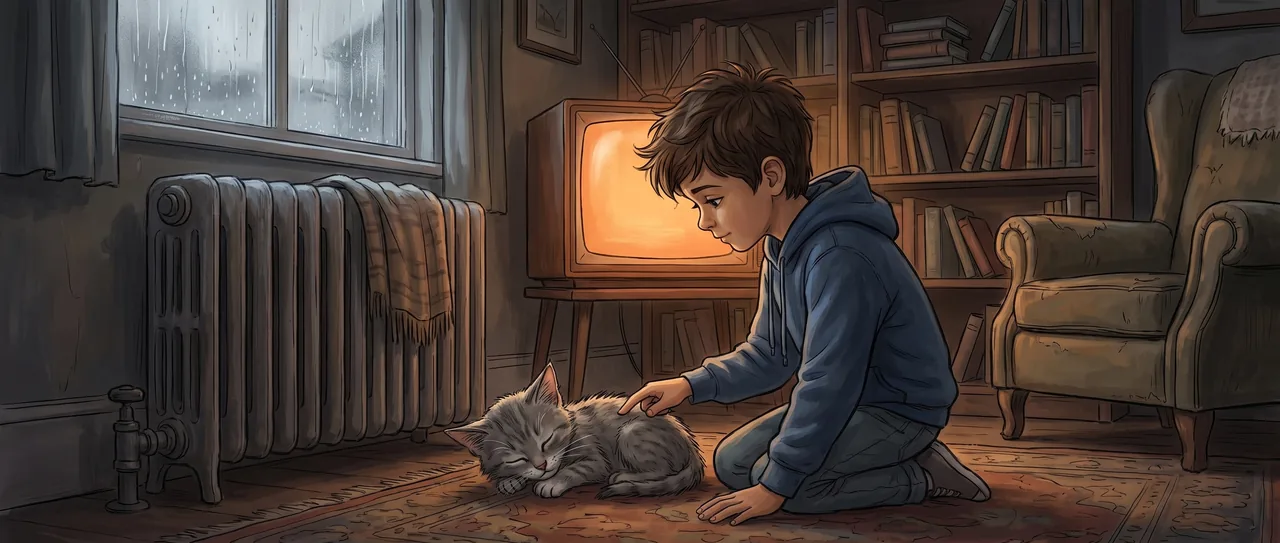
The Cat Who Learned Too Late
The kitten had one eye that worked and one that did not.
Soren noticed it the way he noticed most things, which was by watching something behave wrong before anyone told him it was wrong. Grandmother's new rescue, a gray scrap of a cat named Button, chased the string fine when it came from the left. From the right it missed. Every time. The paw would swipe at empty carpet a hand's width from where the string actually was.
"He's just clumsy," Grandmother said from the kitchen. She was frying onions and did not turn around. "The shelter said his right eye is lazy. Nothing wrong with it. The doctor cat person looked."
Soren crouched and covered Button's good left eye with two fingers. The kitten went suddenly careful, ears back, one paw lifted and frozen. He waved the string. Button's head did not follow it. The eye was open. The eye was pointed the right way. The eye was not seeing.
"The eye works," Soren said. "He's not blind in it. He just doesn't use it."
"Same thing," Grandmother said.
Soren did not think it was the same thing, and he wrote three lines on the page in his lap and drew a small square with a cross through the right half.
He found the documentary that afternoon because the rain would not stop and Grandmother's television only got the free channels. It was old. The colors were faded to a kind of orange and the narrator talked slowly, the way people talked when they were sure of themselves. It was about cats and kittens and the men who had spent their whole lives studying how a brain learns to see.
Soren almost changed it. Then the narrator said something that made him stop with his thumb on the button.
The men had raised kittens with one eye covered. Not damaged. Just covered, for the first weeks of life, during a certain window of time. And when they uncovered the eye later, when the kitten was older, the eye was perfect. Clear lens. Healthy. Everything in it worked.
The kitten could not see out of it. Not a little. Not ever.
Soren sat forward.
The narrator explained it the slow sure way. There was a window early in life when the brain wired itself to the eyes. During that window the two eyes competed for space in the visual part of the brain, like two children racing for the same seat. If one eye sent no signal during the window, the other eye took all the seats. All of them. And when the window closed, it closed. The uncovered eye sent its signal up into the brain and found nowhere to go. No seats left. The brain had already finished building itself around what it had been given.
Later experience could not fix it. That was the part the narrator said twice. Later experience could not fix it, because the building was already done.
Soren looked at Button, asleep on the warm patch by the radiator, the right eye half open even in sleep, catching the gray light and doing nothing with it.
He covered his own left eye with his palm and looked around the room. Everything was still there. The lamp, the cracked spine of the atlas, Grandmother's onions steaming the window. His right eye had gotten its seats. His right eye had made it into the window in time, when he was a baby, before he could remember, before he could want anything.
Someone had held him toward light. Someone had left the lamp on. Somebody, before he had words, had made sure both his eyes sent their signals up while the seats were still open. And he had never once thought to be grateful for it because he did not know it had happened. He had no memory of the most important thing that had ever been built inside him.
He took his hand away and both eyes worked and the room went whole again.
"Grandma," he said. "How old was Button when the shelter got him?"
Grandmother thought. "Little. Weeks. They found the litter in a wall. No light in there, they said. Kittens crammed in a dark pipe." She scraped the pan. "Why?"
Soren did not answer right away. He was doing the thing where he lined up what he knew and checked whether it held.
A dark pipe. The first weeks. The window. Both of Button's eyes had been open in that dark and neither had gotten any signal to send, and then the shelter had opened the litter into daylight, and one eye, by luck, by which kitten lay which way against the pipe, had gotten its seats and the other had missed the closing door by days.
"It's not lazy," Soren said. "The eye's fine. It got out too late."
"Out of what?"
"The time when the brain was still saving him a place."
Grandmother turned off the burner and came and looked at him with the spatula still in her hand. "You're saying we can't fix it."
"No," Soren said. "Nobody can. Not now. The window's shut." He said it carefully because it was a hard thing to have found out and he did not want to say it wrong. "But he can still see. He's got the whole left side. He just built his whole world out of one eye instead of two."
Grandmother sat down heavily on the arm of the chair. "Poor thing."
Soren was not thinking poor thing. He was thinking about how the kitten had no idea. Button did not know the right eye was supposed to work. To Button the world had always been exactly this bright and this flat, and it was fine, it was the only world, and he chased the string and slept in the warm and never once mourned the seats he never got. You could not miss a window you never knew was open.
He wondered, then, with a cold clean feeling down his arms, what windows had closed in his own head already. Windows he would never find the edges of. Whole rooms finished and sealed before he could remember walking into them.
He knelt by the radiator. He moved his finger slowly across Button's right side, into the dark half of the little cat's world, and watched the good eye swing over, hunting, while the other stayed still and open and full of light it would never use.
Read the interactive version, listen to the narration, and earn a gold star →
A science-verified short story for curious kids · Curiosity Land