The Blue Sailor That Wasn't
"Don't touch it," Soren said. "I mean it, Maya. Don't."
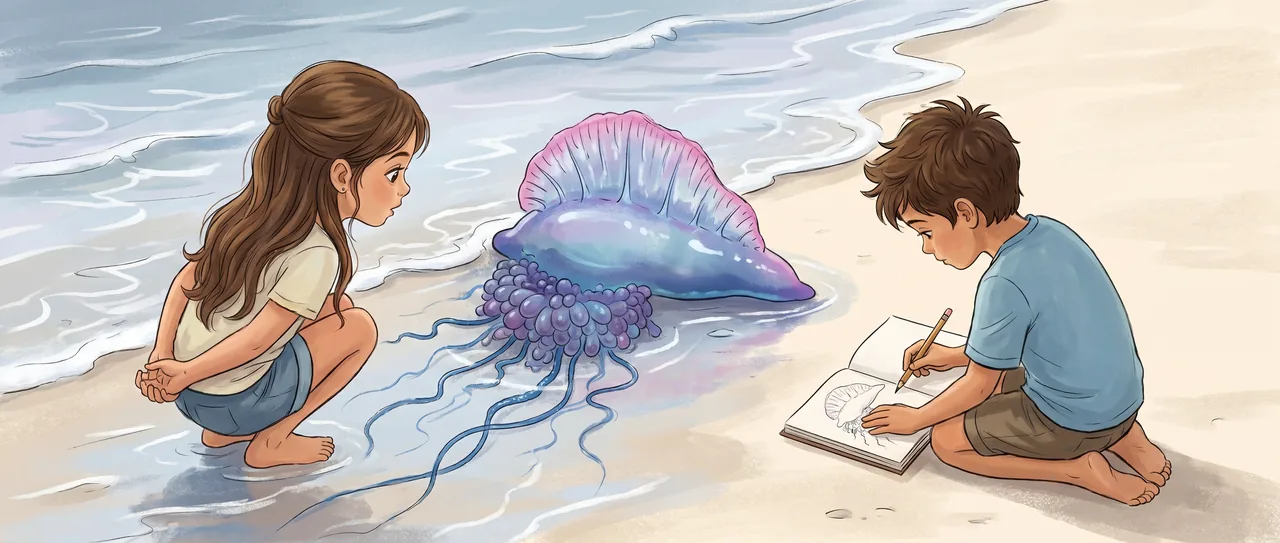
Maya was already crouched over it, hands behind her back like she'd promised somebody. The thing lay in the seaweed like a spilled balloon, blue going purple, with a little pink crest along the top that caught the wind and shivered.
"It's beautiful," she said. "It's also wrong."
"Wrong how?"
"Look at it." She tipped her head. "The float part looks like one animal. The stringy part underneath looks like a different animal. They don't match. Like somebody glued two things together."
Soren knelt on the dry side, keeping the long blue threads well away from his knees. There were a lot of threads. Some of them ran two feet down into the sand.
"Jellyfish don't have a sail," he said. "That thing has a sail. It's built to catch wind."
"So it's not a jellyfish."
"I don't think it's a jellyfish."
Maya sat back on her heels. "Okay. New question. Which part is the animal?"
"What do you mean which part. The whole thing."
"No, listen." She pointed, not touching. "If I found a dog, the dog is the animal. The legs aren't a separate animal. The nose isn't a separate animal. But this." She frowned. "This looks like the float is one thing and the tentacles are another thing and they're just, roommates."
Soren pulled out his notebook. His pencil moved down the page in quick short strokes, the float, the crest, the tangle of threads, the little grape-like beads bunched up under the middle.
"There's a third kind of part," he said. "Here. These fat little bags. They're not float and they're not stinger. They're something else again."
Maya leaned in. "Three kinds of parts."
"Maybe more. I can't tell what the small curled ones are."
A gull landed near the wrack line, considered the blue thing, and decided against it. Smart gull.
"Try this," Maya said. "What if none of them is the main one."
Soren stopped drawing. "Every animal has a main part. A middle. A you."
"Does it, though." She was chewing the inside of her cheek. "You said the sail catches wind. So the sail's whole job is moving the thing around. It's not for eating. It's not for stinging."
"Right."
"And the threads sting. That's all they do. They can't sail. They can't sit up in the wind."
"Right."
"And the fat bags. What if those digest. And what if the little curled ones make babies." She spread her hands. "Four jobs. Four kinds of parts. And not one of them can do a second job."
Soren looked at his own drawing for a while.
"Then none of them could live by itself," he said slowly. "The sail would starve. It's got no mouth. The stingers would blow away, they've got nothing to float on."
"So they're stuck together."
"Not stuck." He was working it out with the pencil now, tapping. "Stuck is two separate things touching. This is. This grew this way. On purpose."
Maya went quiet, looking at the little pink sail trembling in the wind.
"Soren," she said. "What if it's not four parts of one animal. What if it's four animals being one animal."
"That's the same thing."
"It's not the same thing." She turned to him and her whole face was lit up wrong, too bright for a dead thing on a beach. "A dog's leg was never going to be a dog. But what if each of these could have been its own creature, and instead they all agreed to be different pieces. The sail one gave up eating. The stinger one gave up floating. Forever. So that together they could be something none of them could be alone."
Soren stared at the blue thing.
"They'd have to all be, like, the same to start with," he said. "To do that. Same instructions. Then each one reads a different page."
"Same instructions," Maya repeated. "Different pages."
The wind pushed the little sail. It leaned, the way a real sail leans, and the whole blue ruin shifted half an inch across the sand, still trying, even here, even dead, to go where the wind sent it.
"I keep waiting for it to be one thing," Soren said. "My brain wants it to be one thing."
"Mine too." Maya laughed, short and amazed. "It won't hold still and be one thing."
He wrote something at the bottom of the page and underlined it twice.
"Say it's true," he said. "Say you're right. Then when you look at it and ask which one is the animal, the answer isn't the sail and it isn't the stingers."
"The answer is the group."
"The answer is the group," he said. "The animal is the thing they make together that you can't point at."
They both looked at it then, the same way, and neither of them said anything for a bit, because it is a strange feeling to look at a creature and understand that the creature is a decision a bunch of smaller creatures are all making at once.
"Soren," Maya said. "We're a bunch of cells."
"Don't."
"We are, though. Cells. Billions. All the same instructions. Different pages. My eye cells gave up being anything but eye. Forever." She held up her own hand and turned it over. "So which one is me."
Soren looked at his hand too. At the pencil in it. At the notebook, which was made of tree, which had once been alive in cells of its own.
"The group," he said quietly. "The thing they make that you can't point at."
"The thing you can't point at," Maya said.
The tide had turned. A thin sheet of water slid up the sand, curled around the blue float, and pulled at it. The little pink sail caught the water the way it had caught the wind, and the whole colony, all four kinds of it, all the thousands that had once been going somewhere together, lifted off the sand and began, slowly, to leave.
Maya and Soren watched it go out, and neither of them looked away, and neither of them could have said, if you asked, exactly how many things were leaving.
Read the interactive version, listen to the narration, and earn a gold star →
A science-verified short story for curious kids · Curiosity Land