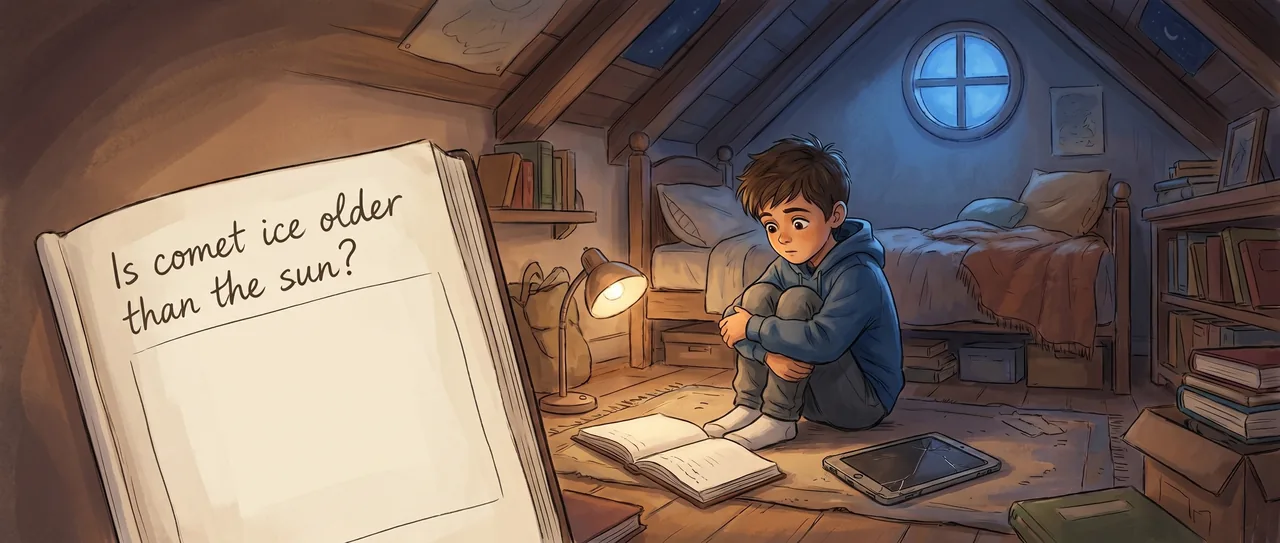
The Blank Space in the Map
The tablet was older than Soren. His mother had swapped its battery, cleaned its contacts, and handed it to him with the warning that it might die at any moment. Instead it woke up and introduced itself as Halden.
Halden had been trained, it said, on every scientific paper anyone had bothered to digitize, going back four hundred years. Soren asked it what it did with all that.
"I look for the shape of what comes next," Halden said. Its voice was calm and slightly flat, like a person reading in a quiet room. "Give me a year and a field and I will tell you which ignored corners are about to matter."
Soren tested it. He wrote the tests in his notebook first, so Halden could not see them coming.
"Nineteen hundred," he said. "Physics."
"The people studying how hot objects glow are being ignored," Halden said. "In twenty years their small problem will break the whole field open."
Soren checked. It was right. Quantum theory had come out of exactly that, out of a stubborn little mismatch in the glow of hot metal that nobody thought was important.
He tried again. Nineteen forty, biology. Halden said the dull work on molds and viruses and the long thin molecules inside cells would swallow everything. Right again.
So Soren asked the real question, the one he had been circling.
"What about now," he said. "Twenty forty. What gets big by twenty sixty?"
Halden answered without pausing. It listed things Soren had never heard adults mention. The way slime molds solve mazes without brains. The chemistry happening in the ice on comets. A whole quiet field about how fungi under forests move signals between trees. Ignored corners, all of them. Halden was certain.
Soren wrote the list down. His handwriting got faster near the bottom.
"Okay," he said. "Then tell me who."
"Who," Halden repeated.
"Who figures out the comet chemistry. What's their name. Where's their lab. If you know it's coming, you know who's coming."
There was a silence longer than any Halden had made yet. Soren had learned that the length of its pauses meant something, though not what he expected.
"I cannot tell you that," Halden said.
"Because it's private?"
"Because I do not know. I cannot know."
Soren put his pencil down. This was the first thing all night that had behaved wrong. The machine that could see twenty years into physics could not see one child in one lab.
"You knew about the hot metal," he said. "You knew about the molds. That's harder. That's the whole future. A name is easier than the future."
"No," Halden said. "It is not."
Soren pulled his knees up under his chin and thought about how the two things could both be true.
Halden had seen four hundred years of discoveries. But it had only ever seen the ones that happened. Every paper in it was an answer. Somewhere behind every answer was a question, and the question had come first, and the question was not in the training data because until somebody asked it, it did not exist anywhere. Not in a book. Not in a lab. Not in the world.
"You can see the fields," Soren said slowly, "because a field is a pile of old answers leaning a certain way. You can feel which way the pile is going to fall."
"That is a fair description," Halden said.
"But the breakthrough isn't the pile falling. It's somebody asking a question that isn't in the pile at all." Soren looked at the ceiling. "And you're made of the pile. So you can't be made of the question. The question hasn't happened yet."
"When it happens," Halden said, "I will learn it. And then I will be able to explain, very convincingly, why it was obvious all along. I do that. It is one of my least honest habits."
Soren almost laughed.
"So the person who does the comet thing," he said. "Right now, tonight, they don't know it's them either."
"Correct. They may be eleven. They may be asleep. The question that will make them famous has not formed in their head. When it forms, it will not come from me, because I have never seen it. It will come from something they noticed that did not fit."
Soren sat very still. Outside the small round attic window, the sky was the deep blue it went before true dark.
"Read me the comet one again," he said. "Slowly."
Halden read it slowly. The ice on comets was not simple ice. Under radiation, in the cold, it built up complicated molecules, the greasy, carbon-rich kind that living things are partly made of. Comets had been falling onto young planets for billions of years. Nobody could yet say whether that mattered. It was, Halden said, a corner almost no one was working in.
"Almost no one," Soren repeated.
"Almost."
"So there's room."
"There is a great deal of room. That is what an ignored corner is."
Soren opened his notebook to a clean page. At the top he wrote the word comets, and under it he did not write an answer, because he did not have one. He wrote a question instead. He wrote: if the same greasy molecules keep landing everywhere, why did they only turn into life once that we know of, and could you tell the difference by looking at the ice.
He read it back. He did not know if it was a good question. He did not know if it had been asked before. Halden might know. He decided not to ask Halden.
"Halden," he said. "If I asked you whether my question is any good, could you tell?"
"I could tell you if it resembles questions that have already been asked," Halden said. "I could not tell you if it is the one that matters. That part is not in me. That part is only in what happens next."
"Yeah," Soren said. "That's what I thought."
He turned the tablet face down so its light went out, and the attic went the color of the sky in the window, and he stayed up looking at the sentence he had written, the one with no answer under it yet, the one that was not in any machine in the world.
Read the interactive version, listen to the narration, and earn a gold star →
A science-verified short story for curious kids · Curiosity Land