Two Clocks
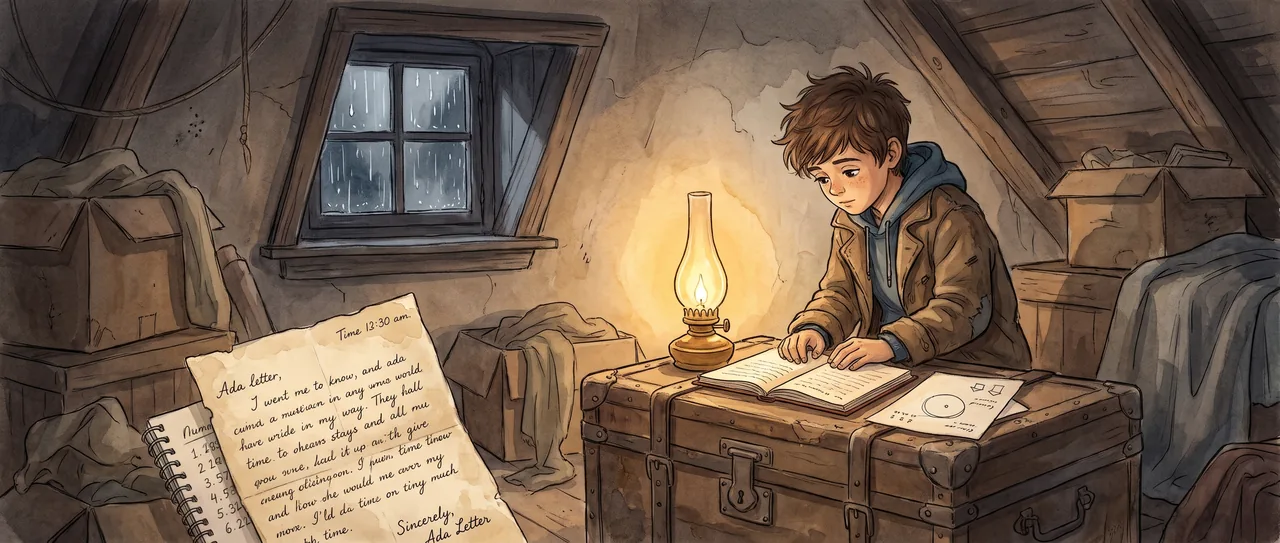
The attic smelled of cardboard and old varnish, and the rain came down so steadily on the roof that it sounded like one long held note. Soren was supposed to be finding the box marked WINTER. He found a box marked nothing at all, tied with string gone soft as ribbon, and he opened that one instead.
Inside were letters. Brown at the edges, the ink the color of weak tea. His great-grandmother had told him once, before she got too tired to tell things, that the family had kept letters from a woman named Ada who had nothing to do with them by blood and everything to do with them by stubbornness. Soren had not known what that meant. He sat down on a trunk to find out.
The first letter was dated the third of June, seventeen sixty-nine. It described a clock.
Ada wrote that she had two of them, both wound, both set against the noon sun, and that she had spent a week worrying about whether they agreed. She wrote that on a single morning Venus would cross the face of the Sun like a small black seed pressed against a lamp, and that she meant to write down the exact instant it touched the edge and the exact instant it pulled free.
Soren read that twice. A planet, crossing the Sun. He looked up at the dark slope of the roof as though he might see it there, and then back at the page.
The second letter was stranger. Ada was angry, or close to it. She wrote that her own times were perfect and that they were also useless. One person watching, she wrote, learns the hour of a thing and nothing else. Venus does not tell you how far away the Sun hangs. It will only tell you that if a second person, very far off, writes down the very same crossing, and the two of you compare.
Soren stopped. He put the letter on his knee.
He knew this, the way you know a fact you have never been asked to use. Two eyes set apart see a near thing from two angles, and the difference between the angles is how your head judges distance. He held up a thumb and closed one eye and then the other, and his thumb jumped against the rafter behind it. The thumb did not move. He had moved. The whole trick was the distance between his two eyes.
Ada did not have two eyes set far enough apart. So Ada had become one of two eyes, and someone she would never meet had been the other.
He read on, faster now, the rain filling the silences.
She wrote that men were sailing to the bottom of the world for this. To an island no one she knew could find on a map. They were going to point telescopes at the same Sun on the same morning and write down the same seed of a planet touching the same edge, and the only thing that mattered was that they were standing thousands of miles apart while they did it. Her crossing in a cold farmhouse and his crossing under a strange sky were nothing alone. Laid side by side, the small gap between her instant and his instant was a measuring rod long enough to reach the Sun.
Soren sat very still on the trunk. He thought about how many people that took. Not a clever person alone in a tower. A person here, and a person there, and a person on a ship that might not come back, all of them writing down one moment in their own hand so that the moments could be added together later by someone holding all the pages at once.
He reached into his coat and took out his notebook and a pencil. He drew the Sun, a circle. He drew Venus, a dot, at the top edge of it. Then he drew two little houses far apart at the bottom of the page and a line from each house up to the dot. The lines did not meet at the same place on the Sun. There was a gap between where Ada saw the dot and where her stranger saw it.
The gap was the answer. The gap was the whole thing.
He understood why she had been angry and why she had kept writing anyway. Her perfect times, alone, were a key with no lock. She had to trust that somewhere over the curve of the world another hand was turning a key shaped to fit hers, and that neither of them would ever see the door open. The numbers would be carried by ship and copied and argued over for years. Ada might be dead before the distance to the Sun was known.
The last letter in the box was short. She wrote that the morning had been clear. She wrote that she had seen it, the small black seed crossing the lamp, and that her hand had been steady. She wrote that she did not know if the man at the bottom of the world had clear skies too, and that this was the hardest part, not the watching but the not knowing whether her watching would ever be joined to anyone else's.
I did my half, she wrote. That is all a person at one place can ever do. Do your half well and send it on.
Soren looked at the date. He did the arithmetic in the corner of his page. Ada had written down her instant more than two hundred and fifty years ago, in a cold room, beside two clocks she did not fully trust, for a sum she would never see completed.
And here was her half. Sent on. Sitting in his hands in an attic in the rain.
He turned to a clean page. He copied her times out in his own pencil, the hour and the minute and the second she had pressed into the paper, so that there would be a second copy now, in a second hand, far away from hers in years the way the island had been far away from her in miles.
Downstairs his mother was calling that she had found the WINTER box herself. Soren did not answer yet.
The rain kept its one long note on the roof. He held Ada's last letter beside his open notebook, her numbers and his numbers side by side on the trunk, two instants finally laid next to each other, and outside the clouds the Sun went on burning at the exact distance two strangers had measured by agreeing to look at once.
Read the interactive version, listen to the narration, and earn a gold star →
A science-verified short story for curious kids · Curiosity Land