The Thing the Numbers Were Pointing At
The project was supposed to be finished. That was the whole point of staying late, to print the poster and go home.
Instead the model on the school laptop kept doing the same thing.
"It's flagging it again," Soren said. "Same cluster. Every time we run it."
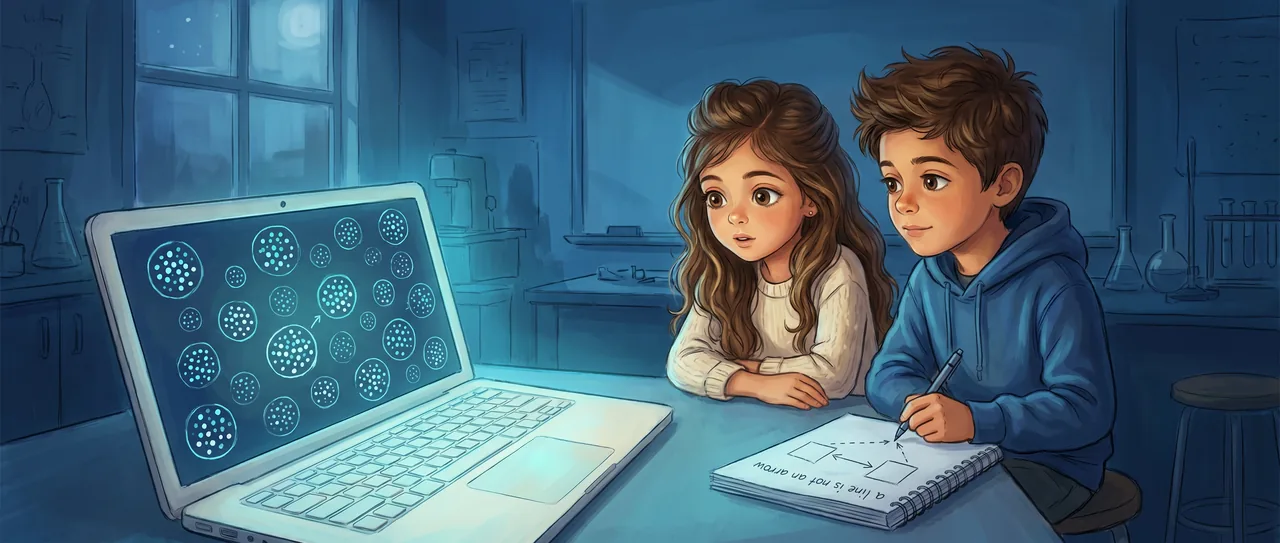
Maya leaned in. The screen showed a tangle of dots, thousands of them, each one a person who had let scientists study the bacteria living in their gut and then taken a memory test. The companion they'd been given for the unit, a little chat helper named Wren, had drawn a loop around one knot of dots.
"Read me what it said," Maya said.
Soren read off the screen. "People carrying this bacterial community score, on average, higher on the working-memory task. The correlation is strong. It holds across the whole dataset."
"So the bugs in your stomach make you smarter," Maya said.
"That's not what it says."
"That's what it sounds like it says."
Soren typed a question to Wren. He typed slowly, because he wanted the words to be exactly right. Does this bacteria cause higher memory scores?
Wren took a second. Then the answer came up.
I cannot say that. I have found a correlation. I do not have a mechanism. Would you like to consider whether a correlation implies a mechanism?
Maya read it twice. "It's asking us a question."
"It's allowed to," Soren said. "It's a companion. It's supposed to."
"No, but listen." Maya pulled the laptop toward herself. "It found the thing. The pattern's real. Thousands of people. And it's the one telling us to slow down."
Soren got out his notebook. He drew two boxes and an arrow between them. Bacteria, then arrow, then memory.
"That arrow," he said, tapping it. "That's the part nobody has."
"Why not? It's right there."
"It's right there in the dots. It's not right there in a body." He chewed the pen cap. "Maya, what would have to be true for the arrow to be real?"
Maya started counting on her fingers. "One. The bugs make something. Some chemical. And it goes up to your brain and helps you remember."
"Okay. Two?"
"Two. It's backwards. Your brain, or how you live, makes the right kind of stomach for those bugs. Smart-ish people eat a certain way and that's the gut the bugs like."
Soren wrote BACKWARDS and underlined it.
"Keep going," he said.
"Three." She slowed down. "Three is the sneaky one. Something else makes both. Like, I don't know. Sleep. Good sleep gives you the bugs and the memory, and the bugs and the memory never even talk to each other. They just both got the same present."
The lab was very quiet. The radiator ticked.
"Three," Soren said. "Three would look exactly the same on the screen as one."
"Exactly the same."
They both looked at the loop Wren had drawn. The same dots. The same strong line. And under it, three completely different invisible stories, and the screen could not tell them apart, and neither could the model, and neither could anyone alive.
"Run it again," Maya said.
Soren ran it. The same cluster lit up. The same loop. Wren waited, patient, asking nothing new, because it had already asked the only thing that mattered.
"It knows," Maya said softly. "It knows it doesn't know. That's the whole answer. That's why it asked instead of telling."
Soren typed again. How many of these correlations are there that nobody can explain yet?
Wren answered. In datasets like this one, many. The gut contains hundreds of bacterial species. Their connections to mood, memory, and attention are being mapped now. Most of the arrows are not yet drawn.
Maya stood up. She walked to the window and looked at her own reflection over the dark parking lot.
"Soren," she said. "There's a whole forest of them inside me right now. Trillions. More of them than there are of my own cells, almost."
"That part's true," Soren said. "We learned it."
"And some of them might be doing something to how I think. Right now. While I'm standing here." She turned around. "Or they might be doing nothing, and it just looks like something, and nobody on Earth can tell which yet."
"Yet," Soren said.
"Yet." She came back and put both hands flat on the table. "That's the best word in the whole thing. The computer found a million yets and it's just sitting there holding them."
Soren looked down at his two boxes and the arrow he wasn't sure of.
"You know what I keep thinking," he said. "Everyone wants the machine to give the answer. And the one it gave us was a better question. That's the part that doesn't fit my idea of what it's for."
"Maybe that's what it's for," Maya said. "Maybe the smart part isn't knowing. Maybe the smart part is knowing the difference between a line and an arrow."
Soren wrote that down. A line is not an arrow. Then, under it: the line is real. the arrow is missing. someone has to go find it.
"Someone has to go find it," he read out loud.
Maya was already looking at the cluster again, at the thousands of people who were really truly different in this one strange way, with no story to explain why.
"It could be us," she said. "When we're bigger. One of these arrows could be ours."
Soren didn't answer. He typed one more line to Wren. Show me the other ones. The ones without arrows.
The screen filled, slowly, with loops. Bacteria and sleep. Bacteria and worry. Bacteria and how fast you learn a list of words. Dozens of clusters, each one a real pattern in real people, each one circled, each one waiting, not a single arrow drawn between any of them.
Maya pulled a chair up next to his. They sat in front of all those open questions and did not turn the laptop off.
Read the interactive version, listen to the narration, and earn a gold star →
A science-verified short story for curious kids · Curiosity Land