The Spikes That Counted Themselves
The bottle had no label, only a smear of black where one used to be.
"Aunt Reza says it leaked all over the art kit," Soren said. "She told me to throw it out."
"Did you?" Maya asked.
"Obviously not. It's still in my hand."
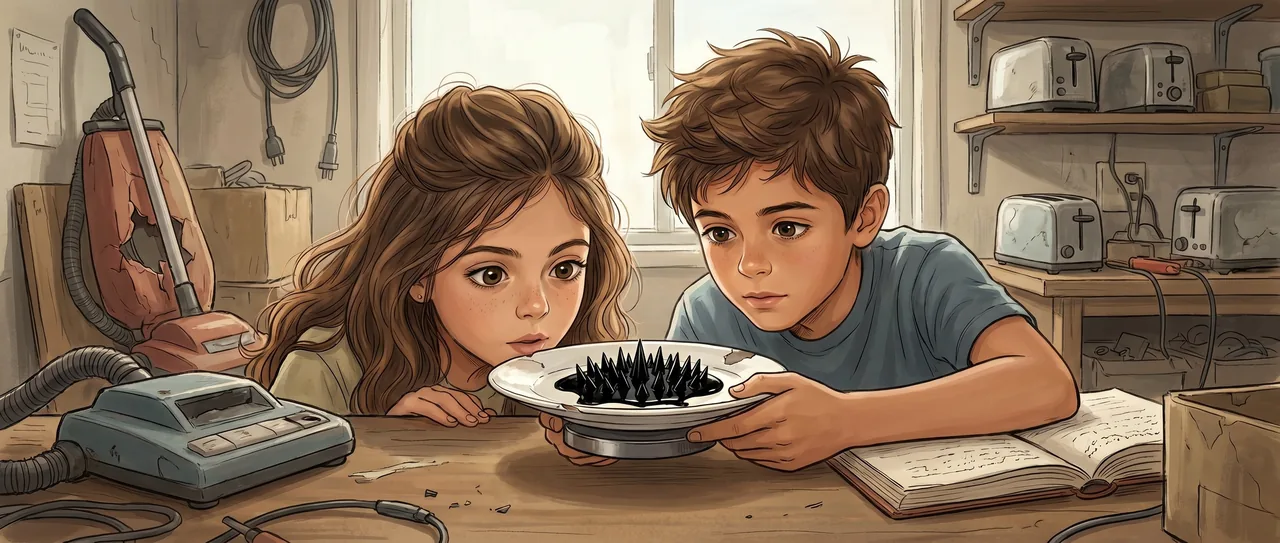
They were in the back of the repair shop, between a dead vacuum cleaner and a shelf of toasters waiting to be fixed. Maya unscrewed the cap. The liquid inside was blacker than anything had a right to be. Not dark blue, not brown. Black like the space between streetlights.
Maya tilted the bottle. The liquid moved wrong. Too heavy at the edges, like it was thinking about which way to go.
"Pour some out," she said.
"On my aunt's bench?"
"On the plate. There's a plate."
There was a chipped saucer under a leaking radio. Soren slid it free and poured a small pool of black onto it. It just sat there, flat and shiny, doing nothing interesting at all.
"Great," Maya said. "Expensive ink."
Soren was already pulling open the drawer where his aunt kept the magnets, the round flat ones she used to hold screws so they wouldn't roll off the bench.
"Why magnets?" Maya asked.
"Because it moved wrong," he said. "Heavy things don't lean toward the edges. Something's pulling on it."
He held a magnet under the saucer.
The black pool stood up.
It did not splash, it did not ripple. It rose into spikes, dozens of them, sharp little cones standing straight off the plate like the back of some animal that had never existed. Maya pulled her hand back without meaning to.
"Okay," she breathed. "Okay. It has hair now."
"They're even," Soren said. "Look how even they are."
They were. The spikes had spaced themselves out across the plate in a pattern, each one sitting the same distance from the ones around it, like somebody had measured. Nobody had measured. Soren had just put a magnet under a saucer.
Maya leaned in close. "Move the magnet."
He slid it sideways. The whole field of spikes flowed after it, collapsing and re-growing, and every time it settled, the spacing came back. Same gaps. Same little army.
"How does it know?" Maya said.
"Know what?"
"Where to stand. Each spike. How does it know how far to be from the other ones?" She pointed without touching. "Nobody's telling them. There's no little ruler in there."
Soren got the notebook out of his back pocket and drew the pattern, the dots and the gaps between them. His pencil stopped.
"They're all pushing," he said slowly. "Magnets that point the same way push each other apart. So every spike wants to get as far from every other spike as it can."
"Then why don't they all fly off the plate?"
"Because they're heavy. They're liquid. Gravity wants them flat." He looked up. "So it's two things at once. The magnet wants spikes. Gravity wants a puddle."
Maya was nodding fast. "And the spikes are where those two arguments stop arguing."
"The cheapest place," Soren said. "The shape that costs the least."
"Costs the least what?"
"Energy." He underlined it. "Standing up tall costs energy because of gravity. Being crowded costs energy because of pushing. So it finds the one arrangement where the total is as small as it can be. Tall enough for the magnet. Spread enough for the crowding. Both. At the same time."
Maya was quiet for a second. "Nobody solved it," she said.
"What?"
"There's no math teacher in the plate. The liquid didn't sit down and calculate the best answer. It just fell into it. The cheapest shape is just where everything rolls to when you let go." She put her chin on the bench, eye level with the spikes. "It's not doing the problem. It is the answer. It's the answer happening."
Soren wrote that down word for word.
"Try two magnets," Maya said.
He slid a second one under the saucer near the first. The spikes rearranged, leaning toward both, finding a new spacing, a longer field with a strange smooth valley in the middle where the two pulls met and canceled.
"Still even," Soren said. "New problem, new answer. Instantly."
"It can't be wrong," Maya said. "That's the part. We could be wrong about why. The spikes can't be wrong about where. They just go to the cheapest place every single time and it's always right because right is just wherever cheapest is."
She sat up. Her face had the look it got when something had cracked open and gone bigger.
"Soren. The whole world does this."
"Does what?"
"Falls into the cheap shape. Soap bubbles are round because round is the cheapest skin for the air inside. Honeycomb is six-sided because six-sided is the cheapest wall for the most cells. Nobody told the bees. Nobody told the bubble." She pointed at the black spikes. "Nobody told this. It's the same thing. The same thing, over and over, everywhere, and it looks designed and nobody designed it."
Soren stared at the spikes, then at his page, where he had drawn bubbles, the honeycomb, and the little black army, and circled all three.
"So everything that looks like somebody planned it," he said, "might just be the cheapest place the energy could fall."
"Might," Maya said. "That's the worst part. Or the best part. You can't tell from looking which things were planned and which things just fell."
The shop's back door opened. Aunt Reza leaned in, a screwdriver behind her ear. "Did you throw that bottle out?"
"Not yet," Soren said.
"Throw it out," she said, and was gone again, busy, already talking to someone about a kettle.
Neither of them moved to throw it out.
Maya reached under the saucer and turned the magnet slowly, a quarter circle. The whole black field of spikes turned with it, every cone leaning into the new direction, re-counting itself, settling again into perfect even spacing nobody had asked for and nobody had taught.
Read the interactive version, listen to the narration, and earn a gold star →
A science-verified short story for curious kids · Curiosity Land