The Shortest Way to Say It
Soren's grandmother kept her past in boxes, and she let him open any of them except the ones marked with a red dot. The box he wanted had no dot. It had a smell, dust and old wool, and inside were her knitting charts, grids of tiny squares filled in with pencil.
"Read me one," she called up the attic stairs. She was at the bottom with her tea, too sore in the knees to climb.
He held up a chart. "It's all blocks. Eight black, eight white, eight black, all the way down."
"Then tell me the short way."
He frowned at it. "Eight black, eight white, repeat sixteen times."
"There," she said. "You just folded the whole sweater into one sentence. I used to do that for a living, you know. Before the knitting."
He came halfway down the stairs with the chart. "You knitted for a living?"
"I made machines that knit numbers," she said. "Calculators, when they were the size of a desk. My job was to test them. You feed a machine a number, it gives you a number back. But how do you know it isn't lying? How do you check a machine that calculates faster than you can?"
Soren sat down on a step. This was a real question and he could feel it.
"You give it something you already know the short way to make," he said slowly. "Like the sweater. If it gives you back eight black, eight white, repeat, you don't have to check every square. You check the rule."
His grandmother laughed, the small pleased laugh she made when he caught up to her. "That's exactly it. We had pages of numbers we could describe in one line. Count by sevens. Square every number. Easy to make, easy to check. The machine and I both knew the rule, so we met in the middle."
He went back up and dug through the box. Under the charts was a single yellowed sheet, covered top to bottom in numbers with no spaces. He carried it down to her.
"What's the rule for this one?"
She took it, held it far from her eyes, and went quiet. Then she smiled in a way he didn't understand yet.
"There isn't one," she said.
"There has to be. You said you only used numbers you knew the short way to make."
"This was the other test," she said. "The hardest one. We needed numbers with no rule at all. No counting, no squaring, no pattern hiding inside. We got them from the static between radio stations, the hiss. We wrote it down digit by digit."
Soren looked at the sheet. Four, one, nine, two, zero, eight, three. He waited for the squares to line up into stripes the way they always did. They didn't.
"Try to fold it," his grandmother said. "Try to find the short way to say this one."
He tried. He looked for a number that came back. He looked for stretches that repeated. He looked for counting up, counting down, every-other. The longer he stared, the more the numbers refused to become a rule. Every time he thought he had a piece of it, the next digit broke it.
"I can't shrink it," he said. "To tell someone this sheet, I'd have to read them the whole thing. Every single digit."
"Yes."
"The sweater I can fold into one sentence. This I can't fold at all." He held the two sheets side by side, the tidy chart and the wall of static. "The chart is bigger. It's a whole sweater. But it's simpler. This little sheet is smaller and it's..."
He stopped. The word he wanted was a strange one to use for a mess.
"It's more complex," he said. "The messy one is the complicated one. Because the shortest way to say it is just to say all of it."
His grandmother set down her tea. "That's the part nobody believes the first time. We spend our whole lives learning that smart means finding the pattern, the short rule, the clean answer. And then you meet a thing that has no shorter answer than itself. The only honest description of it is the whole thing, every digit, no folding."
Soren sat with that. He thought about all the things he had ever tried to describe the short way. A song was a short way to remember a tune. A name was a short way to point at a whole person. He had always assumed everything could be folded if you were clever enough.
"So how do you check the machine on this one?" he asked. "If there's no rule, you can't meet in the middle. You'd have to check every digit by hand."
"Now you understand why it took so long," she said. "And here is the part that kept me up at night. There is no machine, no person, no genius anywhere, that can look at a sheet like this and prove there is no shorter way to make it. You can search and search and find nothing. But you can never be certain a rule isn't hiding one fold deeper, too clever for you to see. You can prove a thing is simple by showing the rule. You can almost never prove a thing is truly random."
Soren looked back down at the digits. A minute ago they had just been a mess his grandmother copied off a radio. Now they felt like a locked door with no key, and behind the door, maybe nothing, maybe a rule no one would ever find.
"So you don't actually know," he said. "If this sheet is really random. Or if it just looks random to everybody who's tried."
"No," she said softly. "I never knew. I still don't."
He pulled his notebook from his back pocket. He copied the first row of the static, digit by digit, his pencil pressing slow, because there was no shorter way to carry it down the stairs and out into the rest of his life.
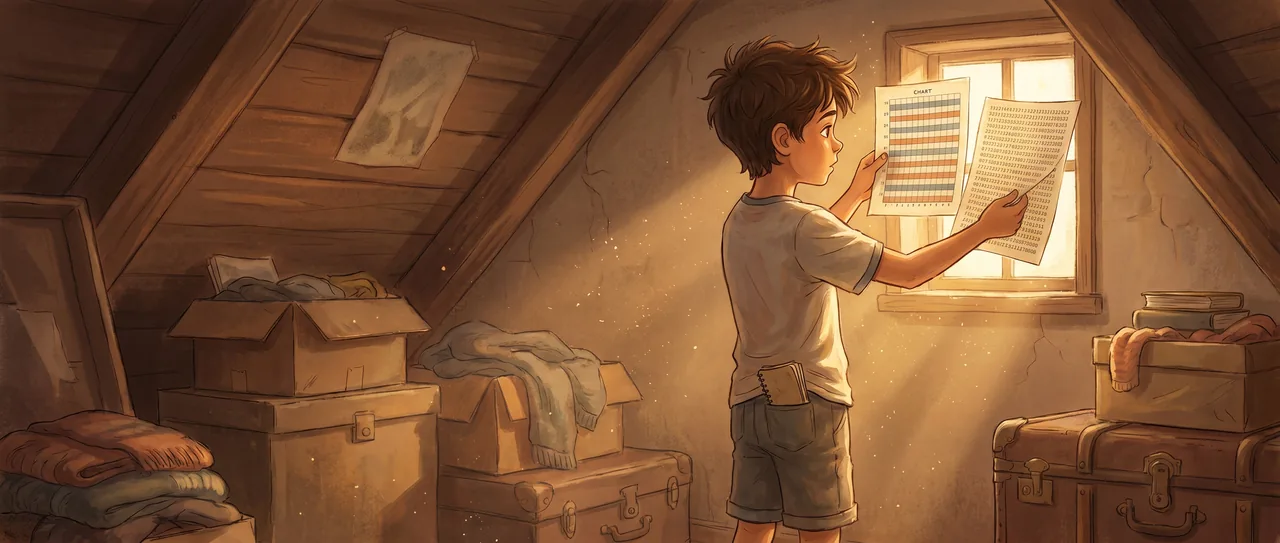
When he finished the row he held the page up to the attic window, the light coming through both sheets at once, the striped chart and the wall of numbers, and he turned them slowly, looking for the fold that no one had found yet.
Read the interactive version, listen to the narration, and earn a gold star →
A science-verified short story for curious kids · Curiosity Land