The Planet That Lost Its Coat
"It's too big," Maya said. "Look at it. The core is too big."
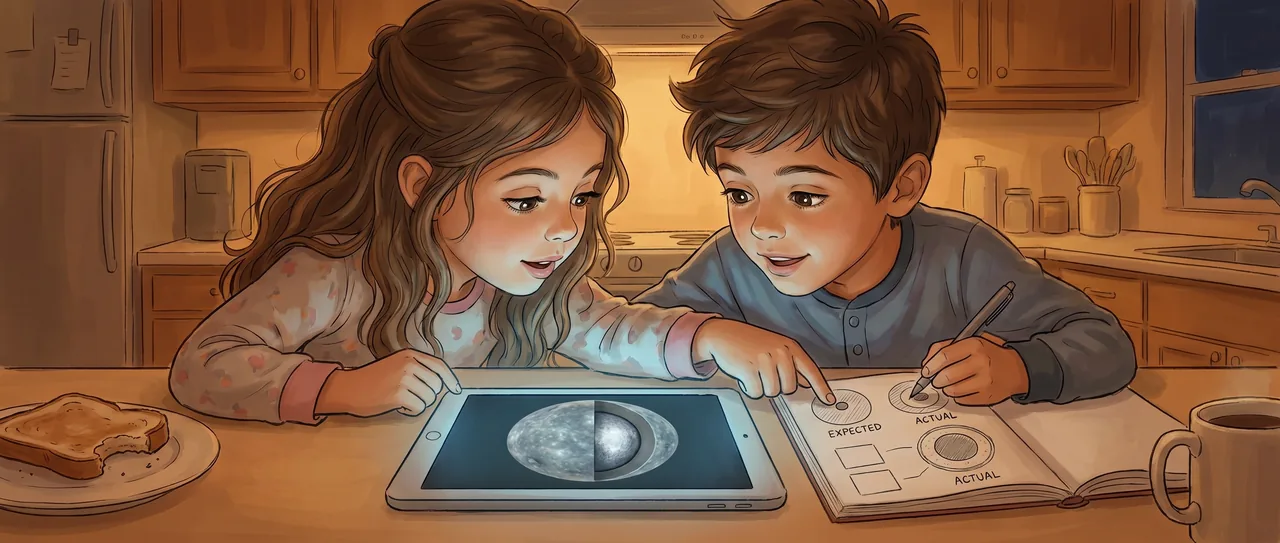
She had the tablet flat on the kitchen table, between the cold toast and the salt. The image was Mercury, gray and pocked, with a cutaway diagram next to it. A huge metal heart with a thin skin of rock around it.
"Too big compared to what," Soren said. He had the notebook open. He drew a circle, then a bigger circle inside it, almost touching the edge.
"Compared to every other planet. Earth's core is small. This one is, like, the whole thing. The rock is just a coat."
"A thin coat," Soren said. He tapped the diagram. "Way too thin for a planet that size."
Maya pulled the tablet closer. She zoomed in on the surface until the gray broke into smooth plains, wide and flat, with old craters drowned underneath them.
"That's lava," she said. "That smooth part. That used to be liquid."
"You don't know that."
"I do, though. It looks exactly like the flood basalts. The big flat ones on the moon, the dark seas. Something melted and ran flat and froze." She sat back. "Mercury was on fire once."
Soren looked at it for a while. He believed in lava more slowly than Maya did, but the longer he looked, the harder it was to call it anything else. Smooth where smooth shouldn't be. Craters cut in half by a flatness that came later.
"Okay," he said. "Volcanoes. A lot of them. So it was hot."
"Really hot. Long ago."
He wrote hot. Then he stopped.
"That doesn't fit," he said.
"What doesn't?"
"A little planet should cool off fast. Small things lose heat quick. That's why your tea goes cold before the pot does." He pointed at the giant metal core in the diagram. "And it's mostly iron. Iron carries heat away. It should have gone cold ages before anything else. But it had volcanoes."
Maya went quiet. She was looking at the two circles he'd drawn, the big core and the thin coat.
"Draw it again," she said. "But draw it the way it should be."
"What do you mean."
"You said the coat's too thin. So draw a normal planet. The right amount of rock. Then tell me what's wrong."
Soren drew a fresh circle. Inside it he drew a smaller core, the size cores usually are. Around it he drew a fat layer of rock, a proper thick coat.
"That's what a planet that size should look like," he said. "More rock. Less metal showing."
Maya put her finger on the fat rock layer.
"So where did it go," she said.
"Where did what go."
"The rest of the coat. Your drawing has way more rock than the real one. The real Mercury is missing a coat." She slid the tablet beside his notebook so the two were side by side. The drawing with the right amount of rock. The photo with almost none. "It's not that the core grew. The core is normal. The rock got taken off."
Soren stared between them.
"You can't just take rock off a planet."
"You can if something hits it," Maya said. Her voice had gone fast and low. "A big something. Big enough to splash the whole outside off. Like cracking the shell off a boiled egg and most of the white comes with it. The metal yolk stays. The coat sprays into space."
Soren felt the cold toast and the salt and the kitchen go very far away.
"That would melt it," he said slowly. "A hit that big. It would melt everything that stayed. The whole surface."
"The volcanoes," Maya said.
"The volcanoes," Soren said.
They looked at the smooth plains again. The flatness that came after the craters. Rock that had run like water and frozen still.
"That's the same answer," Soren said. "The big core and the lava. They're not two mysteries. They're one. The thing that stripped the coat is the thing that lit the fire."
"Maybe," Maya said. She always said maybe when it mattered most. "Maybe a giant hit. Maybe the young Sun boiled the outside off when it was hotter and closer. Maybe the rock never stuck in the first place." She shook her head. "Nobody knows which. That's the part I keep coming back to. Nobody has decided yet."
Soren wrote each maybe on a separate line. A giant collision. A young furious Sun. Rock that never gathered. He drew a small box next to each one and left the boxes empty.
"They're sending the spacecraft to check," he said. "BepiColombo. That's what these pictures are. It's going to go into orbit and weigh the inside. Measure what the rock is actually made of."
"And if it's the collision," Maya said, "the rock that's left should be the wrong kind. The light stuff that survives a splash. Different from the deep stuff."
"And if the Sun boiled it," Soren said, "it should be missing the parts that burn off easy."
"Different fingerprints," Maya said. "For different stories."
"And one of them is true." Soren looked at his three empty boxes. "Right now, this minute, all three are still allowed. The real answer is already out there. It already happened, four billion years ago. We just haven't read it yet."
Maya picked up the tablet and held it close to her face, the way she did when she wanted to fall into a picture. The little planet glowed gray. A metal world wearing the wrong coat, with the burned-flat record of whatever undressed it written all over its face.
"It's wearing the evidence," she said quietly. "The whole crime is just sitting there in the light. We only have to go close enough to read it."
Soren turned the notebook around and looked at the three empty boxes. Then he set his pen down on the table, next to it, ready, and left all three boxes open.
Read the interactive version, listen to the narration, and earn a gold star →
A science-verified short story for curious kids · Curiosity Land