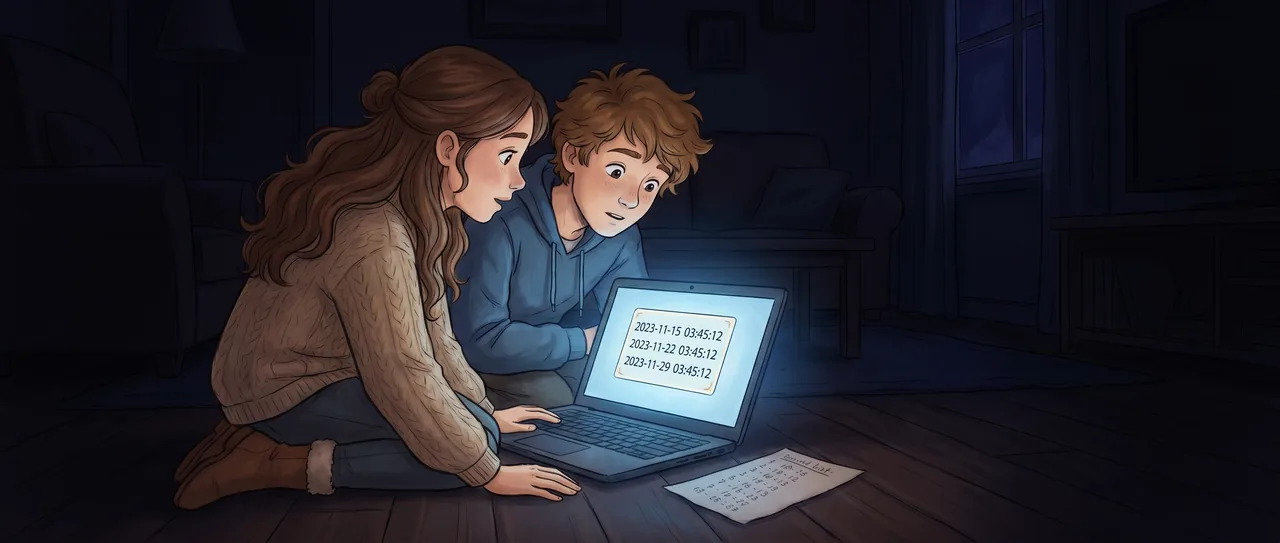
The One That Keeps Knocking
The laptop made a sound like a single water drop every few seconds.
"What is that," Maya said. She was lying on the floor with her boots still on, which Soren's mom had given up about.
"My cousin left his sky app running," Soren said. "Every drop is a fast radio burst. Somewhere out in the universe something flashes in radio for about a millisecond, and a telescope catches it, and the app pings."
"How many a day?"
"Thousands. The whole sky is full of them."
Maya sat up. "Thousands a day and nobody at your house is watching."
"Nobody anywhere can watch all of them. There's too many. The app's AI flags the weird ones for people to look at later."
The drop sound came again. Then again. Then a fourth time, faster.
"Show me the weird ones," Maya said.
Soren pulled the laptop down between them. There was a list of flagged events, little gray cards with numbers on them. Sky coordinates. A number called dispersion measure, which Soren said told you roughly how much space the signal crossed to get here. Most of the cards said the same thing in small letters at the bottom. Single event. No repeat.
"They flash once," Soren said. "And then never again. One flash from one place, and that place goes quiet forever. Almost all of them are like that."
"That's sad," Maya said.
"Why sad?"
"Because you'd never know. One knock on a door and then nothing. You'd spend your whole life not sure you heard it."
Soren wrote the dispersion numbers down the side of a page, in pencil, lining them up so he could see them next to each other.
Maya was scrolling. She scrolled past the gray cards fast and then she stopped.
"This one's blue."
Soren leaned in. One card, near the bottom, was edged in blue instead of gray. The small letters didn't say single event. They said repeat candidate. Three detections.
"Three," Maya said. "It knocked three times."
"Same spot?"
Maya tapped it open. Three timestamps. The first was four months ago. The second was six weeks ago. The third was eleven minutes ago.
"It just did it," she said. "Eleven minutes. It's still knocking."
Soren checked the coordinates against the other cards, running his pencil down his own list. "None of the single ones are near it. It's by itself out there. And look at the dispersion measure, it's huge. This thing is far. Like, other-galaxy far. Maybe billions of years of travel."
"So a thing flashed three times," Maya said slowly, "and the three flashes left at three different times, billions of years ago, from a galaxy that probably doesn't even look like that anymore. And they all walked across the whole universe. And they landed here. On your cousin's laptop. While we were arguing about boots."
The drop sound went again, but it was a different burst, somewhere else.
"Click the info," Maya said. "What is it. What makes a thing repeat."
Soren clicked. There was a panel. He read it out.
"It says most fast radio bursts are seen only once. A small fraction repeat. It says the repeating ones probably come from something different than the one-time ones, maybe a young neutron star with a wild magnetic field, called a magnetar. It says." He stopped.
"It says what."
"It says the reason some repeat and some don't is not understood."
Maya looked at him.
"Read it again," she said.
"The reason some repeat and some don't is not understood."
"So nobody knows."
"Nobody knows."
Maya lay back down on the floor and stared at the ceiling like the answer might be up there.
"The AI found it," she said. "It flagged it blue. It looked at thousands of knocks and went, that one, that one came back. But it can't ask why."
"It's not built to ask why," Soren said. "It just sorts. It pulls the repeaters out of the noise and sets them on the table." He looked at the blue card. "And then it waits."
"For what?"
"For someone to pick it up and ask."
Maya rolled onto her side. "How many blue cards are there. In the whole app. Everyone's."
Soren scrolled to the global counter. There was a number for repeat candidates that no human had opened yet. It was four digits. It ticked up by one while they watched.
"Four thousand and something," Soren said quietly. "Repeaters. Sitting there. Nobody's looked."
"Four thousand somethings out in the universe, knocking more than once," Maya said, "and we don't know what any of them are, and there aren't enough people to ask."
Soren wrote that down. Then he wrote the coordinates of their blue one, careful with each number, because if he had them he could find it again, he could be the someone, the table was right here.
"Eleven minutes ago it knocked," Maya said. "When's the next one."
"That's the thing," Soren said. "Some of them have a rhythm. Some are random. Ours, three times, we can't tell yet. Not enough knocks."
"So we'd have to wait."
"We'd have to watch it. For a long time. Weeks. Catch the fourth. And the fifth."
Maya sat up again. She had the look she got when a thing had stopped being a fact and started being a question she was going to chase.
"Could we," she said. "Could we just, keep this card open. Watch this one spot. Us."
"It's a free app," Soren said. "Anybody can."
"Then it's ours till the fourth knock."
Soren turned the brightness down so the room went dark except for the list. The blue card sat near the bottom, three timestamps, a galaxy that was gone, a question nobody had asked yet.
The laptop made its water-drop sound. A gray card. Not theirs.
They both leaned toward the screen anyway, watching the one spot in the dark where something had knocked three times and might knock again.
Read the interactive version, listen to the narration, and earn a gold star →
A science-verified short story for curious kids · Curiosity Land