The Ghost in the Wrist
Maya's grandmother kept rubbing her wrist the way you rub a window to see through fog.
"It's been a year," Soren said quietly, after she went to make tea. "You said the bone healed in eight weeks."
"It did," Maya said. "There's a new x-ray on the fridge. Look. It's perfect. Whiter than the other wrist."
Soren looked. The bone was smooth and solid. He took out his notebook and copied the shape of it, the little ridge where it had knit back together.
"So why does she still wear the brace?"
"Because it still hurts." Maya picked at the edge of the table. "That's the part that doesn't make sense. A healed thing isn't supposed to hurt."
When her grandmother came back, Maya asked her straight out. She always asked straight out.
"Nana. Where does it hurt?"
Her grandmother set down the mugs and traced a line along the top of her wrist. "Here. A burning. Sometimes just from the sleeve touching it."
"The sleeve," Soren repeated. He wrote that down. A sleeve weighed almost nothing.
"The doctor says there's nothing left to fix," her grandmother said, and she laughed in a way that wasn't really laughing. "He says I should use it normally. But normally it screams at me. So I don't."
Maya went very quiet, and then she said, "Do you not use it because it hurts, or does it hurt because you don't use it?"
Her grandmother blinked. "That's the same thing, sweetheart."
"I don't think it is," Maya said.
Soren felt the back of his neck go cold . "Maya. Remember the path."
"What path."
"At the science camp. They showed us the time-lapse of the grass. When one person walks across a field, nothing happens. But the same line, walked over and over, every day, it wears down to dirt. A trail. And then everybody uses the trail because it's there. Not because it's the only way. Because it got easy."
Maya turned to look at him, and he could see her catching up to where he was, and then passing him.
"You're saying the pain is a trail."
"I'm saying nerves are wires that get stronger when you use them." Soren flipped back two pages to something he'd written about how practicing the same piano piece makes the playing automatic. "We learned that. The more a signal travels a route, the easier that route gets. That's how you learn anything."
"So if a pain signal goes down the same wire enough times," Maya said slowly, "the wire gets good at pain. It gets so good it doesn't even need the broken bone anymore."
"It just fires. Because firing is what it learned to do."
The rain ran in long lines down the window. Maya's grandmother was looking between the two of them with the expression adults get when children say something that frightens and relieves them at the same time.
"You're telling me," she said carefully, "that my wrist remembers being broken."
"More than that," Maya said. "It practiced."
Nobody said anything for a moment. Soren's pencil had stopped. He didn't like saying things he couldn't test, and this was a thing he could not test, and it might also be true, and both of those facts sat in his chest at once.
"That's a terrible thing," her grandmother said softly.
"No," Maya said, and she stood up so fast her chair scraped. "No, it's the opposite. Don't you see? A broken bone you can't argue with. It's just broken. But a trail." She was talking with her hands now. "A trail isn't permanent. If you stop walking the wire, the wire stops getting fed. You can grow the grass back."
"How," said her grandmother, and it wasn't a challenge. It was the most open question Maya had ever heard her ask.
Soren answered before he knew he was going to. "You teach it something else. You give the wire new things to carry that aren't pain. The signal that goes down that path has to start meaning something different."
"The brace," Maya said. "The brace is part of the trail. Every time it hurts you reach for the brace, and the reaching tells the wire, yes, this is dangerous, fire harder. You're watering it."
Her grandmother looked down at the brace on her wrist. The velcro had gone soft from a year of opening and closing.
"I'm afraid to take it off," she admitted.
"Then don't take it off because we said so," Maya said. "That won't work either. The fear is on the trail too."
Soren looked up. "Use it for one thing. One small thing. Something that isn't scary. Pick up the tea."
Her grandmother's hand hovered over the mug. Maya watched the hand, not the face. The hand was the part that had learned the lie.
"It will hurt," her grandmother said.
"Probably," Soren said honestly. "The trail's still there. But the hurt isn't news anymore. It isn't the bone. It's just the wire telling you about a wire."
Her grandmother laughed, and this time it was nearly a real one. "A wire telling me about a wire."
She took the velcro between two fingers. The rip of it was very loud. She set the brace on the table, and her bare wrist looked thin and ordinary and pale where the sun never reached it.
Maya didn't tell her to hurry. She knew not to.
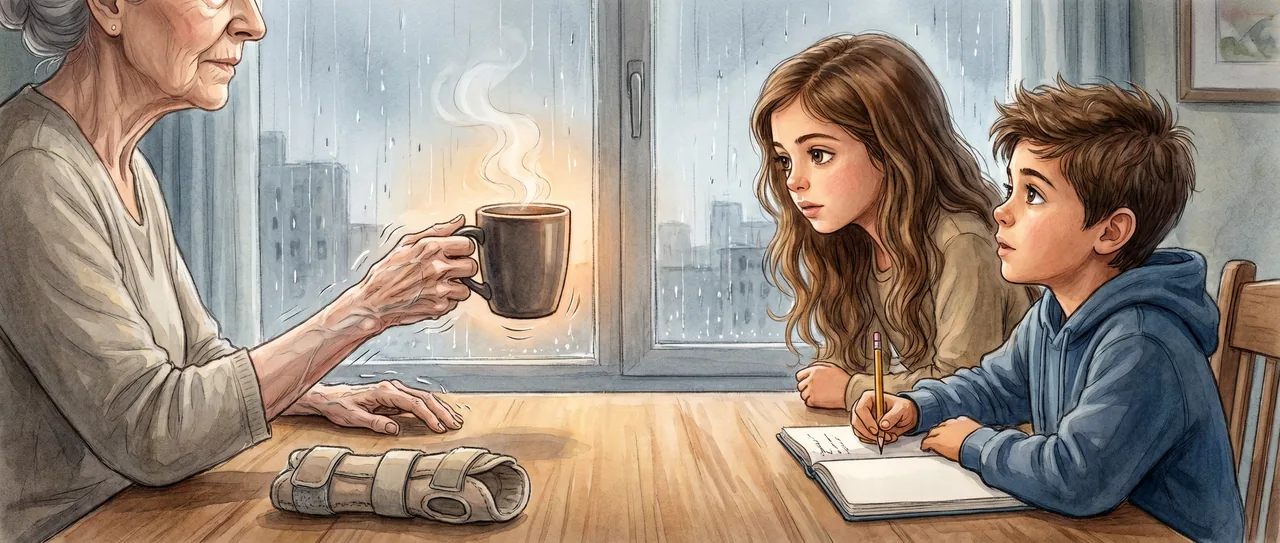
Her grandmother reached for the mug. Her fingers closed around it. She lifted it an inch, and her breath caught, and she held it there, an inch above the table, shaking just slightly, the tea trembling its small rings inside the cup.
"It hurts," she whispered.
"I know," Maya whispered back. "Keep holding it."
Her grandmother held it. One inch up, the steam curling past her knuckles, the wrist that all the machines swore was whole carrying the warm weight of an ordinary cup, learning, for the first time in a year, that it was allowed to.
Soren wrote one line and stopped, because the cup was still up, and he didn't want to look away.
The rain kept walking its long trails down the glass. And on the table the brace lay open and empty, the velcro still gaping, while the old woman's hand stayed in the air, holding on.
Read the interactive version, listen to the narration, and earn a gold star →
A science-verified short story for curious kids · Curiosity Land