The Gap That Won't Close
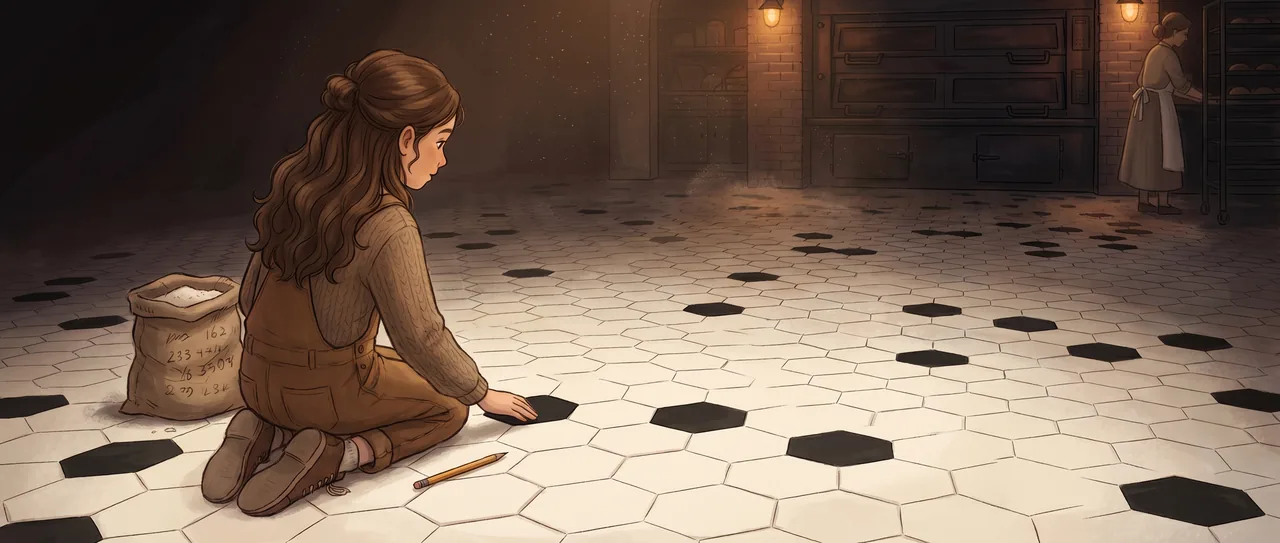
Maya's aunt sold the last loaf at six and locked the door at six fifteen, and after that the bakery belonged to the tiles.
There were two boxes of them. White hexagons and black hexagons, and the floor near the ovens had cracked in the heat, so they needed redoing. Aunt Vera was in the back doing the numbers that paid for things, calculator clicking, not paying attention to the numbers Maya was building on the floor.
Maya wanted the black tiles to land in a pattern. Not random. A rule.
She tried every fifth tile black. That made stripes, boring, a thing anyone could predict from the doorway. She pried them up. She tried every third. Stripes again, tighter. She sat back on her heels and looked at the long white field of hexagons running toward the ovens and thought, what if the black ones only land on prime numbers.
She counted out loud under her breath. Two. Three. Five. Seven. Eleven. She set a black tile at each, counting along the rows, leaving white everywhere else.
Near the door the black tiles came thick. Two, three, five, seven, all crowded together at the start. But as the count climbed toward the ovens the black tiles spread out. The gaps between them stretched. Where the beginning had been almost checkered, the far end was nearly all white, with a lonely black tile every once in a while like a footprint in snow.
She stood up and walked the length of it.
That was the first surprise, and it sat in her chest the way a wrong note does. The primes were thinning. They got rarer the higher she went. It was not her counting, she checked. It was the numbers themselves. They were running out of room to be prime.
"You're standing on my floor," Aunt Vera said, coming through with a cloth.
"They're disappearing," Maya said.
"Who is."
"The black ones. They give up."
Aunt Vera looked at the floor without much interest. "Looks fine to me. Don't leave gaps." She went back to the calculator.
Maya knelt at the thin end, where the black tiles were scarce, and she started doing something she had not planned to do. She started looking at the gaps. If the primes were spreading out, the spaces between them should keep growing. The black tiles should drift further and further apart forever, like swimmers losing each other in the dark.
Mostly they did.
Then they didn't.
Way out near the ovens, where she had laid black tiles at twenty-nine and thirty-one, there they were. Two apart. Touching almost. A pair, sitting close together as if the thinning had never happened to them.
She frowned and went back along the floor. Eleven and thirteen. A pair. Seventeen and nineteen. A pair. The crowded beginning had hidden it, but the pairs did not only happen at the beginning. There was a pair right out here in the empty part too. The primes were thinning. That was true and she could see it, the whole white field proved it. But the pairs kept showing up anyway. Two black tiles, exactly one white hexagon between them, surfacing again out in the lonely part where there should not have been room.
She wanted to know if they stopped.
She had used up the tiles. So she did it with a pencil on the back of a flour bag, counting higher than the floor went. Forty-one, forty-three, a pair. Fifty-nine, sixty-one, a pair. Seventy-one, seventy-three. They kept coming. Further apart now, the whole field of numbers emptier around them, but every so often, there, two primes leaning together with a single gap between.
"Aunt Vera," she said. "Do they stop."
"Does what stop, baby."
"The pairs. The close ones. If you went up forever. A million. A billion. Higher than anyone ever counted. Would you still find two of them right next to each other."
Aunt Vera set the calculator down. She was good at numbers in the way that paid rent, and she knew the edge of what she knew. "I don't know," she said. "That sounds like the kind of thing somebody would have figured out."
"But did they."
"I don't know that either."
Maya looked back at the flour bag. The thing about her question was that it had two halves and the halves fought each other. The primes get rarer the higher you go, she had watched it happen across a bakery floor. So the pairs should get impossible. There should be too much empty space for two of them to ever land beside each other again. And yet every time she pushed higher, expecting the pairs to finally quit, another one surfaced.
She pressed the pencil down and kept counting. One hundred one, one hundred three. There. A pair, way out where the primes were strangers to each other.
She did not feel like she was getting closer to the bottom of it. She felt like she was walking out onto a frozen lake and the ice kept holding and she could not see the far shore and there might not be one.
Nobody knows, she thought, and the not-knowing was not a wall. It was a door, and it was open, and the cold came through it.
This was real. She would learn later that grown mathematicians with chalk and computers and two thousand years of trying had asked her exact question. They had names for it. They had proved the pairs keep coming up surprisingly far, further than anyone expected. But the whole of it, forever, no end, two primes always finding each other no matter how empty the world got around them, nobody had ever proved. Not in two thousand years. The question she asked on a flour bag was still standing open at the front of human knowing.
But she did not know that yet. She only knew the pairs would not stop for her, and she could not make them stop, and she could not promise they never would.
Aunt Vera turned off the back light. "Finish the floor, Maya. We're closing."
Maya looked at the long bakery floor, the black tiles thick at the door and thinning toward the dark of the ovens, the pairs surfacing out in the empty part where they had no right to be.
She got down on her knees and reached for the next tile.
Read the interactive version, listen to the narration, and earn a gold star →
A science-verified short story for curious kids · Curiosity Land