The Compound Nobody Finished Reading About
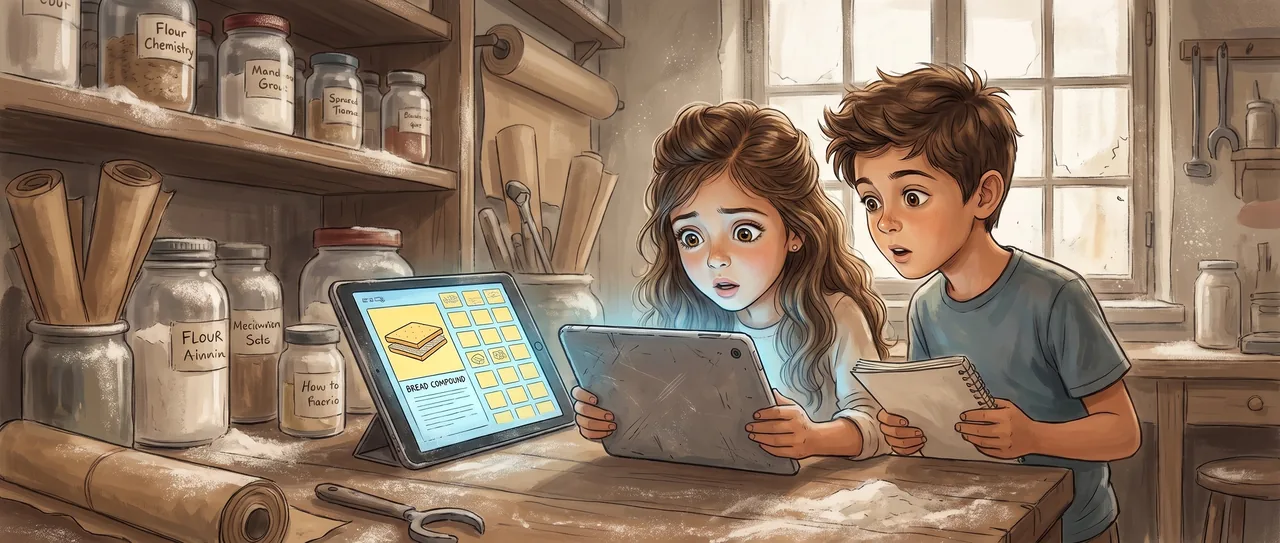
The storeroom smelled like flour and old paper. Maya's grandmother had run the bakery downstairs for forty years, and up here she had kept jars of things with handwritten labels, a sink, and a window that rattled.
"It found another one," Soren said. He had the tablet flat on the workbench. The search tool was free, the kind a library gives away, and it had been chewing through chemistry papers all afternoon because Maya had asked it one question and then refused to stop asking.
"Read it," said Maya.
"Sodium something. A food preservative. Patented in nineteen ninety-three to keep bread from going stale."
"Bread." Maya leaned over the screen. "Why did it pick bread?"
"Because you told it to find molecules with a flat, layered shape. Sheets stacked on sheets. This one has that." Soren scrolled. "The paper is about shelf life. Mold. Nothing else."
"Then why is it glowing yellow."
The tool put a yellow box around things that matched two profiles at once. Maya had set up the second profile that morning, copying numbers out of a physics article about superconductors, materials that carry electricity with no waste, no heat, no loss. The article said the dream was one that worked at room temperature. The article said nobody had found it yet.
"It's glowing," Soren said slowly, "because the shape of the bread molecule matches the shape they think a room-temperature superconductor would have. The spacing of the layers. The way the electrons would have room to line up."
Maya went quiet. Then she said, "So somebody made this. In nineteen ninety-three."
"To keep bread fresh."
"And then what."
Soren checked. He was careful about this part, because it was the part that could be wrong. He read the list of every paper that had ever mentioned the compound. There were nine. He read what each one was about.
"Bread," he said. "Crackers. A cheese study. Bread again. Somebody testing if it was safe to eat. It is. More bread."
"Soren." Maya's voice had changed. "Did anybody ever cool it down?"
"What?"
"Superconductors. You test them cold first. You make them very cold and you run electricity through and you watch. Did anybody ever do that to the bread one."
Soren read all nine papers' worth of summary again. His finger stopped moving.
"No," he said. "Nobody ever measured how it carries electricity. At any temperature. Nobody ever thought to. It was food."
The window rattled. Downstairs a delivery truck went by.
"Wait," Maya said. "That can't be right. Somebody must have. Thirty years. Thousands of scientists."
"The tool checked," said Soren. "Every paper. Every language it can read. The electrical properties of this exact compound have never been published. Not because they tested it and it failed. Because nobody asked."
Maya sat down on the flour-dusted stool. She was looking at the jars on the shelf, the handwritten labels, all the things her grandmother had kept because you never knew.
"That's the part I can't hold," she said. "There's a number that exists. Right now. How well this stuff carries electricity. It's a real number. It's been real since nineteen ninety-three. And nobody has ever looked at it."
"It's just sitting there," Soren said.
"Inside the molecule. Waiting." Maya pressed her hands to the sides of her head. "That's the strangest thing I've ever heard and I don't know why it's strange."
Soren reached for his notebook. He wrote the name of the compound and the year and the word nobody, and underlined nobody twice.
"Here's what gets me," he said. "The tool didn't discover anything. The molecule was always shaped like that. The physics article was always sitting in the same library. The only new thing is that somebody put them in the same room."
"We put them in the same room."
"We asked it to."
Maya stood up again. She couldn't stay sitting. "How many," she said.
"How many what."
"How many other ones. Glowing yellow. Right now. In there." She pointed at the tablet like it was a window into something enormous.
Soren scrolled to the top of the results. He had been so fixed on the bread one that he hadn't counted. He counted now.
"This page," he said. "There are forty-one yellow boxes on this page."
"And how many pages."
He checked. He had to scroll a long time. The little number at the bottom kept climbing.
"Two hundred and sixty," he said.
Neither of them said anything. The number sat in the room with the flour and the jars.
"Most of them are nothing," Soren said finally, because it was true and he wouldn't pretend otherwise. "Matching a shape isn't the same as being the thing. Almost all of these will be glue, or paint, or food, and they'll stay glue and paint and food. The tool can only say worth a look. It can't say yes."
"I know," Maya said.
"But."
"But one of them might be the bread one. The real one. And the only way to find out is to cool it down and run the electricity and watch."
"And nobody's done that."
"For any of them."
Maya picked up the tablet with both hands. She looked at the yellow box around the bread molecule, the one a scientist had drawn in nineteen ninety-three and walked away from, sure they were finished, sure the only question worth asking about it was whether it kept mold off a loaf.
"They thought they were done," she said. "They wrote it down and closed the folder and they were done. And the whole time the molecule had a second answer in it and nobody asked the second question."
"Maybe nobody knew there was a second question."
"There's always a second question." Maya was almost whispering. "That's the part. There's always a second question and most people stop after the first one and the answers just sit there. For thirty years. For a hundred years. Waiting for somebody who can't stop asking."
Soren looked at her. "You can't stop asking."
"No," Maya said. "I really can't."
She set the tablet down between them and tapped the next page. Forty-one new yellow boxes bloomed across the screen, and somewhere among two hundred and sixty pages of them, maybe, a thing that had been called bread was waiting to be called something else.
Read the interactive version, listen to the narration, and earn a gold star →
A science-verified short story for curious kids · Curiosity Land