The Coldest Place in the Building
The snow had shut the whole town, which was why Maya and Soren were sitting on the floor of a hallway that smelled like cold metal, waiting for Maya's aunt to stop being a scientist for the day.
"She said five minutes forty minutes ago," Maya said.
"She said one more reading," said Soren. "Scientists never have one of anything."
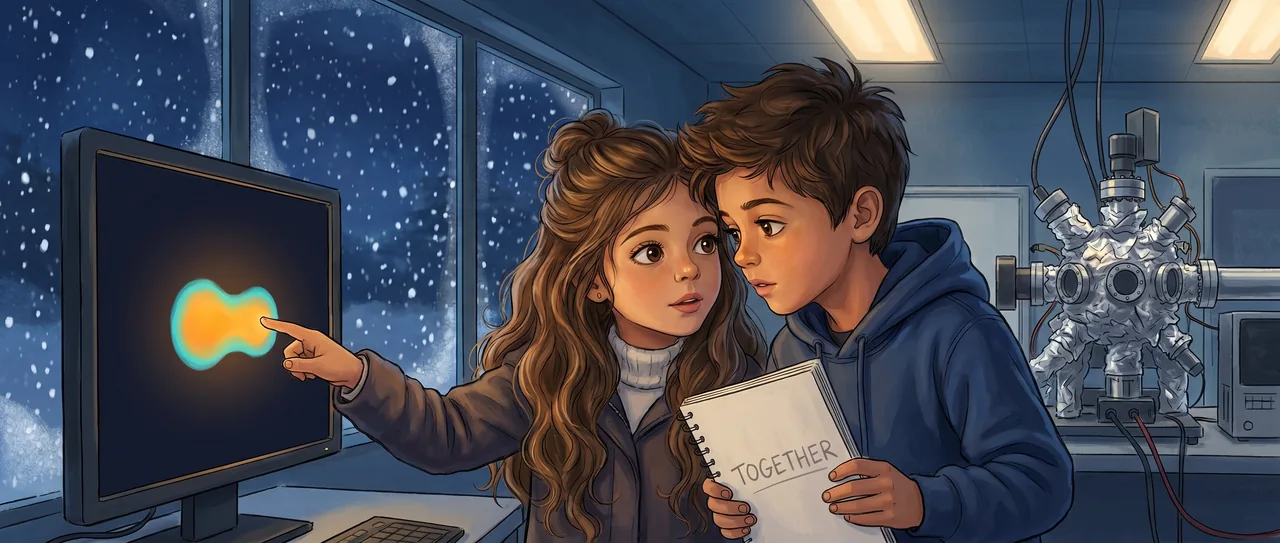
Through the door's little window they could see a machine the size of a refrigerator, wrapped in foil and wires, humming. Maya's aunt Priya stood at a screen, frowning at a smudge of color that meant nothing to either of them.
Maya stood up. "What is the coldest thing in here?"
"Outside," said Soren. "It's minus ten."
"No." Maya pressed her nose to the glass. "Inside that box. I bet it's colder than outside."
Aunt Priya opened the door without turning around. "You two can come in if you don't touch anything and don't ask me why nineteen times."
"How cold is it in the box," Maya asked.
"That's one," said Priya. She tapped the screen. "Inside the trap, right now, about four hundred billionths of a degree above absolute zero."
Soren stopped walking. "Billionths."
"Billionths."
He had his notebook out. His pencil hovered over the page and did not come down. "Outside it's minus ten. Space is about minus two hundred and seventy. You're saying this box is colder than space."
"Much colder. Space is balmy compared to in there." Priya almost smiled. "The coldest places in the universe are not stars dying or moons drifting. They're boxes like this one, in buildings like this one, made by people who wanted to see something."
Maya was already looking at the smudge on the screen. A little blob of light, brighter in the middle. "See what?"
"Atoms," said Priya. "A few million of them. Rubidium. We hold them with lasers and magnets and we take away their heat, bit by bit, until they're barely moving at all."
"Heat is moving," Soren said slowly. "So no heat means."
"Almost no moving. The atoms slow down until they're sitting nearly still."
Maya frowned at the blob. "That doesn't look like millions of things. It looks like one thing."
Priya went quiet. Not the busy quiet from before. A different one.
"Say that again," she said.
"It looks like one thing," Maya said. "If there's millions of atoms shouldn't it look like millions of dots? Like sand? That looks like one drop of something."
"What made you say a drop," Soren asked her.
"Because it's got a fat middle. Sand doesn't have a fat middle. Sand is just scattered." Maya pointed. "That's pooled."
Priya pulled a stool over and sat down between them, which adults never did. "Tell me what you think is happening, and I won't tell you if you're right."
Maya looked at the blob. Soren looked at his notebook, where he had written cold = slow and underlined it twice.
"Okay," Maya said. "When they're warm they're all bouncing around being separate. Like kids at recess. Everybody doing their own thing."
"And when you take the heat away they stop running," said Soren.
"They stop running," Maya said. "And then." She stopped. "And then what. They're just sitting still next to each other. That's not one thing. That's a bunch of still things."
"That's where it gets strange," Priya said, and said nothing else.
Soren stared at the screen. He was thinking about the recess kids. "At recess you can tell which kid is which because they're all in different places doing different stuff. But if everybody stopped. If everybody stood in the exact same spot, doing the exact same nothing."
"You couldn't tell them apart," Maya said.
"You couldn't tell them apart," Soren repeated. His pencil came down on the page. "Maya. If you can't tell them apart, are they even apart?"
Maya turned all the way around to look at him.
"That's the whole question," Priya said softly. "At this temperature the atoms stop being a crowd. They overlap. Each atom spreads out, like a wave instead of a dot, and the waves slide into each other until they're one wave. Millions of atoms, marching as a single thing. You can see it with your eyes, right there. A piece of the quantum world, big enough to look at."
"That's not allowed," Maya said.
"Why isn't it allowed?"
"Because quantum stuff is supposed to be tiny. You always hear it's too small to see, it only happens to single little particles, you can never catch it." Maya jabbed a finger at the screen. "And there it is. Just sitting in a box. In the middle of a snow day."
Soren had gone very still over his notebook. Then he wrote one word and turned the page so Maya could read it. He had written: TOGETHER.
"That's it," he said. "That's what cold does. Not just slow. It makes them stop being separate."
"How cold did you have to make recess," Maya asked Priya, "to get that to happen."
"Colder than anything had ever been made when they first did it," Priya said. "People said it couldn't be reached. It took seventy years from the math to the moment someone actually saw the blob. Seventy years of people being told it was too cold to be possible."
Maya was quiet now too. "And it was just here. The whole time. Hiding in how cold you could go."
"Hiding in the cold," Priya said.
Soren looked up from the page. "How many people have seen this? With their own eyes, the actual blob, not a picture."
Priya thought about it. "In the whole history of the world? Not many. A few thousand, maybe."
Maya pressed closer to the screen until her breath fogged a small circle on the cold glass casing of the machine, right over the blob.
"Don't," Priya said gently. "Your breath is warmer than the entire experiment by a few hundred billion degrees."
Maya pulled back fast, and the fog shrank, and vanished, and there was the blob again. One thing made of millions of things that had forgotten how to be apart.
"Aunt Priya," she said. "How much colder can it go."
Priya looked at the screen, and then at the two of them, and did not say five minutes.
"Pull up a stool," she said. "Both of you."
The machine hummed. On the screen the wave sat in its trap, the coldest, quietest, most crowded loneliness in the universe, holding perfectly still while the snow came down outside.
Read the interactive version, listen to the narration, and earn a gold star →
A science-verified short story for curious kids · Curiosity Land