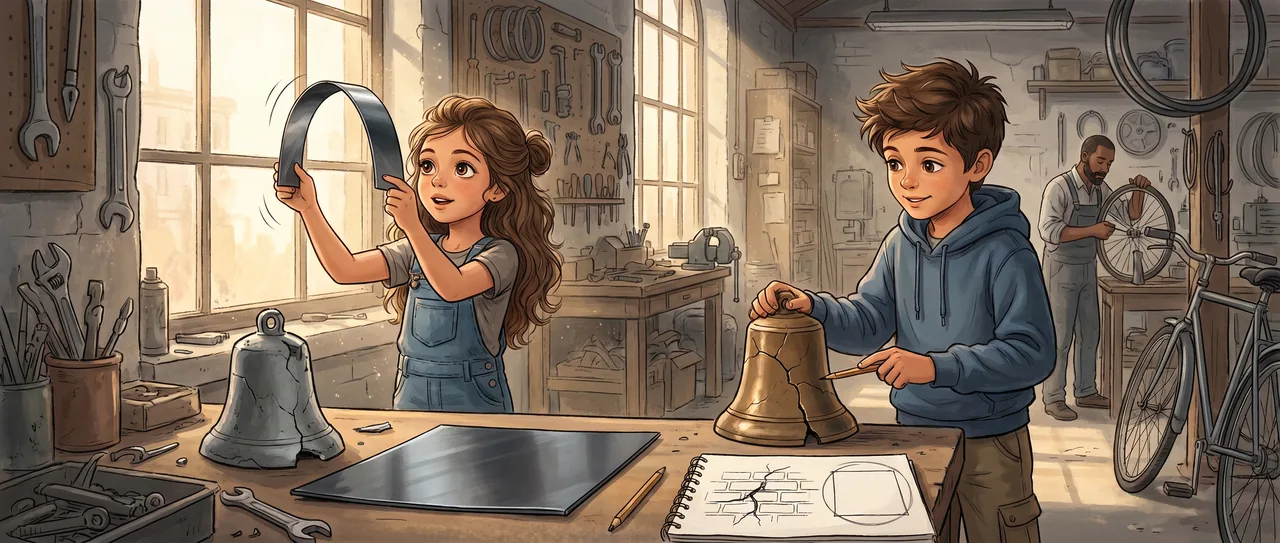
The Bell That Wouldn't Break
The bell had cracked in half, and Maya wanted to know why.
"Bells don't just split," she said, turning the two pieces in her palm. "Somebody dropped it a hundred times before this. There's a line where it gave up."
Soren leaned in. The break wasn't clean. It zigzagged, like a river drawn by someone with the hiccups.
"It went around stuff," he said. "See how it bends? The crack didn't go straight. It found the easy path."
"What easy path?"
"I don't know yet."
Mr. Okafor ran the shop, and Mr. Okafor was busy. He fixed bicycles, not bells, and he'd told them twice they could melt the thing down and recast it in the little kiln out back as long as they didn't touch anything that was already plugged in. He had a wheel clamped in a stand and a customer at noon and absolutely no interest in their bell.
"It's pewter, probably," he called over his shoulder. "Melts easy. Pour it in the sand mold, let it cool, done."
So they melted it. The two halves slumped into a silver puddle, and the puddle shivered with heat.
"Okay," Soren said. "He said let it cool."
Maya was already looking at the bucket of water by the sink. "How fast?"
"He didn't say."
"He said let it cool. He didn't say slow." She tilted her head at the bucket. "What happens if it cools really fast?"
"Cracks, usually. Fast cooling makes things brittle. Glass shatters because it cools uneven."
"But the bell already cracked slow. What if fast is different."
Soren wrote something. His pencil moved, then stopped.
"There's only one way to know," he said.
They poured half the melt into the sand mold like Mr. Okafor said. The other half Maya tipped, fast, between two flat steel plates they'd chilled in the water bucket. The metal hit the cold steel and went silent. No crackle. Just a thin gray sheet, instant, like the puddle had been switched off.
They waited.
The sand-mold bell came out dull and gray. Soren tapped it with a screwdriver. It went thunk. He tapped harder. A chip flew off the rim.
"Brittle," he said. "That's the normal one."
Maya peeled the thin sheet off the steel plates. It was darker, glassier, almost like the bottom of a frying pan that had seen things. She flexed it. It bent. It sprang back.
"Soren."
"What."
"It bends."
He took it. He bent it too, more than he meant to, and it snapped straight again the second he let go. He set it on the bench and hit it with the screwdriver. No chip. No thunk. A high clean ring that hung in the air for a long time.
"That's not how metal works," he said. "Same metal. We poured the same metal."
"We didn't do anything different except fast."
Mr. Okafor wandered over, wiping his hands, glancing at the clock. "You two done? Customer's in twenty." He picked up the gray bell, tapped it, nodded. "There it is. Pewter." Then he picked up the thin dark sheet, bent it without thinking, and stopped.
He bent it again. He looked at it the way you look at a word you've spelled right a thousand times that suddenly looks wrong.
"That's the same metal?"
"Same puddle," Maya said. "We just cooled it different."
Mr. Okafor frowned, set it down, and went back to his wheel, because the customer was real and the bell was not his problem. But he looked back at it twice.
Soren had the two pieces side by side now, the brittle one and the bendy one, and he was staring at the cracked edge of the broken original.
"The river," he said.
"What river."
"The crack, before. It zigzagged because it had a path. Metal that cools slow grows in little grains, like a wall made of tiny bricks. The crack just runs along the lines between the bricks. The mortar. That's the easy path."
Maya's eyes went wide. "And the fast one."
"The fast one cooled so quick the bricks never got to form. There's no lines." He picked up the dark sheet and held it to the light, turning it. "It's all one thing. Frozen mid-pour. Like glass, but metal. There's nowhere for a crack to go because there's no mortar to follow."
"So it can't find the easy path."
"Because there isn't one."
Maya took the sheet back and bent it, and it sprang, and she bent it again. "It's not a wall of bricks," she said slowly. "It's a window that won't break."
They were quiet then, both of them, holding a thing that should not exist by every rule they'd ever been told about how metal behaves. Mr. Okafor's wheel spun behind them. Outside, a car passed.
"Maya." Soren's voice was careful. "All the metal in the world. Every spoon, every bridge, every train rail. It all cooled slow enough to grow the bricks."
"So it all has the lines."
"So it all has the easy path." He looked at the dark sheet. "This one just didn't get the chance to be ordinary."
Maya thought about that. She thought about the bell that had cracked because somewhere inside it, invisible, there had always been a line waiting. And she thought about the sheet in her hand, which had no line, because nobody had given it time to grow one.
"It got rushed," she said. "And rushing made it stronger."
"It got rushed past the part where it turns into bricks."
She held it up to the window. The afternoon light came through the shop glass and lay flat along the dark surface, and there were no grains in it, no lines, no place for the light to catch and break. Just one smooth unbroken gray, all the way down.
She flexed it one more time. It rang, high and long, and the ring went on after she'd stopped, filling the whole foundry, refusing to die out, a sound from a thing with nothing inside it left to crack.
Soren picked up his pencil and drew a wall of tiny bricks. Then he drew a line straight through the mortar. Then, beside it, he drew nothing at all, a blank rectangle, and circled the blankness twice.
Read the interactive version, listen to the narration, and earn a gold star →
A science-verified short story for curious kids · Curiosity Land