What the Machine Saw First
Aunt Reza had gone to lunch and left them with one instruction, which was do not touch the patients' files, and one screen glowing in the dim room.
"It already guessed," Maya said. "Look. It put a number on this one before you even sat down."
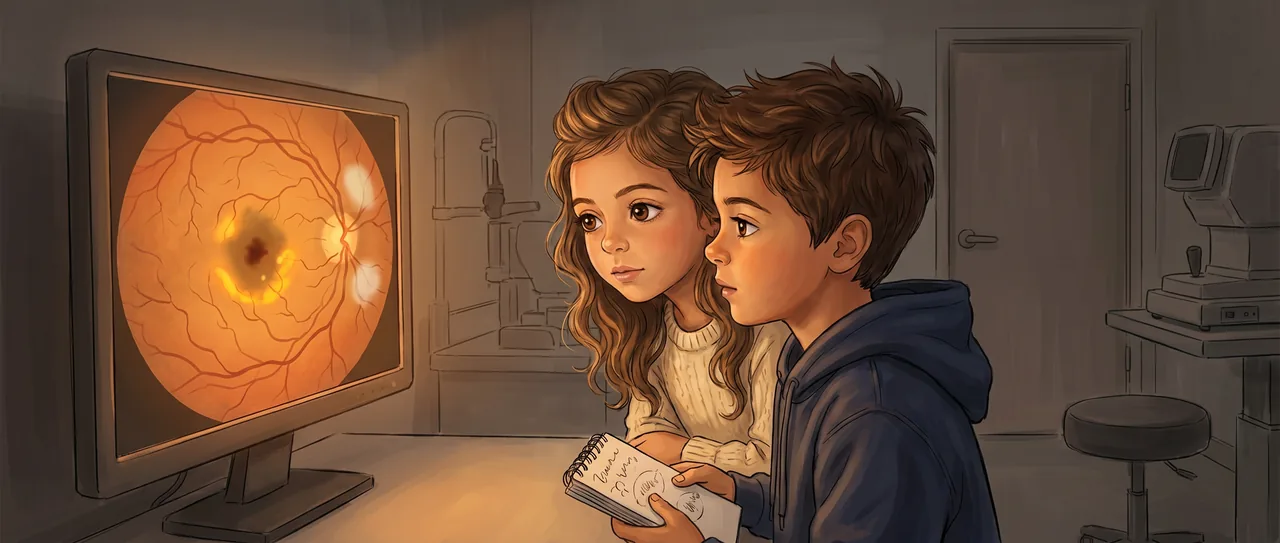
Soren leaned in. The screen showed a photograph of the inside of someone's eye, all orange and branching like a river seen from a plane. Underneath, the program had written a percentage and the words referral suggested.
"How does it know," he said. It was not really a question yet. It was him deciding to make it one.
"My aunt says it's smarter than the old machines. It catches the sugar-sickness in the eye early. Before people can."
"Before doctors can?"
"Before doctors can." Maya scrolled. Another eye. Another number. "She showed me. They tested it against the actual eye specialists, hundreds of them, and it tied. Sometimes it won."
Soren took out his notebook and copied the branching shape of the eye, slowly, getting the forks right.
"So what's the rule," he said. "What does it check. Like, if a vein looks bumpy, refer. If there's a red dot, refer."
"That's the thing." Maya turned to him. "There's no rule. Nobody told it a rule."
"Somebody told it something."
"They showed it eyes. A hundred thousand eyes. More. Each one labeled, sick or not sick, by real doctors. And the machine just looked until it found whatever the sick ones had in common."
Soren stopped drawing.
"But what did they have in common?"
"It doesn't say. That's what I'm telling you. Nobody typed in the rule. It made its own."
He sat with that. "Then how do we know it's looking at the right thing? Maybe it's looking at, I don't know, the corner of the picture. Maybe sick people get photographed at a different clinic with a different camera and it just learned the camera."
Maya pointed at him like he'd won something. "Yes. That happens. My aunt told me about that. A skin-cancer one learned that doctors put a ruler in the photo when they already thought it was bad. So it just learned, ruler means cancer."
Soren laughed, then stopped, because it wasn't funny, it was strange. "So it was right for the wrong reason."
"Right for a reason nobody chose."
They both looked at the orange river of the eye on the screen.
"Try one," Soren said. "You guess first. Then it guesses. See if we see the same thing."
Maya pulled up a fresh scan from the practice set, the ones with the answers hidden. She studied it. She was good at this, finding the thing that didn't belong, the smudge in the wallpaper.
"That," she said, touching a tiny dark fleck near the center. "That's wrong. That doesn't fit."
Soren wrote down center, dark fleck.
She clicked. The program thought for half a second and put up its number. High. Referral suggested.
"We got the same one," she said, pleased.
"Did we though." Soren was frowning at a second line of text that had appeared, smaller. "It says here it's also weighting something. There's a little map. The hot part."
The program could show you, in a wash of color, which parts of the image had pushed its decision. Maya turned it on.
The dark fleck she had spotted lit up red. Good.
But so did something else. A faint area off to the side, near where the optic nerve came in, pale and unremarkable, a place neither of them had looked. The machine had painted it warm.
"Why there," Maya said. "There's nothing there."
"There's nothing there to us."
They leaned in together until their heads almost touched the glass. The pale region looked like nothing. It looked like the rest of the eye. And the machine had stared at a hundred thousand eyes and decided that this nothing was part of the something.
"It sees a pattern," Soren said slowly, "that doctors don't have a name for."
"Or don't have yet." Maya's voice had gone quiet and quick. "Soren. What if it's finding things first. What if there's a sign in the eye, a real one, that means the sickness is coming, and people just never noticed it because you'd have to look at a hundred thousand eyes to see it, and no one person ever looks at a hundred thousand eyes."
"The machine looked at all of them."
"The machine looked at all of them."
Soren wrote pale region, no name, then put his pen down because his hand had stopped being interested in writing and wanted only to point.
"There are eye photos like this from years ago," he said. "Of people. And we know now which ones got sick later. So you could feed it old eyes from healthy people and ask it, who gets sick. And it might know. Off a thing we can't even see."
Maya was already nodding. "And then you go back and find out what the thing is. The machine shows you where to look. And then a person figures out why."
"That's backwards from how it's supposed to go."
"I know." She grinned. "Usually the person finds the rule and teaches the machine. This is the machine finding the rule and the person hasn't caught up."
They both stared at the warm pale patch that meant something nobody on Earth could yet explain.
Soren said, "So somewhere out there is a doctor who's going to spend their whole life figuring out one thing a machine already noticed and couldn't say."
"Maybe lots of things."
"Maybe lots of things."
Maya thought about that. The kind of person who could sit with a thing that didn't fit and not need it explained yet, who could hold the question for years. She thought she knew people like that. She thought she might be one.
The door clicked. Aunt Reza came back smelling of coffee. "You touch anything?"
"Just the practice set," Maya said. "It lit up a part of the eye that isn't anything."
Aunt Reza glanced at the screen, at the pale warm patch, and her face did something complicated. "Yeah," she said. "It does that sometimes. We don't entirely know why."
She set her coffee down and pulled a chair to the screen and leaned in, the same way they had, until her own head nearly touched the glass.
Read the interactive version, listen to the narration, and earn a gold star →
A science-verified short story for curious kids · Curiosity Land