Two Hundred and Eighty
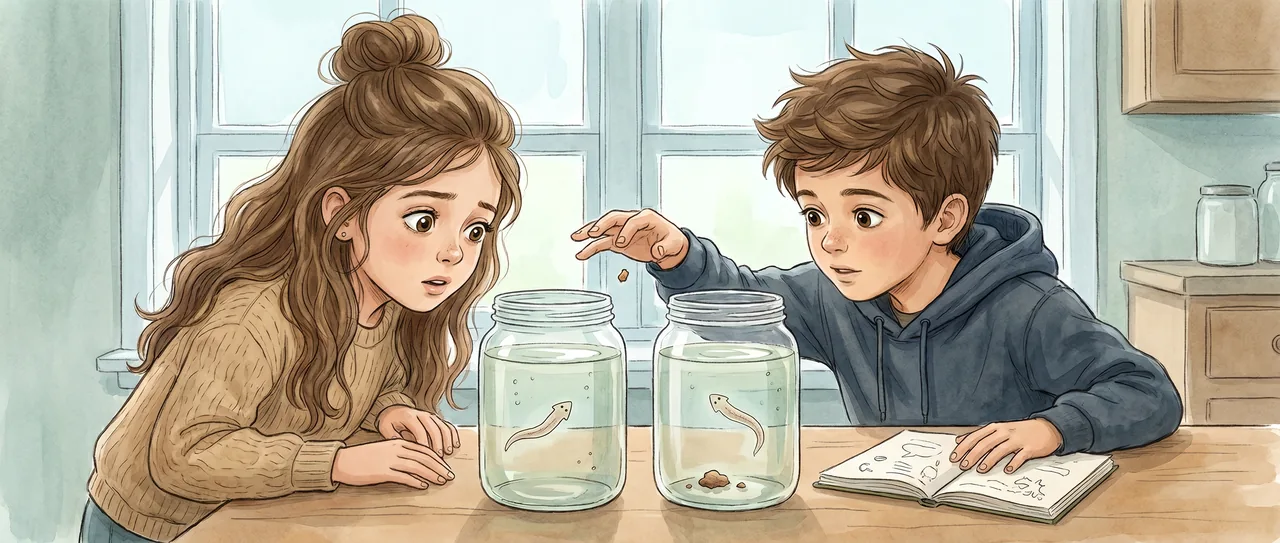
Maya held the jar up to the kitchen window so the worm inside turned the color of weak tea.
"Watch this," she said. "Soren. Watch."
She tipped a crumb of boiled liver into the water. The flatworm, no longer than her pinky nail, swam to it without hunting, without wandering, straight as a thrown dart, and folded itself around the food.
"It went right to it," Soren said.
"Every time. I've fed it from the left corner for two weeks. It knows where the corner is."
Soren leaned close. The worm had a tiny arrow of a head, two dots that looked like crossed eyes. "That's not knowing. That's smelling."
"It's the same corner whether I drop liver or not. It checks the corner first." Maya set the jar down. "That's a habit. Habits are in the head."
Soren got out the notebook and wrote planarian, left corner, two weeks. Then he asked the question he always asked. "How do you cut a worm in half without killing it?"
"You don't kill it," Maya said. "That's the whole thing. My cousin told me. You cut a planarian and it grows the missing part back. Cut the head off, it grows a head. Cut the tail off, it grows a tail."
Soren stopped writing. "Both pieces live?"
"Both pieces become a whole worm."
He looked at the jar for a long time. "Then which one is the worm."
Maya didn't answer right away .
They did it carefully, the way you do a thing you are not sure is allowed. A clean razor from the craft drawer, a wet white dish, the worm laid out flat in a film of pond water. Maya made one cut, crosswise, behind the head. The two halves curled like commas and then went still.
"Did we hurt it," Soren said.
"It's not bleeding. It doesn't bleed." Maya bent down. "They're both moving."
The head end was already gliding. The tail end, the half with no eyes, no arrow, no mouth, sat in the water doing nothing in particular.
They put both halves in the jar and waited. Waiting, it turned out, took days.
By the third day the tail end had grown a small pale blunt knob where the head used to be. By the sixth it had eyes, two faint dots, crossed. By the eighth there were two whole worms in the jar, each the size of the first, each with an arrow head and a working mouth.
"Okay," Soren said. He had filled a page and a half. "That's the part everybody knows. It grows back. But the tail one never had a brain. It built a new one."
"Feed it," Maya said.
"What?"
"The tail one. The one that built a new head. Feed it from the corner."
Soren looked at her. "It's a new head. New brain. It never learned the corner. The old head learned the corner, and the old head is over there being its own worm now."
"I know," Maya said. "That's why we feed it."
Soren understood what she was asking and felt the back of his neck go cold. He moved the original head worm into a separate cup. Then he held a crumb of liver over the jar where the rebuilt worm swam, the one that had been a tail, the one whose entire brain was eight days old.
He dropped the liver in the right corner. Wrong corner. On purpose.
The worm went to the left corner first.
"Do it again," Maya said. Her voice had gone quiet.
He did it again. Liver in the center. The worm checked the left corner before it turned to the food.
"Again."
Six times. Six times the rebuilt worm went to the left corner first, the corner the original worm had been fed from for two weeks, the corner this brain had never once been fed from, because this brain had not existed two weeks ago.
Soren put the liver down. His hand wasn't quite steady. "It can't remember that. It wasn't there."
"Half of it was there," Maya said. "The tail half."
"The tail doesn't have a brain."
"Then where was the corner kept?"
Neither of them said anything. The two worms swam in their two containers, identical, both checking left corners that only one of them had ever been taught.
Soren picked the notebook back up and held it without writing. "My cousin's thing," Maya said slowly, "the worm thing. People did it for real. With mazes. A scientist trained worms to run a maze, then cut them up and grew new ones, and the new ones ran the maze faster than worms that were never trained. The pieces remembered. Even the pieces with no head."
"That's not possible," Soren said, and the way he said it was not an argument. It was a person standing at the edge of something. "Memory is in the brain. We grew this brain in the jar. We watched it happen. It's eight days old."
"So the memory isn't only in the brain."
"Then where is it."
Maya looked at the jar. "In the body. In the whole body. Spread out everywhere, so when you cut it, the memory's in every piece."
"They cut one into two hundred and seventy-nine pieces," she said. "That's the number my cousin said. Two hundred and seventy-nine. And it became two hundred and seventy-nine worms."
"And every piece would still go to the corner," Soren said.
"Every piece."
Soren set down the notebook and looked at his own arm in the window light, at the skin over the muscle, at the place where a person keeps the things they remember, which everybody had always told him was up behind his eyes and nowhere else.
He dropped one more crumb of liver into the jar, dead center, equal distance from every wall.
Both worms, the old one returned to the jar and the eight-day-old one, turned left at the same moment and went to the empty corner first.
Read the interactive version, listen to the narration, and earn a gold star →
A science-verified short story for curious kids · Curiosity Land