The Skating Drops
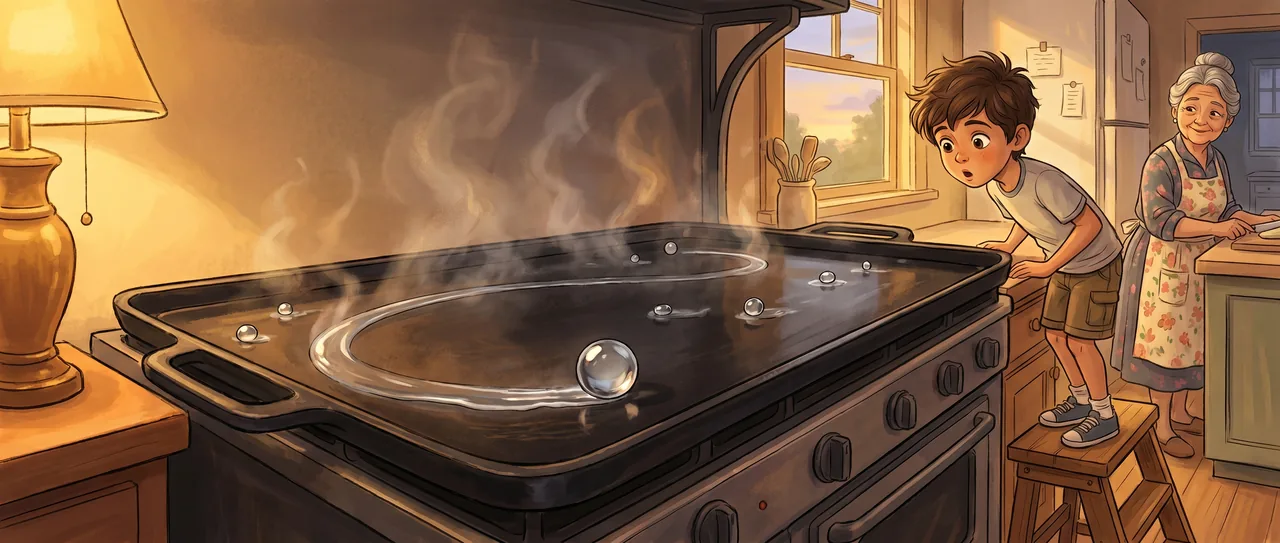
The kitchen smelled like hot iron and the first edge of smoke. Soren stood on the stepstool beside the stove, close enough to feel the heat lean out of the griddle and press against his cheek like a flat hand.
Grandmother flicked water off her fingertips toward the pan. The drops hit and vanished with a hiss, gone before he could blink.
"Not ready," she said. "When it stops doing that, it's ready."
That made no sense to him. The water disappeared faster than anything. How could that mean not yet?
He watched her stir batter and talk about the lake and his cousins, and the whole time he kept his eyes on the pan, waiting. She flicked water again. Hiss. Gone.
Minutes passed. The iron got hotter. He could tell by the way the air above it shivered, the way the smoke smell sharpened. And then she flicked the water a third time, and something changed.
The drops did not vanish.
They landed and they ran. Little beads of water, skating. They slid across the black iron in long curving paths, fast, like the surface had turned to glass and tilted, except it was flat. One drop chased another. They didn't sizzle. They didn't spit. They glided, whole and round and shining, for one full second, two, before they finally shrank away.
Soren forgot to breathe.
"There it is," Grandmother said, satisfied. "Now it's hot enough." She poured the first ladle of batter.
But he was still looking at the place where the drops had been. Hotter meant the water lasted longer. That was backwards. Everything he knew said a hotter pan should kill a drop faster, boil it off in an instant. Instead the cooler pan ate the water at once, and the scorching pan let it skate around like it was having fun.
"Do it again," he said. "Please."
She sighed, but she liked when he got like this. She tapped a few drops off her fingers.
They skated.
He leaned in, careful of the heat, and watched one bead the size of a peppercorn travel almost the whole width of the iron. It never touched anything. That was the thing his eyes kept insisting on. It looked like it was hovering, riding on nothing, a tiny silver puck on an invisible rink.
Riding on nothing. He turned that over.
Not nothing. The bottom of the drop, the part kissing all that heat, would flash to steam instantly. And steam was a gas, a cushion, a layer of pushing-away. The drop sat on a pillow it made out of its own underside. The pillow held the rest of the drop up off the iron, just barely, so the iron could never grab it all at once. So it lasted. So it skated.
On the cool pan there was no pillow. The water touched, and the iron took it.
He felt the kitchen get bigger around him.
"Grandma," he said slowly, "is that why you can do the lead thing?"
She looked up. "What lead thing?"
"There's people who dip a wet finger in melted metal. Fast. And it doesn't burn them." He'd seen it once and it had scared him and amazed him and he hadn't understood it and it had sat in his head ever since, unsolved, one of the items on his list of things that did not make sense yet. "They're wet first. They wet their hand."
Grandmother frowned. "I'd never let you do anything like that."
"I know. I'm not. I'm asking why it works."
And then he had it, the whole shape of it, arriving all at once like the drops arriving on the iron.
The water on the finger does the same thing the drops did. The instant it meets something that hot, the outside flashes to steam and the steam shoves back and makes a cushion, and for a heartbeat, a half a heartbeat, the cushion holds the metal away from the skin. Not forever. Just long enough to pull the hand out. The steam is a wall the heat has to climb before it can reach you, and a wall like that takes time, and time is exactly what a fast hand is buying.
The pancake bubbled. Grandmother flipped it without looking, because she'd done it ten thousand times.
Soren reached for the notebook in his back pocket. His pencil pressed a row of small skating beads across the page, each one with a thin curved line beneath it, the line for the steam. Under them he wrote: the hotter it is, the longer it lives. He looked at the sentence and the strangeness of it didn't go away. Some true things stay strange even after you understand them.
"You're missing the pancakes," Grandmother said, sliding the first one onto a plate, golden and steaming.
He wasn't, though. He was watching her wet her fingers again, out of habit, to test a pan that was already plenty hot.
The drops landed.
They ran across the black iron, round and silver and unafraid of the heat that should have destroyed them, skating on the thinnest pillow of their own breath, and Soren counted under his breath, one, two, all the way to three, before the last one disappeared.
Read the interactive version, listen to the narration, and earn a gold star →
A science-verified short story for curious kids · Curiosity Land