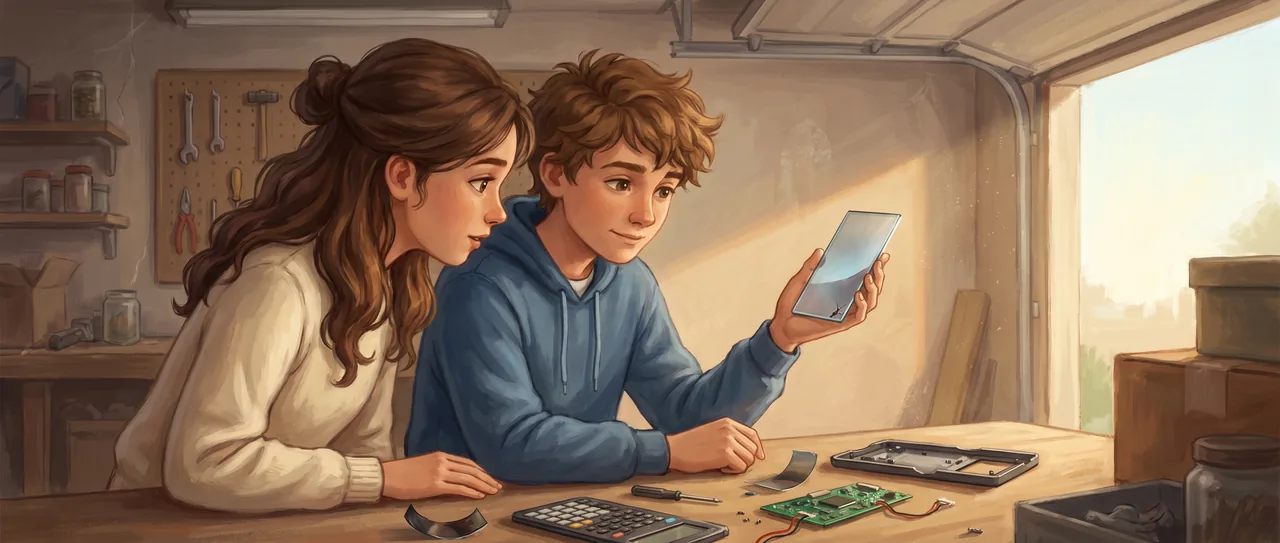
The Screen That Was Almost Awake
The calculator had been dead for a year. Soren had asked his dad if he could take it apart, and his dad had said take whatever you want, just don't lose the small screwdriver, and then gone back to the lawnmower.
"Six screws," Soren said. "Why six. It's the size of a cracker."
"To keep curious people out," said Maya. She had her chin on the workbench, eye level with the thing.
The back came off. The little solar strip, the buttons, a board the color of a leaf. And the screen, which Soren lifted out by its edges like it might be hot.
"It's glass," he said. "Two pieces of glass. With something between them."
Maya tilted it toward the open garage door. The gray went silver, then nearly clear, then gray again as she moved it.
"Do that again," said Soren.
She did. "It changes when I turn it. Not the screen turning. The light turning."
Soren found the polarizing film, a soft plastic sheet glued to the front. He peeled a corner loose. Under it the glass looked different, like a window that had been pretending to be a mirror.
"There's a film like this on both sides," he said. "Front and back. And the goo is in the middle."
Maya pressed the glass with her thumbnail, gently, near the edge where it had cracked. A faint dark bloom spread under the pressure, then eased back when she let go.
"It moved," she said. "Like water. But it's holding a shape too. Look. The dark part has edges."
Soren leaned in. "Water doesn't have edges."
"This does. A little." She pressed again and watched the bloom and the slow return. "It flows but it remembers. That's a weird thing to be."
Soren wrote something. His hand moved across the page and stopped.
"Okay," he said. "Two films. Goo in the middle. The numbers used to show up black on gray. So the goo isn't black. It does something to the light."
They took the two polarizing films, the front one and a piece from a broken pair of sunglasses Maya kept in her pocket because she kept everything, and held them up together.
"Turn yours," Soren said.
Maya turned the sunglass lens against the film. At one angle the world dimmed. She kept turning. At another angle it went black. Two clear pieces of plastic, and between them, no light at all.
"That's the trick," she said slowly. "Two of these crossed and nothing gets through."
"But the screen wasn't black all over," said Soren. "It was gray. Light came through everywhere except the numbers."
They looked at each other.
"Something in the middle un-crosses it," Maya said.
"The goo," said Soren.
He slid the lens away and held just the calculator glass to the light again, turning it the way Maya had. The silver came and went.
"It twists the light," he said. "That's what flowing-but-remembering is for. The molecules line up in a little staircase from the front glass to the back glass, and the light follows the staircase around. It goes in lined up one way and comes out lined up another way. So it can get through the second film even though the films are crossed."
Maya was already nodding before he finished. "And the numbers. The black parts. Those are where the staircase got knocked down."
"Knocked down by what?"
She pointed at the leaf-green board, the thin wires, the place the battery used to feed. "Electricity. You push electricity through one little spot and the molecules in that spot stop twisting. They stand straight up. The staircase is gone. The light goes in lined up and comes out lined up the same way, and the crossed films stop it cold. Black."
Soren stared at the board. "So the calculator never made black ink. It just told certain molecules to stand up straight."
"One spot at a time. The top of the seven. The middle bar of the eight."
"And when the electricity turns off?"
"They flow back into the staircase." Maya pressed the glass once more, watching the dark bloom rise and sink under her thumb. "They remember the shape. They go home to it."
Soren put his pencil down. "That's not a liquid. A liquid forgets. And it's not a crystal either. A crystal can't flow."
"It's both," Maya said. "It's a thing that's both."
They sat with that. Out in the driveway the lawnmower coughed and caught and droned away.
"Ice is a crystal and it can't move," Soren said. "Water moves and it can't hold a pattern. We learned there were three things. Solid, liquid, gas. Nobody said there was a thing in between that flows like one and lines up like the other."
"Nobody said," Maya agreed. "But it's in a calculator. A dollar calculator. It was in there the whole time, doing it, every time you added something up."
Soren picked up the little screen and held it flat on his palm. "How many screens," he said. "Phones. The microwave. The clock in the car. The thing at the gas pump."
"All of them," Maya said. "All of them full of molecules standing up and lying down. Standing up and lying down. Faster than we can see."
Soren tilted the glass toward the door one more time. He turned it slowly, and the gray slid to silver and back, the staircase inside catching the daylight and letting it go, catching and letting go, a whole crowd of molecules lining up for a light that wasn't even electric anymore, just the afternoon coming through the open garage.
Maya watched his hand turn it. "Do that slower," she said.
He turned it slower.
Read the interactive version, listen to the narration, and earn a gold star →
A science-verified short story for curious kids · Curiosity Land