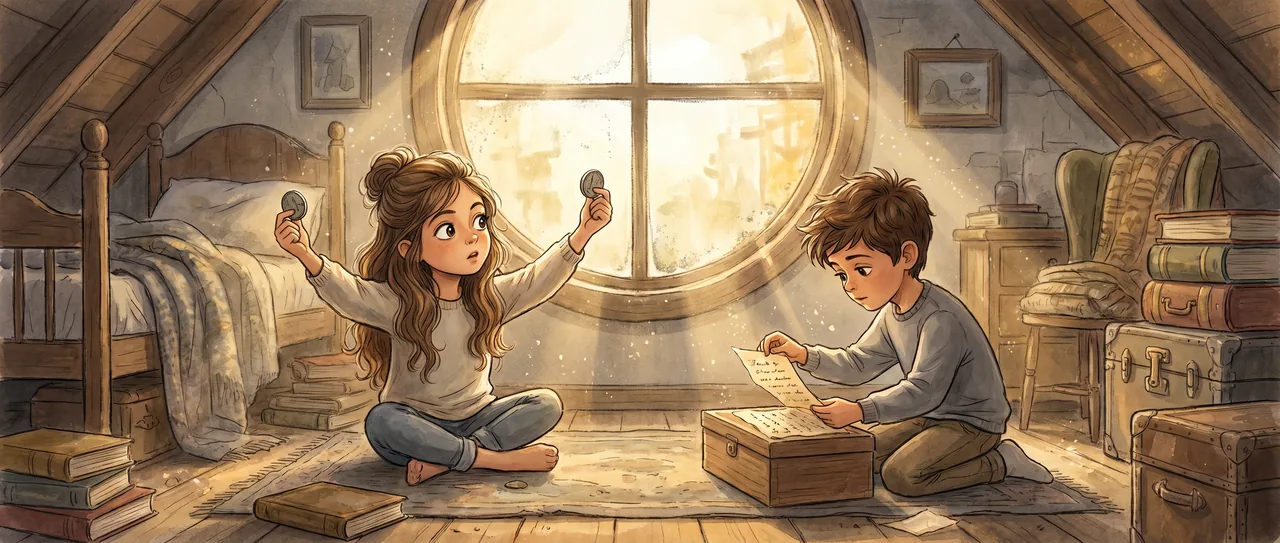
The Same Coin
The box was labeled in handwriting so old it leaned over like it was tired. PAIRS, it said. DO NOT SEPARATE. KEEP TOGETHER.
"Too late," said Maya, because the box had clearly been dumped out and shoveled back in by somebody. She pulled out two flat gray disks. Magnets. They snapped together so hard they pinched her thumb.
"Those aren't it," said Soren. He was reading the note that had been taped inside the lid. "Listen. He says, when you measure one, you already know the other. No matter how far. He underlined far three times."
"That's just magnets," said Maya. "They pull. You pull one, the other follows."
"He says no pulling." Soren held the note up. "He says, the thing about a true pair is that nothing passes between them. He underlined nothing too."
Maya took the note. She read it twice, fast. "Okay. So not magnets."
"Right."
"Then what." She wasn't really asking him. She was asking the attic.
Soren dug deeper into the box and found an envelope. Inside were two coins, each cut clean in half, the way you'd split a cookie. He fit one pair back together. Heads. Then the other pair. Also heads.
"He cut coins in half," said Soren.
"Why would a physicist cut coins in half."
"To explain something to somebody who didn't get it." Soren turned a half-coin over in his fingers. "Watch. Pretend I mail you one half in a sealed envelope. You fly to the other side of the world. You open yours. It's heads. So you know mine is heads. Instantly. Even though I'm thousands of miles away."
Maya frowned. "That's not amazing. The coin was already cut. Mine was always heads. Yours was always heads. We just didn't look."
"Right," said Soren. "That's exactly what he wrote next. He wrote, this is what everybody thinks it is. And it isn't."
Maya went quiet. Then she said, "So the trick is the coin isn't decided yet."
"What do you mean."
"Read me the next part."
Soren turned the note over. The back was crowded with smaller writing, like he'd run out of room and didn't care. "He says the pairs he's talking about aren't like coins in envelopes. He says before you look, neither one is heads and neither one is tails. They're both. Sort of smeared. And the instant you look at one and it picks, the other picks the opposite, the same instant, however far away it is."
"But it wasn't decided before."
"He says no. He says people checked. There are ways to check whether the answer was hiding the whole time or whether it really got decided at the moment you looked." Soren stopped. "And it really got decided at the moment you looked."
Maya picked up the two reattached coins, one in each hand. She held them as far apart as her arms would go.
"So if these were real," she said slowly, "and I looked at this one, and it became heads right then, this other one would become tails right then. Even if I'd carried it to the Moon."
"Faster than light could get from one to the other," said Soren. "Yeah."
Maya looked at the coin in her right hand for a long second. Then she grinned, and it was the grin she got when something was wrong in a way she liked.
"Then I could send you a message," she said. "You go to the Moon. I stay here. I look at my coin. Boom, yours changes. We tap out words."
Soren shook his head before she finished. "That's the part everybody tries. He's got it here. He says it doesn't work and it took him years to feel why."
"Why not."
"Because you don't get to choose. When you look, your coin comes up heads or tails, but you can't make it be heads. It's random which way it falls. So your coin on the Moon goes random too, the opposite of mine. To you up there, it's just a coin flipping randomly. You can't tell I looked. There's no pattern in it until we get back together and lay them side by side and see they always matched."
Maya's mouth opened. Closed. "So they're connected."
"Completely."
"But you can't use it to send anything."
"Nothing. No message. No signal. Nothing travels." Soren looked at the note like it might be tricking him. "They just agree. They always agree, instantly, across everything, and the agreement carries zero information until somebody brings the two halves into the same room."
Maya sat down right on the dusty attic floor. She put one coin on her left knee and one on her right knee and stared at them like they'd done something rude.
"That's worse than magic," she said. "Magic at least sends something. A spell goes from here to there. This doesn't send anything and it's still tied together." She picked one up. "How. How are they tied if nothing goes between them."
"He doesn't say," said Soren.
"He has to say. He has a note for everything."
Soren read the last line. He read it twice before he said it out loud, and his voice came out smaller. "The last thing he wrote is, I have measured this ten thousand times and I have never once found out how they know. I only found out that they do."
The attic was very quiet. A bar of late light came through the round window and lay across the open box.
Maya rolled the coin between her two palms. "He cut all these coins," she said, "trying to feel a thing that isn't a thing you can feel. Because nothing crosses. There's no string. There's no wire. There's no pull." She stopped rolling it. "And he kept doing it anyway. Ten thousand times."
"Because they always agreed," said Soren.
"Because they always agreed and he couldn't stand not knowing why." Maya looked up at Soren, and something in her face had changed, gone open. "That's the whole job, isn't it. That's allowed to be the whole job. Finding out that something is true before anybody knows how."
Soren didn't answer. He was already pulling the note free of the tape, careful at the corners, and folding it once along a crease the old man had folded it on a thousand times before.
Maya held both coins up to the round window, one in each hand, arms wide, and looked from one to the other, back and forth, faster, as if she could catch the exact instant the far one knew.
Read the interactive version, listen to the narration, and earn a gold star →
A science-verified short story for curious kids · Curiosity Land