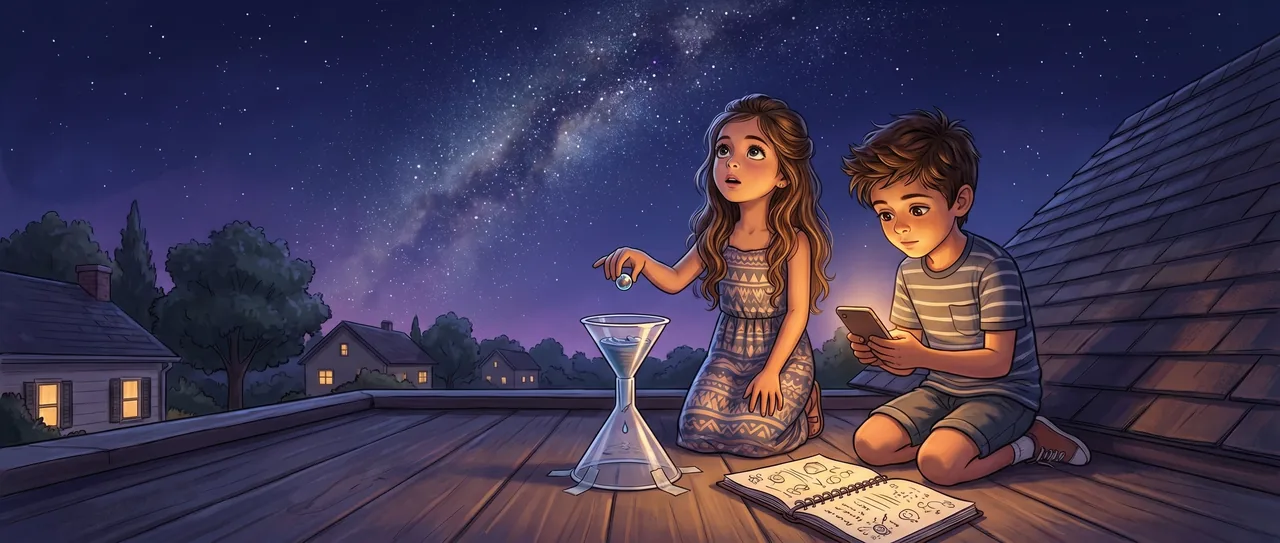
The Pull We Can't See
The marble went down the funnel the way it always did, spiraling fast, then faster, then gone.
"Do it again," said Maya.
Soren did it again. The marble circled the plastic funnel they had taped to a stool, tightening its loops, dropping toward the hole in the middle.
"That's gravity," he said. "The marble's rolling on a slope, but the slope is sort of standing in for space being bent. The big thing in the middle pulls."
"Right." Maya was lying flat on the warm garage roof, her phone held straight up at the sky. "Where's the funnel for us, though."
"What?"
"We're the marble." She didn't look away from the screen. The satellite app crawled little dots across the dark. "The Earth goes around the Sun. The Sun goes around the middle of the galaxy. So we're rolling down something. What's our funnel."
Soren set the marble down on the stool so it wouldn't roll off the roof. "Okay. The galaxy spins. We're going around the center at, I don't know, two hundred kilometers a second."
"Two hundred and thirty," said Maya. "You looked it up last week."
"Two hundred and thirty. So that's our funnel. The black hole and all the stars in the middle."
Maya was quiet. Then she said, "That's the funnel we're going around. I'm asking what we're falling toward."
Soren opened his mouth and then closed it. He pulled his notebook out from under his knee and clicked the pen. He wrote whole galaxy and put a question mark after it.
"Galaxies move," he said slowly. "The whole Milky Way has to be going somewhere. It's not nailed down."
"Toward what."
"I don't know." He liked saying that out loud. It meant there was somewhere to go. "Something bigger than the galaxy."
Maya sat up. "Bigger than the galaxy."
"The galaxy's already enormous," Soren said. "A hundred thousand light years across. For it to fall toward something, the something would have to be way more than that."
They both looked at the sky for a while. The Milky Way itself was up there, a pale smear of stars running corner to corner, so thick with light it looked like spilled flour.
Maya pointed at it. "That bright band. That's us looking edge-on into our own galaxy, right. All the stars stacked up."
"Yeah."
"So we can't see through it."
Soren followed her finger. The band was crowded, glowing, jammed with stars and dust. "No. There's too much in the way. Whatever's behind that part of the sky, we can't see it. The galaxy blocks it."
"Like trying to see across a room," Maya said, "when somebody's standing right in front of your face."
Soren wrote galaxy blocks the view. Then he stopped writing.
"Maya."
"What."
"What if the thing we're falling toward is behind the part we can't see."
She turned her head toward him slowly. "Say that again."
"We fall toward something. Something huge. And the direction it's in is hidden behind the bright band, behind all our own stars. So we're being pulled by something we literally cannot look at. Our own galaxy is in the way."
The app on Maya's phone kept crawling its little satellites along, calm and certain, knowing exactly where everything close was.
"That can't be real," she said. But she said it the way she said things she already believed.
Soren got his own phone out. He typed: is the Milky Way falling toward anything. He read for a moment. His face did a thing.
"Read it," Maya said.
"It has a name," Soren said. "People named it. The Great Attractor."
Maya laughed, one short startled sound. "They named it that."
"They named it that because they don't know what it is." He kept reading. "It's about two hundred and fifty million light years away. And the whole Milky Way, and a whole bunch of other galaxies, thousands of them, are all being pulled toward it. At six hundred kilometers a second."
Maya was on her feet now. "Six hundred. Right now."
"Right now. While we're lying on a roof. We're moving six hundred kilometers toward it every second and we can't feel any of it."
She spun toward the bright band of the Milky Way, the spilled-flour stripe of stars. "And it's that way. Behind all that."
Soren checked. "Roughly. It's in the part of the sky they call the Zone of Avoidance. Because our own galaxy's stars and dust sit right in front of it. We've been trying to look at it for fifty years and our own galaxy keeps standing in the way."
Maya didn't say anything. She was looking at the band of light with her whole face, the way you look at someone who just told you a secret about yourself.
"You asked the exact right thing," Soren said. "You asked what we're falling toward. That's the question nobody can finish answering. People with telescopes the size of buildings can't finish it."
"Because we're standing inside the thing that blocks the view," Maya said. "We're inside the funnel. You can't see down your own funnel."
Soren wrote that down word for word. Then he looked up.
"They can see a little," he said. "X-rays go through the dust better than regular light. So they get pieces. They can tell something's there, a giant pile of galaxies, and even that isn't enough mass to explain the whole pull. There's more pulling than they can account for."
"So it's not solved," said Maya.
"It's not solved."
The marble sat on the stool where Soren had left it, perfectly still on the flat plastic, because there was no slope under it. Nothing for it to roll toward that they could see.
Maya picked it up and held it out over the funnel and didn't drop it. She just held it there, in the air, above the hole.
"Right now we're the marble," she said. "We're already rolling. We just can't see the bottom."
She looked back up at the crowded stripe of stars, at the exact crammed part of it where the thing was, the thing with the giant name and no real answer, the thing pulling six hundred kilometers a second through the dark.
Then she let go, and the marble dropped, and circled, and was gone down the hole before either of them could count to one.
Read the interactive version, listen to the narration, and earn a gold star →
A science-verified short story for curious kids · Curiosity Land