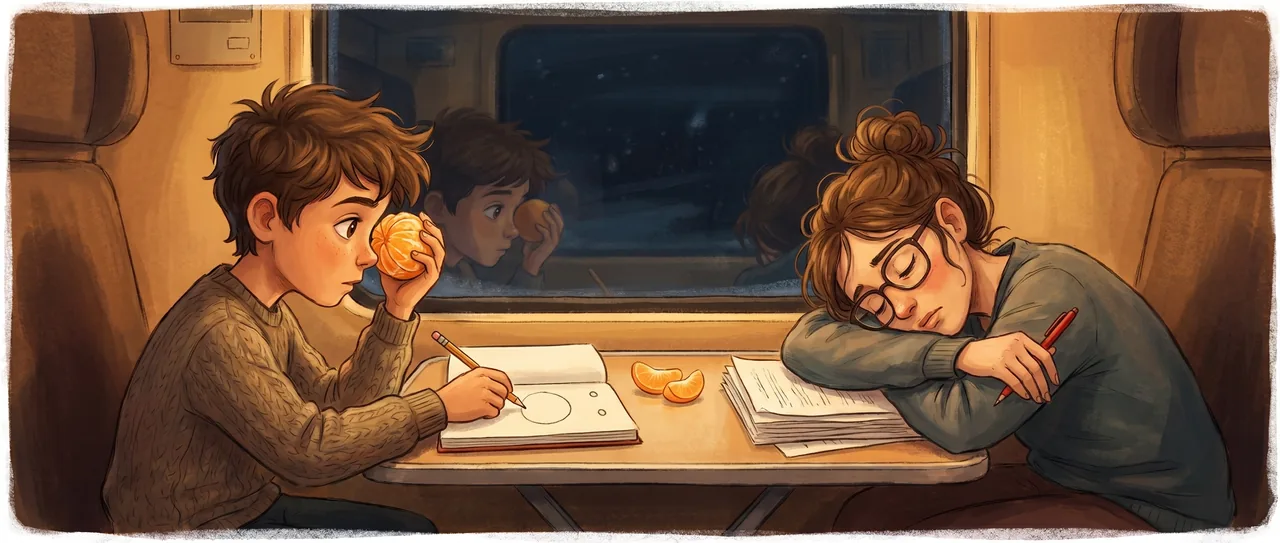
The Orange That Was Not Possible
The woman across the aisle had a stack of papers as thick as a brick and a red pen she clicked when she was thinking. She had been clicking it for an hour. Soren had been watching the lights of towns slide past, peeling an orange he was not very hungry for.
He set the peel on the little folding table in one piece. It had come off in a long spiral, and now it sat there like an empty orange made of nothing but skin.
The woman glanced at it. Click.
"You can put it back together," Soren said. He did not know why he said it. He fitted the spiral back into a ball shape. "Sort of."
"Mm," she said. "That's nothing. I can make two oranges out of one."
Soren waited. She kept grading. He did not look away.
After a while she sighed and put the pen down. "It's a theorem," she said. "Banach and Tarski. Two mathematicians, almost a hundred years ago. They proved you can cut a solid ball into a few pieces, just five if you like, and move those pieces around, no stretching, no squishing, only sliding and turning, and put them back together as two balls. Each one exactly the size of the one you started with."
"That's not possible," Soren said.
"No," she agreed. "And yet it is proven. Both are true." She picked the pen back up.
Soren looked at his orange. He pulled the segments apart and counted them. Eleven. He pushed them back together. Eleven again. He had not made any more orange. He had just rearranged the orange he had.
"You can't," he said. "If I cut this into five pieces and slide them around, I still have one orange of orange. The amount doesn't change. You can't get more stuff out of moving stuff."
"Correct," she said, not looking up.
"But you said."
"I said pieces. I didn't say pieces like that." She gestured at the segments with her pen. "Those are pieces a knife can make. The Banach-Tarski pieces are not. They have no smooth edges. They have no volume you could ever measure. They are scatterings of points, infinitely fine, so strange that the question how much orange is in this piece has no answer at all. Not a big answer. Not a small answer. No answer."
Soren stopped pushing the segments around.
"You can't weigh them," he said slowly.
"You can't weigh them. The idea of weight doesn't fit them. That's the whole trick. When you can't measure the pieces, the amounts don't have to add up the way you expect. One ball's worth of points, scattered the right way, turns out to be enough points to build two balls. The points were always there. There are that many points in anything."
Soren held the orange up close to his eye. It looked completely ordinary. Bumpy skin, white threads where the peel had been.
"How many points are in this," he said.
"More than the number of grains of sand on Earth. More than that times itself. More than any number you can write. There is no last point. Between any two of them there is always another."
"So inside the orange," Soren said, and then he stopped, because the next part was large and he wanted to get it right. "Inside the orange there's already enough for two oranges."
The woman's pen went still.
"There's enough for a hundred," she said. "There's enough for a million. The theorem only bothers to make two because two is enough to surprise people."
Soren put the orange down very carefully. "Then why," he said, "can't I do it. With a knife. Why is it only true if the pieces are the kind nobody can hold."
She leaned forward for the first time. The papers slid in her lap and she let them.
"That is the right question," she said. "That is exactly the question. A knife can only make pieces that have a size. Real pieces. The world we can touch only lets us cut along measurable lines, and measurable things always add up. One orange in, one orange out, forever. The doubling lives in a place a knife can't reach. It lives in the points themselves, which are real in the mathematics and have no width in the world. The orange in your hand is honest. The orange in the proof is something else."
"But it's the same orange," Soren said.
She looked at him for a long moment.
"Is it," she said. It was not really a question. She picked her papers back up, but she did not start grading. She was watching him over the top of them.
Soren turned the orange in his fingers. Somewhere in it, between every two points he could imagine, was another point, and between those, another, going down and down with no floor at the bottom. He could not feel them. His thumbnail could not reach them. They were closer than the skin and further away than the towns going by outside.
He took out his notebook and a pencil. He drew a circle. Inside it he made a dot, and beside that dot another dot, and then he tried to draw a dot in the space between them, and his pencil tip was already too fat, the gap already gone. He pressed lighter. Still too fat. There was no pencil thin enough. There never would be.
The train went into a tunnel and the window turned black and gave him back his own face, the orange, the circle on the page.
"Keep the orange," the woman said quietly. "It's a better one than it looks."
Soren did not answer. He had peeled half of it without noticing. He set one segment on the table, and then he set a second one beside it, and he sat looking at the two of them, the two small pieces of the one fruit, trying to find the place where one stopped being enough and became enough for more, and not finding it, and looking anyway.
Read the interactive version, listen to the narration, and earn a gold star →
A science-verified short story for curious kids · Curiosity Land