The Joint That Healed Itself
The rail had a gap in it.
Maya crouched at the edge of the gravel and put her hand near the steel without touching it. The metal held the day's heat the way a sidewalk does, faint and patient. She ran her eye down the line until the two pieces of rail stopped agreeing with each other. There was a finger-width of nothing between them, dark and clean.
"Don't lean on the track," her aunt said, not looking up from her clipboard. Aunt Reza inspected freight cars. She had told Maya twice that the wait would be boring and to bring something to do. Maya had brought her eyes.
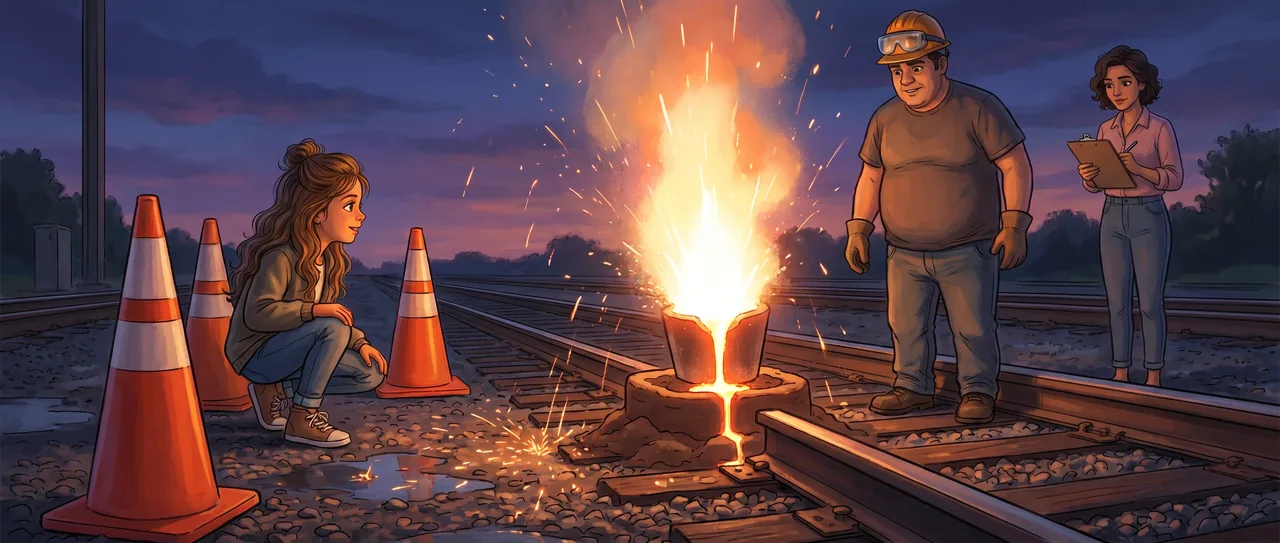
The two crew workers were doing something strange to the gap. They had packed a clay mold around it, snug as a cast on a broken arm, and on top of the mold they had set a small crucible the color of a clay pot. One of them, a broad man with reflective glasses pushed up on his hard hat, kept checking a watch.
"What's in the cup," Maya said.
"Powder," the man said. "Stand back behind the cones, kid."
That was not an answer, and Maya filed it on the list in her head of things that did not yet make sense. She backed up to the cones. She did not stop watching.
The man lowered his glasses. He touched something to the top of the crucible.
The light came before the sound. It was not orange like a campfire and not yellow like a candle. It was white, a white that pushed past white into a color Maya did not have a word for, the way the sun is not really a color so much as a refusal to be looked at. She felt it on her cheeks from ten steps away, a sudden bloom of heat like opening an oven that had been on all day. Sparks fountained up and curled and fell, and where they landed on the wet gravel they did not hiss out. They kept burning. On the wet stones. Tiny suns lying in puddles, unbothered.
That was the thing. That was the thing that did not fit.
Maya knew water. Water was what you threw on fire. Water was the rule. She had watched her mother smother a pan with a lid and douse a campfire until it sighed black. Fire needed feeding and you could starve it or drown it. Everyone knew that.
The sparks in the puddles glowed and dimmed at their own speed, taking their time, ignoring the water completely.
"It's not going out," Maya said, out loud, to no one.
The crucible was running now. Something poured from a hole in its bottom, down into the mold around the gap, and it moved like honey and shone like the inside of a star. Metal. Liquid metal, going exactly where the missing piece of rail used to be.
Maya's mind worked the way it always did, sideways and fast, landing on the wrongness before the reason. Water cools things by stealing their heat and carrying it off as steam. That was the trick of it. The water turns to vapor and leaves, and takes the heat with it. So for water to fail, completely, on a wet stone, the fire had to be making heat faster than the water could possibly carry it away. Not a little faster. Stupendously faster. So fast the water never got the chance.
She stared at the poured metal cooling in the gap and a colder thought arrived underneath the hot one.
Fire needs air. That was the other rule. You smother a candle with a glass and it dies because you take its air. But the powder in the cup had not gasped for air. It had not flickered or starved. It had burned in a steady, certain rush, as if it carried everything it needed inside itself.
"It doesn't need the air," she said.
The broad man heard her this time. He pushed his glasses up and looked at her, and there was something careful in his face, like he had not expected the kid behind the cones to be doing arithmetic.
"Two metals," he said. "A powder and a rust, basically. The one wants the other's oxygen so bad it takes it right off it. Hands it over. All that holding-on the rust was doing, that's where the heat comes from. It brings its own oxygen to the party. You can't take away what it already owns."
"So water can't drown it," Maya said.
"Water can't even slow it down," he said. "Hotter than a volcano, that little cup. Couple thousand degrees. We're not lighting the rail on fire. We're melting it on purpose, just at the seam, so the new iron and the old iron forget they were ever two pieces."
Maya looked at the gap that was no longer a gap.
The rule she had carried her whole life, throw water on fire, was not a law of the universe. It was a habit that worked for the slow tame fires people kept in pans and pits, fires that begged the air for every breath. It had nothing to say about a fire that came holding its own air in its hands. The whole tidy rule was just a thing that happened to be true near the kitchen.
She wondered how many of her rules were like that. How many were the truth, and how many were only the truth around here, near home, at our size, in our weather. The thought did not frighten her. It opened. The metal in the seam had gone from blinding to orange to a deep, sullen red. The crew began chipping the clay mold away. Where the break had been there was now a single rail, healed, a faint ridge marking the place two pieces had agreed to become one.
Aunt Reza finally looked up from her clipboard. "You missed it," she said. "It's just a weld."
Maya did not answer. She walked, slowly, to the nearest puddle on the gravel, where one last grain of the powder still sat glowing under a skin of water, unbothered, taking its own sweet time, burning at the bottom of a small clear pool that could do nothing to it at all.
Read the interactive version, listen to the narration, and earn a gold star →
A science-verified short story for curious kids · Curiosity Land