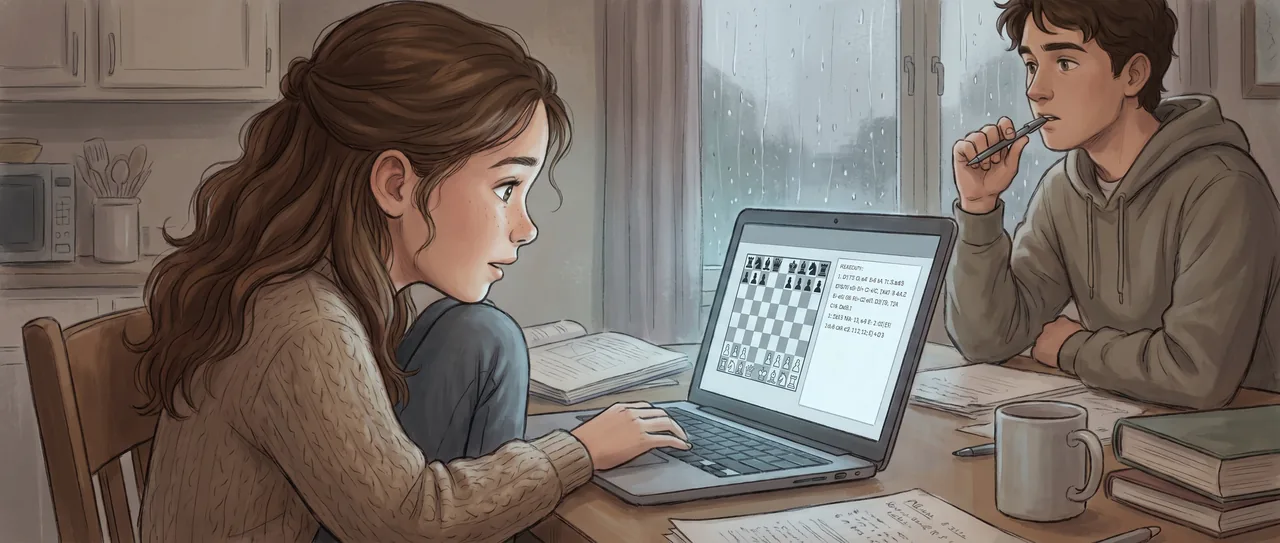
The Game Nobody Taught It
The laptop had been left open on a stack of cousin Theo's college papers, and the screen said: type a move.
Maya did not know how to play chess. She knew the horse one moved in an L. She typed e4, because Theo always typed e4, and he was always proud of it.
The program typed back c5.
She typed knight f3, spelling it out the way she'd seen, and a little board redrew itself in plain gray squares. The program answered before she lifted her finger.
Theo came in chewing a pen. He was supposed to be studying.
"Don't break it," he said. "That thing took me a month."
"What is it."
"A language model. I trained it small." He sat. "It reads. That's all it does. It reads text and guesses what word comes next. I fed it about a million chess games written out in notation. e4, c5, all that."
"So you taught it chess."
"No." Theo grinned around the pen. "That's the part. I never told it the rules. It doesn't know a bishop moves diagonally. It doesn't know what a bishop is. It just learned what letters usually come after other letters."
Maya looked at the board. She looked at him.
"That's not playing," she said.
"Beat me yesterday."
She didn't believe that. She believed Theo lost to lots of things. She pulled the laptop closer and made the program play itself, move after move, the gray board flipping and flipping. The pieces went where pieces should go. None of them walked through each other. None of them landed off the edge.
"How does it know not to cheat," she said.
"It doesn't know anything."
"Then how."
Theo shrugged and went back to his pen. That was the trouble with Theo. He had built the thing and stopped being curious about it the second it worked.
Maya started doing something on purpose. She typed a move that wasn't real. She moved a piece from one corner clear across to the other in a single jump, a thing no piece could do, and she spelled it out cleanly so the program couldn't blame her handwriting.
The program paused. Then it answered with a normal, sensible move, as if she hadn't cheated at all. As if it hadn't noticed. As if it couldn't notice, because there was nothing inside it that could check.
"Theo. It let me cheat."
"Course it did. No rules, remember."
Maya sat very still with that.
Then she did the opposite. She played a hundred clean games and watched. Every single time, the program played legal chess. Good chess. It castled at the right moment. It refused to leave its king in danger. It saw three moves ahead and traded a knight for a better square.
It had no rules. And it never broke one, unless she broke one first.
"That's impossible," she said, but quietly, because she could see it happening.
She tried to find the place where it would crack. She set up a strange position, pieces in a tangle no real game would ever reach, and asked it to move. It thought longer this time. Then it played something clumsy. Then, the move after, something brilliant again.
Maya leaned back.
It wasn't following rules. It was doing the thing a kid does when they've watched a card game for an hour without anyone explaining it, and then they pick up the deck and they just know, mostly, what comes next. Not because they were told. Because they soaked.
"It only ever saw the writing," she said. "It never saw a board."
"Right."
"It's never seen a single board in its whole life."
Theo looked up, because her voice had changed.
"There's a board in there," Maya said. She pointed at the laptop, but she meant somewhere she couldn't point. "There has to be. Not a real one. A pretend one it built by itself, out of nothing but the words. Because the only way to guess the next move right, every single time, a million times, is to figure out where the pieces actually are."
Theo opened his mouth. Closed it.
"You typed it words," Maya said, faster now. "Just letters. And to get good at guessing the letters it had to invent the whole board behind them. The squares. The pieces. Where they're allowed to go. Nobody put that in. It grew it. Just to do its guessing better."
"I," said Theo. "Huh."
That was the thing about Theo. He'd built a mind and never once wondered if there was a room inside it.
Maya thought about that. About how she learned things. Nobody had ever sat her down and given her the rules for the sound her mom's footsteps made when something was wrong, or for which kids at school were about to laugh at her and which were laughing with her. She'd never been taught. She'd just heard the pattern enough times that one day a board appeared behind her eyes and she knew where everything stood.
She'd always thought that made her strange. Reading rooms nobody handed her the rules to.
The program had done the same thing. From less. From only words.
"Theo," she said. "When it plays a move you didn't expect. A good one you didn't teach it."
"Yeah?"
"You can't actually see why. Can you. You can't open it up and find the reason."
Theo was quiet a second too long. "Not really," he admitted. "I can see the numbers. I can't see the why."
Maya pulled the laptop the rest of the way into her lap.
"Then nobody knows what it's thinking," she said. "Not even you. And you made it."
She didn't say it like it scared her. She said it like a door.
She typed a move. A real one this time, careful, the knight in its L. Then she leaned in close to the gray squares and waited to see what the thing that had never seen a board would decide the board looked like.
The cursor blinked. Outside the rain kept on. Then the pieces moved.
Read the interactive version, listen to the narration, and earn a gold star →
A science-verified short story for curious kids · Curiosity Land