The Bubbles That Were Older Than Mammoths
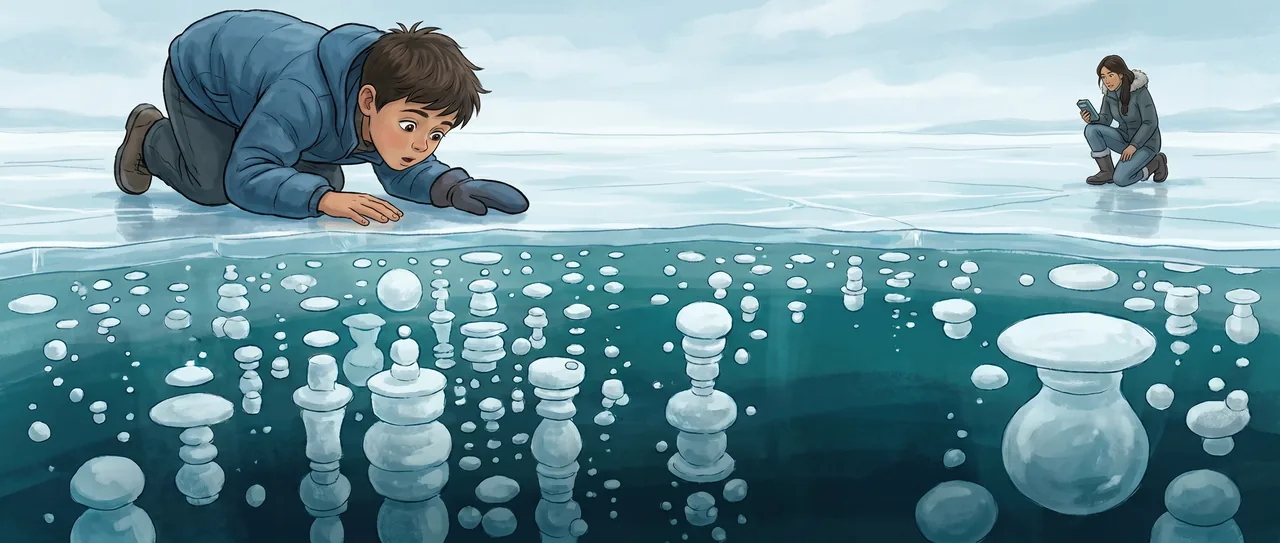
The ice was so clear it did not look like ice. It looked like the lake had forgotten to put a lid on and Soren was about to step into open water.
His aunt Reyna had told him to walk where she walked, and then she had stopped telling him anything, because she was on her knees with a meter that beeped, frowning at numbers and writing them on her wrist with a marker like the cold had eaten her notebook. So Soren walked where she walked, and then he stopped too.
Under his boots, frozen into the ice, were bubbles.
Not a few. Hundreds. Stacked like white coins, like jellyfish caught mid-rise, some flat as dinner plates and some small as peppercorns, layered down into the dark until he could not see the bottom of them. They had been climbing toward the surface when the cold caught them and held them still.
He knelt. The cold came up through his knees immediately, a clean ache. He pressed his ear nearly to the ice, the way you do with a seashell, expecting nothing.
He heard a tick. Then, far down, a soft knock. The ice was talking to itself.
Reyna crawled past, muttering a number, and Soren said, "Where are the bubbles coming from?"
"Mud," she said, not looking up. "Lakebed. Don't light a match." And she crawled on.
That was the whole answer. Mud, and don't light a match.
Soren stayed with the bubbles. He took off one glove and laid his bare palm flat. The ice did not feel like a floor. It felt like a window with something behind it that was still moving. He could see the freshest bubbles, just under the surface, holding a faint shimmer, the way warm air shivers over a road in summer.
Warm. That was the wrong word for a frozen lake and he knew it, but his hand had felt it and his hand was usually right before he was.
He got out his notebook. His pencil moved stiffly in the cold. He drew the stacks of bubbles, the big ones deep, the small ones near the top, and beside them he wrote: bigger and older underneath.
Then he stopped, because that did not make sense. New bubbles should be the small ones, just made. Old bubbles should be the ones that had floated up and gotten flat against the ice. But the deep ones, the ones still climbing from the dark, were the fat ones. The mud was making bigger bubbles now than it used to.
The mud was making more.
Soren sat back on his heels. The cold was in his fingers now, real cold, and he put the glove back on, but slowly, because his mind had gone somewhere and his hands were waiting for it to come back.
Mud at the bottom of a lake. But this was Alaska, and the ground here was supposed to be frozen, all the way down, all year, for longer than there had been towns or roads or his aunt or anyone. He had read the word on the drive in, on a brown sign. Permafrost. Ground that stays frozen.
Except the lake had a soft bottom. Mud, she had said. Soft enough to bubble.
Something down there had stopped being frozen.
"Aunt Reyna," Soren called, and his voice came out smaller than he meant. "What's in the bubbles?"
This time she stopped. She sat back, pushed her hood off one ear, and looked at him like she had only just remembered he was a person and not a smaller, slower meter.
"Methane, mostly," she said. "Some carbon dioxide. You want to know the part that keeps me up at night?"
Soren nodded. He always wanted that part.
"That gas is old," she said. "The carbon in it was a plant, or an animal, when this ground froze. Tens of thousands of years ago. It froze before it could rot. So it's just been waiting down there, locked in the ice, the whole time. Twice as much carbon under the frozen ground as there is in the entire sky." She tapped the ice with one knuckle. "And now the bottom of my lake is thawing, and it's rotting, and it's coming up."
Soren looked down at the fat bubbles climbing from the dark. Plants that had been green before there were pyramids. Animals that had walked here when the mammoths did. All of it breathing out now, finally, after waiting longer than he could hold in his head.
"And the gas makes it warmer," he said slowly. He was not asking. He was feeling his way along a chain, link by link, the way he liked. "The gas comes up because it's warm. And the gas makes it warmer. So more comes up." Then she said, "Yeah. That's it. That's exactly it. That's the whole problem in one sentence and it took me three years of school to say it that plainly."
Soren did not feel proud. He felt the size of it. The bubbles under his knees were not just bubbles. They were the breath of a buried world, and the breath was speeding up, and the speeding up made it breathe faster still. A door that, once cracked, helped to open itself.
"How far down does it go?" he asked. "The frozen part. The carbon."
"Deep," she said. "Deeper than we've measured everywhere. That's the honest answer. We know it's huge. We don't know all of where it is or exactly how fast." She almost smiled. "You found the right question. That's the one nobody can fully answer yet. People your age are going to."
Soren turned that over. Somewhere out there were grown people whose whole job was to lie on frozen lakes and count breath that was older than history, and not one of them knew the whole shape of it yet. There was room. There was so much room.
He pressed his ear back to the ice.
The ticking had not stopped. Down in the dark, another bubble pulled loose from the mud and began its long climb up through the years toward his face, and behind it came another, and another, a slow rising chain of breath that had been waiting since before anyone was here to hear it knock.
Read the interactive version, listen to the narration, and earn a gold star →
A science-verified short story for curious kids · Curiosity Land