No Parts That Move
The ring was eleven inches down the bathroom drain, sitting on the curve of the pipe where the water turned, and Maya could see it shining when she pointed the flashlight straight down.
"It's my grandmother's," Maya said. "It was on the edge of the sink. I heard it the second it went."
"We need something that grabs," Soren said. He had a margarine tub of broken things in front of him. He liked the broken things. "Like little tongs. Two arms, a hinge, you squeeze, they close."
So that was what they built first. They taped two strips of metal together at one end, with a paperclip through both as the hinge, so the metal arms could swing.
The paperclip slipped out on the way down the pipe.
"The hinge fell apart," Maya said, fishing the loose metal back up by its string. "The whole thing is just a hinge. The hinge is the part that breaks."
"Hinges need a pin," Soren said. "The pin's the weak spot. It rattles, it slides, it falls out." He turned the paperclip over in his fingers. "Every machine I ever took apart died at the joint. The gears were fine. The pin was rusted."
Maya was not listening anymore . She picked up a strip of clear plastic, the kind that strapped a box of granola bars shut. She bent it. It bent. She let go. It snapped straight again.
"What if there's no pin," she said.
"There has to be a pin. The arms have to move."
"Watch." She folded the plastic strip in half, not all the way, just into a soft V. "It moved. No hinge. It moved by bending."
Soren took it from her. He pressed the two ends of the V together and felt the plastic fight him, springy, wanting to open back out.
"That's not moving," he said. "That's just bending."
"Same thing," Maya said. "To the ring it's the same thing. The ends came together. Who cares why."
"I care why," Soren said, but he was already cutting the strip longer. He looked at the lid of the margarine tub, the kind with the little built-in hinge that lets the lid flap open a thousand times and never falls off. He flapped it. Open, shut, open, shut.
"There's no pin in this either," he said slowly. "It's all one piece of plastic. The hinge is just a thinner part that bends. They make it thin on purpose so it bends there and not anywhere else."
"So make the grabber out of one piece," Maya said. "No pin to fall out."
They cut a long oval from the side of a plastic clamshell, the see-through kind that strawberries come in. When you pinched the middle of the oval, both ends bowed inward toward each other, like a slow blink. Let go, and the springiness in the plastic itself pushed the ends back open. Nothing to oil. Nothing to lose down a pipe.
"The bending is the machine," Soren said, and he said it carefully, the way he said things he was going to write down later. "The plastic stores the push. You don't put the spring in. The shape is the spring."
Maya was already trimming the two ends into little hooks.
The first try, they cut the oval too wide and it wouldn't fit the pipe. The second try, too thin, and it crumpled and stayed crumpled, a dead fold that didn't spring back.
"Too thin and it just stays bent," Maya said. "Like the granola wrapper when you crease it hard."
"There's a right amount of bend," Soren said. "Past that it stops coming back." He held the crumpled one up to the light, at the white stress line across the fold, where the plastic had gone cloudy and stayed cloudy. "It remembers the wrong way now."
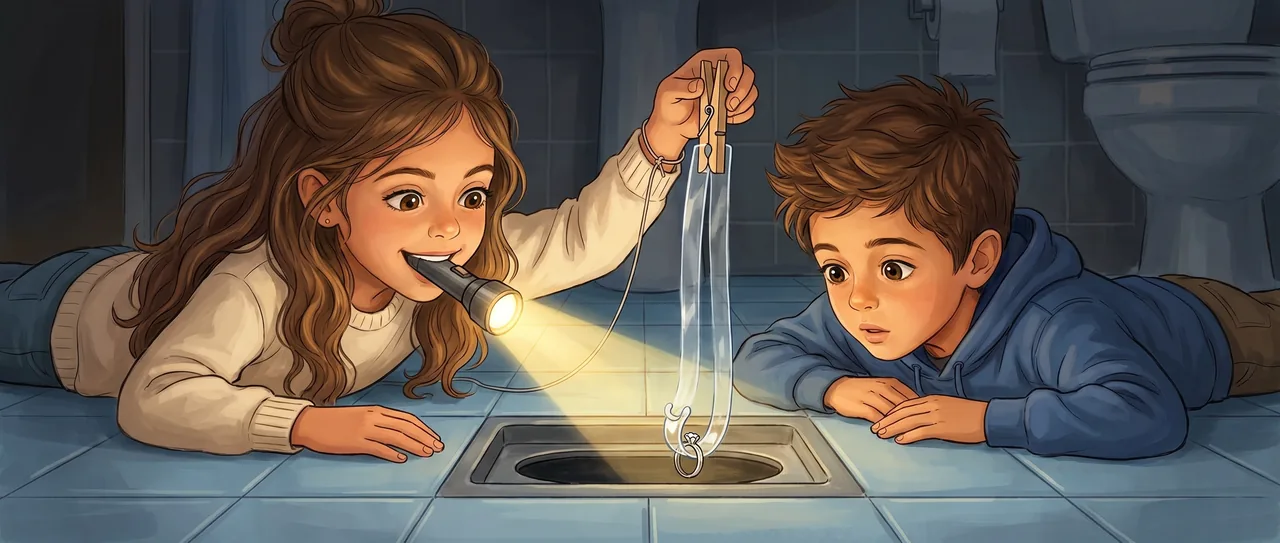
The third one was right. A long clear tongue of plastic with two soft hooks at the bottom, pinched at the top by a clothespin so Maya could squeeze the hooks shut from above. They tied a thread to the clothespin so they could not drop it.
Maya fed it down the pipe with the flashlight in her teeth. Soren lay flat on the tile beside her, watching the clear tool slide into the dark.
"Hooks are open," he said. "It wants to be open. That's good. It only closes when you squeeze."
"There," Maya said, the words mushy around the flashlight. "It's beside the ring."
"Now squeeze, but slow. If you squeeze too hard past the bend it won't open again down there."
Maya pressed the clothespin a little. Through eleven inches of plastic, the hooks bowed in. She felt the gentle resistance climb up the tool into her fingers, the whole length of it bending as one piece, no click of a joint, no give of a pin, just the steady honest push of a thing that wanted to be straight.
The hooks closed under the ring.
"Up," Soren breathed. "Slow."
She drew it up out of the dark, and the ring came with it, hooked and held by nothing but the shape of a strawberry box deciding to bend.
Maya spat the flashlight into her lap and held the ring up to it.
"No moving parts," she said. "The whole thing moved and there were no moving parts."
Soren sat up. He turned the clear tool over and over, looking for the hinge that wasn't there. He pressed the two hooks together one more time and let them spring open in the flashlight beam.
"Surgeons have these," he said. "I read it. Tools that fold open inside a person with no joints, so nothing can come loose where they can't reach it." He squeezed it again. Open. Closed. Open. "Somebody figured out the whole thing could just be the bend."
He squeezed it slowly in the light, watching the plastic hold the push and give it back, again, and again, and again.
Read the interactive version, listen to the narration, and earn a gold star →
A science-verified short story for curious kids · Curiosity Land