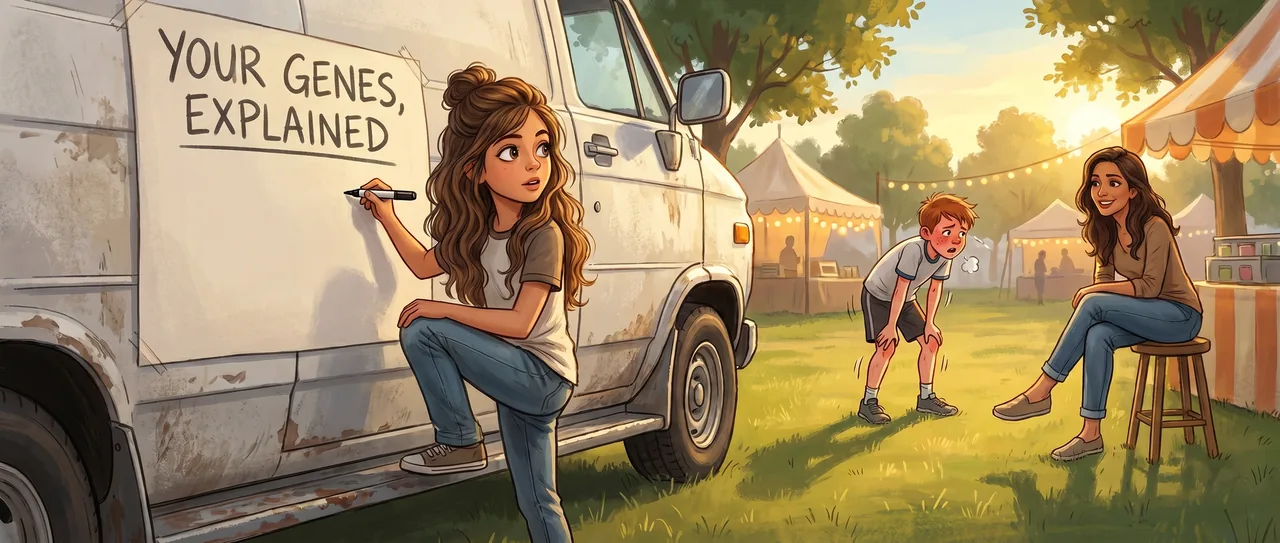
The Switch That Wasn't There Before
Maya's aunt ran a battered white van with a centrifuge bolted to the floor and a sign on the side that said YOUR GENES, EXPLAINED. At the community fair she let Maya hand out cotton swabs while she ran the machine.
"Swab your cheek," Aunt Reza told each kid. "Spit goes in the tube. We look at one little stretch of your DNA and tell you something you already knew, like whether you can roll your tongue."
The kids loved it. Maya did not. It bothered her in a way she couldn't name yet, the way a song bothers you when one note is wrong.
By the third hour she figured out the wrong note.
"You keep saying the DNA is the same in every cell," Maya said. "In my cheek. In my foot. In my hair."
"Same letters, every cell," Reza said, not looking up. "You got the whole instruction book in each one."
"Then how does a cheek cell know to be a cheek?"
Reza did look up then. She had the face adults make when a kid skips four questions ahead.
"Marks," she said. "On top of the letters. Little chemical tags that tell a cell which pages to read and which to keep shut. We call them epigenetic. Your cheek cell and your foot cell read different pages out of the same book."
Maya turned the cotton swab over in her fingers. "So the tags can move."
"They're set early. Mostly. They're pretty locked down once you are who you are."
Mostly. Pretty. Maya kept those two words. They were the soft kind of words, the kind that meant the adult wasn't actually sure.
Across the grass, a girl from Maya's class was doing burpees for a fitness booth, red-faced, counting. Down, jump, down, jump. Her legs were shaking.
Maya watched the shaking legs and thought about which pages a leg cell would have open right now. A leg cell mid-burpee needed energy fast. It needed to burn sugar, build more of the little engines that burned it. Somewhere in that muscle, the cell was screaming for more power.
"Aunt Reza. When that girl's muscles are working hard, do they need different stuff than when she's sitting?"
"Sure. More fuel-burning. More of the genes that make energy."
"So those pages have to open. The energy pages."
"They turn up the volume, yeah."
"But you said the pages are decided by the tags. The marks." Maya was talking fast now, the swab forgotten. "If she needs different pages open than ten minutes ago, then the marks moved. In ten minutes. While she was jumping."
Reza opened her mouth and then closed it. "I want to swab a muscle," Maya said.
"You can't swab a muscle at a fair, kid."
"Then tell me if I'm wrong." Maya looked straight at her. "Tell me the marks don't move when you exercise."
Reza sat back on her stool. She wiped her hands on her jeans, slow, the way people do when they're deciding how honest to be with a child.
"You're not wrong," she said finally. "There's research. They take a tiny sample of someone's thigh muscle. Then that person rides a bike, hard, one time. One workout. Then they take another tiny sample."
"And?"
"And the marks are different. Already. Some of the tags on the energy genes come off. Within that single ride. The genes that help the muscle burn fuel get unlocked, right then, because the muscle worked."
Maya stood very still.
"Say that again," she said.
"One workout changes the marks on your DNA. Not the letters. The marks. The on-off tags."
Maya looked across the grass at the shaking-legged girl, who had stopped now and was bent over with her hands on her knees, gulping air.
That girl's DNA was not the same as it had been before lunch. Not the letters. The girl still had the same letters. But the book was open to different pages now. She had reached into her own muscle, without knowing it, without any swab or machine, and turned tags off that had been on an hour ago. She had edited which parts of herself were being read. By jumping. By choosing to jump.
"Everybody here," Maya said slowly. "Everybody who walked to the fair. Everybody who carried something heavy. They changed it. Today. They changed which parts of the book are open."
"A little. Yeah."
"Not a little." Maya shook her head. "You said it's locked down. You said it's who you are. But it's not locked. It listens. The body listens to what you do and changes which pages it reads, that day, that hour."
Reza looked at her niece for a long moment. Then she laughed, but it wasn't a laughing-at laugh. It was the laugh of someone who has been handing out tongue-rolling facts all day and just got reminded what her own work was actually about.
"I've been telling people the boring half," she said. "You already knew you could roll your tongue. Nobody walks away from that trembling."
"I want the other half on the sign," Maya said.
"What would it say?"
Maya thought. The girl who'd done burpees was walking off toward the lemonade, legs still wobbly, completely unaware that an hour ago she'd reached down into her own cells and flipped switches that no machine in the van could have flipped for her.
"It would say you're not finished," Maya said. "It would say the book keeps getting rewritten by what you do, all day, every day, and nobody ever showed you the part where you're holding the pen."
Reza handed her the marker.
Maya climbed up onto the step of the van, reached for the blank bottom corner of the sign, and started to write.
Read the interactive version, listen to the narration, and earn a gold star →
A science-verified short story for curious kids · Curiosity Land