The Sweet Wormwood Problem
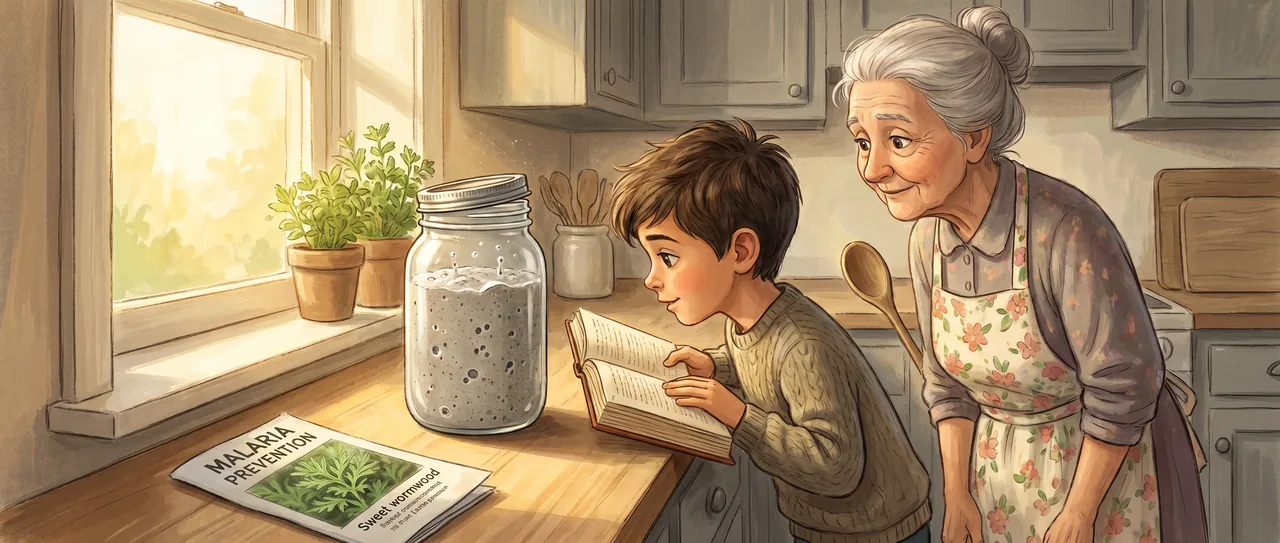
The jar on the windowsill was breathing.
Not really. Soren knew it was not really. But the lump of grey starter his grandmother kept for bread had pushed its lid up overnight, and there were bubbles climbing through it, slow and steady, like something alive deciding things.
"It is alive," his grandmother said, not turning from the stove. "Yeast. Millions of them. They eat the flour and breathe out gas and that is what lifts the bread." She said it the way she said everything, as if it were both obvious and a small miracle, and she expected you to hold both at once.
Soren put his face level with the jar. The bubbles were not random. They came from certain spots, the same spots, over and over. Tiny factories that had agreed on where the doors were.
On the table was the brochure from the museum trip, the one about diseases. He had folded it to the page that bothered him. A photograph of a feathery green plant, sweet wormwood, and underneath it a sentence he had read four times. The best medicine against malaria comes from this plant. The plant is hard to grow. The price goes up and down. Some years there is not enough.
Malaria killed hundreds of thousands of people a year. The brochure said that too, in small print, the way you write things you hope nobody dwells on.
Soren dwelt on it.
He looked at the plant. Then he looked at the jar of yeast lifting its own lid.
"Why does it have to be the plant," he said.
His grandmother stirred. "Because that is where the medicine grows. In the leaves. People have used that plant for two thousand years."
"But the medicine is just a thing. A chemical. The plant builds it." He picked up a pencil and turned the brochure over to the blank side. "Something builds it. Some part inside the plant. Little machines following instructions."
"If you say so."
"You said it." He pointed at the jar. "You said millions of them, eating and breathing. That is machines following instructions too. The yeast knows how to make gas. The plant knows how to make medicine."
His grandmother turned around now, wooden spoon dripping. "And?"
Soren did not answer right away. He was looking at the bubbles and thinking about instructions. The yeast did what it did because of something written inside it, the way the bread recipe was written inside his grandmother's head. The plant did what it did the same way. Two different sets of instructions, in two different living things.
But instructions could be copied. His grandmother had taught him the bread recipe last summer. The instructions had moved from her head into his.
"What if you could teach the yeast the plant's recipe," he said.
The spoon stopped dripping.
"The plant is hard to grow," Soren said, faster now. "It needs land and weather and time and some years there is not enough. But this." He tapped the jar. "This grew overnight on flour and water on your windowsill. You did not even mean to feed it. If the yeast had the plant's instructions, the part that builds the medicine, then you would not need fields. You would need a jar. A big jar. A thousand big jars. You could brew the medicine like bread."
His grandmother set the spoon down very carefully.
"Soren," she said. "You cannot teach a yeast to be a plant."
"I do not want it to be a plant. I want one recipe. Just the medicine part." He was drawing now, two blobs and an arrow between them. "The plant has thousands of instructions. I do not want the leaves or the roots or the smell. I want the line that says, build this chemical, step by step. Move that one line. Leave the rest."
He stopped. Because he had heard himself say move that one line, and he did not actually know if a person could.
He did not know. That was the honest part. He wrote at the top of the brochure, in his own hand, can instructions be moved between living things, and under it, smaller, who would know.
That afternoon he found out who would know, and it turned out the answer was already yes.
It was in a library book about genes, with a chapter near the back his grandmother had to read over his shoulder twice before she believed it. People had done exactly the thing. They had found the instructions inside the sweet wormwood plant, the precise stretch that built the start of the medicine. They had copied that stretch. And they had put it inside yeast.
Not a plant anymore. Yeast. The same kind breathing in the jar on the windowsill.
The yeast, fed sugar in great steel tanks, had read the borrowed instructions and begun to build the medicine. Not in fields. Not waiting on weather. Brewing, the way beer brews, the way bread rises. They could grow as much as the tanks could hold.
Soren read it three times. Then he carried the book to the windowsill and held it next to the jar, as if the two things needed to be introduced.
"They did it," he said. "They already did it."
His grandmother read the page again over his shoulder. He felt her go quiet behind him. "All those years," she said, "I thought the only thing my yeast knew how to make was bread."
Soren looked into the jar. The bubbles were still rising from the same few spots, the little doors the yeast had agreed on. Millions of them, each one carrying a set of instructions it had not chosen, doing the work written inside it without knowing what the work was for.
And a set of instructions could be moved. He kept landing on that, kept turning it over. Not just the medicine recipe. Any recipe, in principle, from anything alive, into anything else alive. The plant's gift for building a cure was not locked inside the plant. It never had been. It was just writing, and writing could be carried somewhere new, the way his grandmother's bread had walked out of her head and into his.
He wondered what else was written, right now, inside things too small or too slow or too rare to make enough of it.
The lid of the jar lifted another fraction and settled, lifted and settled, as the yeast breathed out the only thing it had ever been taught.
Read the interactive version, listen to the narration, and earn a gold star →
A science-verified short story for curious kids · Curiosity Land