The Spoon That Won't Lift
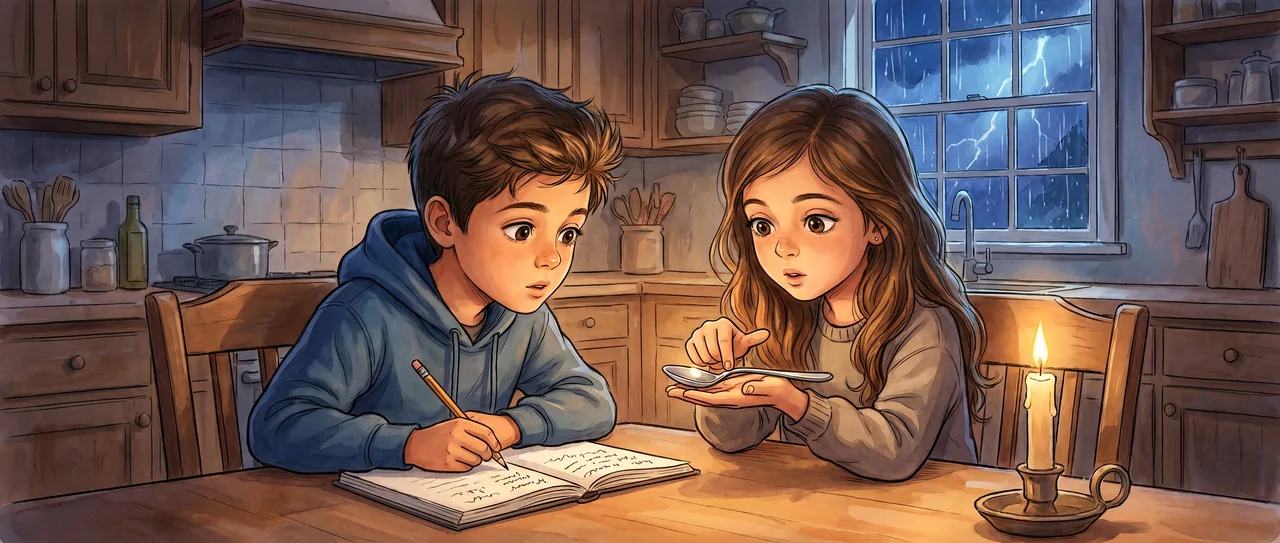
The power had been out for an hour, and Maya was holding a spoon over a candle like it was evidence.
"This is the heaviest thing in the kitchen," she said. "The cast iron pan. Soren. Feel it."
Soren lifted it. "It's heavy."
"It's the heaviest thing."
"It's the heaviest thing in the kitchen," he said. "That's a small claim."
His uncle was asleep on the couch in the next room, the podcast still murmuring out of the phone on his chest because nobody wanted to wake him to turn it off. A man's voice was talking about dead stars. Maya had been only half listening, which was how she heard the part that didn't fit.
"He said a teaspoon," she said.
"Who did."
"The phone. He said a teaspoon of a certain star weighs a billion tons." She set the cast iron pan down. "A teaspoon."
Soren stopped. He picked up the actual teaspoon from the table and turned it in the candlelight. "That's not a small claim."
"It's not a real claim. You can't have a billion tons in a spoon. The spoon would break."
"The spoon would break," Soren agreed. "Then it would go through the table."
"Then the floor."
"Then the ground." He set the spoon down very carefully, as if it might already be too heavy. "Okay. So either he's lying, or the stuff isn't like stuff."
Maya liked that. Not like stuff. She turned it over. "What makes stuff weigh anything? Like, what is weight."
"How much stuff is packed into the space," Soren said. "Density. The pan is heavy because the iron is crammed close. Bread is light because it's mostly air."
"So if you want a billion tons in a spoon," Maya said slowly, "you have to pack it."
"You'd have to pack it so hard."
"How hard."
Soren thought. He was good at the next step when there was one. "Okay. Everything's mostly empty. Right? The teacher said atoms are mostly empty space. The bit that's heavy, the middle of the atom, is tiny, and there's this huge gap, and then the electrons way out at the edge."
"How huge a gap."
"Like if the middle was a marble," he said, "the edge of the atom would be down the street."
Maya went quiet. She picked up the spoon again. "So all of this," she tapped the metal, "is mostly the gap. The street. Not the marble."
"Mostly the gap."
"So what if you took out the gap."
The candle leaned in the draft. "If you took out the gap," he said, "the marbles would all touch."
"All of them. Every marble in the spoon. Touching." Maya was holding the teaspoon flat on her palm now, looking at it like it was about to do something. "That's the billion tons. That's not new stuff. It's the same stuff with the street taken out."
"You can't take the street out," Soren said. "The electrons push. They don't want to. That's why your hand doesn't go through the table."
"So what takes it out?"
He reached for his notebook on the table and opened it, and his pencil moved while he talked. "The podcast said it was a star. A star that died. Stars are huge. The middle of a big star is squeezing the whole rest of the star down on itself, all that weight, the whole time it's alive."
"And when it dies it stops fighting back."
"It stops fighting back," Soren said, and the pencil stopped too. "So the weight wins. The whole star falls into its own middle. And it squeezes so hard the electrons get shoved into the marbles, and the street closes."
Maya looked at the spoon in her hand. "How big does the star get. After."
"You mean how small."
"How small."
Soren did the thing where he guessed and committed. "A whole sun. Crushed down to a city. Like, you could drive across it."
"A sun," Maya said. "The size of a town."
"And the podcast said the spinning part." He flipped back a page. "It spins. Hundreds of times a second."
Maya laughed, the surprised kind. "A whole sun. The size of a town. Spinning hundreds of times a second."
"Faster than the blender."
"Way faster than the blender." She put the spoon down on the table between them, and they both looked at it, this ordinary spoon, and Maya pressed one finger on it like she could feel the gap inside, the street, the long empty distance from the marble to the edge that was in everything, in the pan, in the table, in her own finger.
"It's in us too," she said. "The gap. We're mostly street."
"Mostly street," Soren said.
"So somewhere out there is a thing that's all marble. No street at all." She wasn't laughing now. "And it used to be a star, and it's the size of our town, and it's turning around hundreds of times in the time it takes to say it."
In the next room the uncle's podcast had moved on to something else, weather, a voice reading the storm track, ordinary again. Neither of them got up to listen.
Soren wrote one more line and then held the pencil still over the page. "The light coming off it," he said. "The light we'd see. It left a long time ago. The town-sized sun might already be doing something else by now."
"Or be gone."
"Or be gone, and we'd still see it spinning."
The power came back. The kitchen light snapped on, the refrigerator shuddered awake, the microwave clock blinked twelve. Maya didn't move to blow out the candle. She reached over and picked up the spoon one more time and let it sit in her open hand, light as a spoon, and turned her palm slowly under the new electric light, watching it not fall through.
Read the interactive version, listen to the narration, and earn a gold star →
A science-verified short story for curious kids · Curiosity Land