The Panel That Wouldn't Quit
The big silicon panel was the obvious choice, so Maya grabbed it.
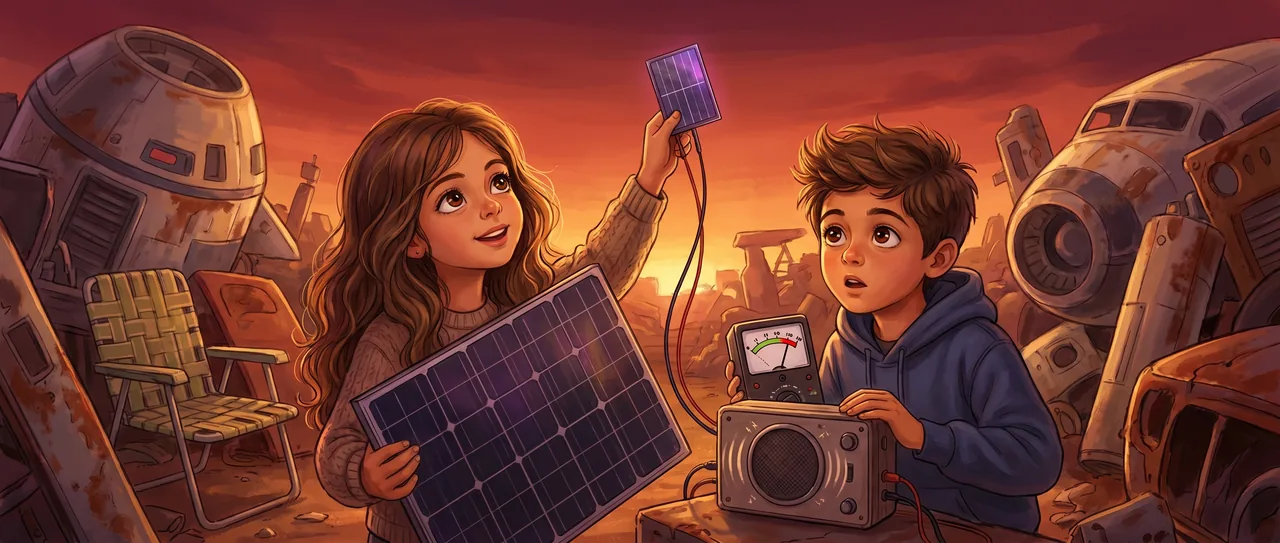
It was the size of a cafeteria tray and it had come off somebody's roof. The little one next to it was barely bigger than a playing card, dark and strange, with a faint purple shine like an oil puddle.
"That one," Maya said, pointing at the big one. "More panel, more power. We wire it to the radio and we're done."
Soren turned the little card over in his hand. "This one was in the bin marked spacecraft."
"Spacecraft bin is just where Reuben throws the expensive-looking stuff," Maya said. "Come on. Sun's already going."
Reuben owned the junkyard. He had worked on satellites for thirty years and now he mostly napped in a lawn chair and told you the wrong price on purpose to see if you were paying attention. He did not look up.
They wired the big silicon panel to the radio first. It was late afternoon and the light was going gold and low. The needle on Soren's little voltage meter twitched, climbed, and stopped.
"Point four," Soren read. "That's not enough to make a sound."
"It's a huge panel," Maya said.
"It's a huge panel that's barely working."
Maya frowned and tilted it toward the sun. The needle didn't care. She tilted it the other way. Nothing.
"Try the little one," Soren said.
"It's a tenth the size."
"I know. Try it anyway. I want to see how bad it is."
Maya unclipped the wires and clipped them to the dark purple card, mostly to prove a point. The radio coughed. Then a thin band of music slid out of the speaker, scratchy and clear.
They both went quiet.
"Read it," Maya said.
Soren looked at the meter. "Point nine. From the little one." He looked at the big one. He looked at the little one again. "That's wrong. That's the wrong way around."
"It's not wrong, the radio's playing," Maya said. She was grinning already. "Something about the little one is greedier."
"Greedier how?"
"Same sun's hitting both. Same light. The big one's throwing most of it away and the little one isn't." She held the card up to her eye, like she could catch the sun cheating. "What's it made of that the big one isn't?"
Reuben, from the lawn chair, said, "You're holding about four hundred dollars."
"For this?" Maya said. "It's the size of a cracker."
"That cracker flew," Reuben said. He didn't open his eyes. "Silicon stays on roofs. That one goes to space."
Maya and Soren looked at each other.
"Why would you send the tiny expensive one to space," Soren said slowly, "instead of the cheap one that's a hundred times bigger?"
"You wouldn't," Maya said. "Unless the cheap one wasn't actually getting you a hundred times the power. Unless out there it falls behind."
"It falls behind here too," Soren said. He tapped the meter. "Right now. In a junkyard. It's already losing."
Maya picked up both panels, one in each hand, and held them flat to the sky. The sun was sinking into the orange part of the day, where the light goes deep and red.
"Okay," she said. "Sunlight isn't one thing. It's a whole stack of colors, and some you can't even see. Reds and blues and the invisible stuff past both ends."
"Right," Soren said. "We did that with the prism in the spring."
"So if sunlight is a stack of colors," Maya said, "and the panel turns colors into power, then the question isn't how big the panel is." She lifted the silicon one higher. "It's how many of the colors it can actually catch." Big panel. Little panel. Big. Little.
"The silicon's only grabbing part of the stack," he said. "There's a whole chunk of the sunlight it just lets pass through. Reds, the warm end, the invisible heat. It's blind to most of it."
"And the little one?"
"The little one's eating more of the stack." He looked up. "It sees colors the big one can't use at all."
Maya laughed, the surprised kind. "That's why it's tiny and still wins. It's not weaker. It's awake to more of the sun."
"Gallium arsenide," Reuben said from the chair, like he was reading it off the inside of his eyelids. "That's the word for the cracker. Costs you the moon. Catches more of the light than silicon ever will. So we put it where every gram counts and there's no buying a second one." He finally opened one eye. "You don't send up the cheap panel that's mostly blind. You send up the one that's awake."
"A hundred times the price," Soren said.
"For about double the catch," Reuben said. "Down here that's a terrible deal. Up there, where you can't just bolt on more roof, double the catch is the whole game." He closed the eye again.
Maya was still holding both panels to the dying light. The red part of the sky was pouring down on them, the deep low colors, and she was thinking about all of it landing on the big silicon panel and going straight through, unfelt, wasted, while the little dark card drank the same red and turned it into a song coming out of their radio.
"Soren," she said. "The whole sky is brighter than the silicon can tell."
"More than the silicon," Soren said. "Probably more than the gallium one too. There's light past both their edges. Stuff neither of them catches."
Maya turned to him. "Stuff nothing catches yet."
Neither of them said anything for a second.
"Somebody has to build the thing that catches it," Soren said.
The radio was still playing on the little panel, thin and steady. Maya set the big silicon tray down in the dirt, where it had been losing all along, and kept the dark purple card in her hand, turned up to the last of the red sun.
The needle on the meter held at point nine and did not drop, even as the light went from gold to ember and the music kept coming out of the speaker.
Read the interactive version, listen to the narration, and earn a gold star →
A science-verified short story for curious kids · Curiosity Land