The Oldest Part of You
The box was labeled GLASSES in shaky pen, and inside it were eleven pairs, one for each decade the great-aunt had needed stronger ones.
"She kept all of them," Maya said. She held the smallest pair up to the window. The lenses were thin, almost flat. "These must be the first."
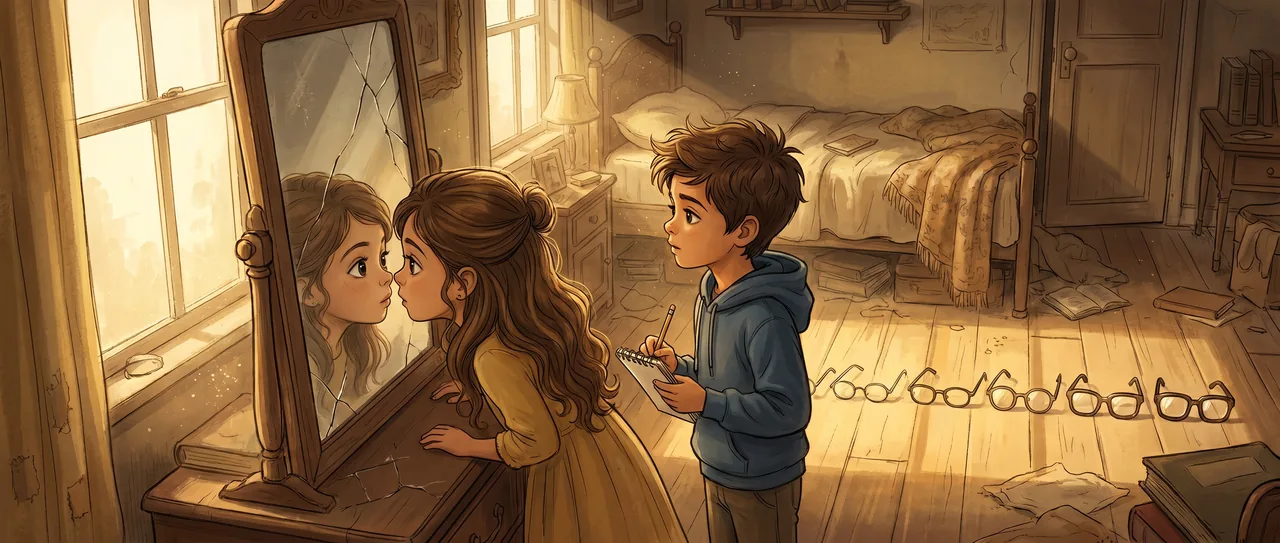
"There's a card with each pair," Soren said. He had found a stack of yellowed appointment cards, rubber-banded by year. He started laying them in a row on the floorboards. "Look. Her eyes got worse the same way every time. A little, then a little more."
"Everybody's eyes get worse."
"But why the same direction? Why don't they ever get a little better one year?"
Maya put the small glasses down and picked up the last pair, the thick ones from the end. They felt heavy. Through them the floorboards swam and bent.
"It's like the glass keeps getting added to," she said. "Like she got fuller."
Soren looked up from the cards.
"Say that again."
"I don't know. She got fuller. The lens she was looking through. Not the glasses. The one inside."
Soren took out his notebook. His pencil moved down the margin while he talked. "The lens in your eye. It focuses light. If it changes shape over your whole life, then by the end it's stiff. That's why she needed the thick ones to help. The reading kind."
"So it grows," Maya said.
"It can't grow like a plant. It's clear. If it grew it would have, I don't know, bumps. Blood. You'd see them."
Maya sat down cross-legged on the floor, holding the small first glasses in one hand and the thick last ones in the other.
"What if it grows on the outside," she said slowly. "And keeps the inside."
Soren stopped writing.
"Like a tree," he said.
"Like a tree."
They both went quiet, and the house ticked around them.
"No," Soren said. "Trees push the old part to the middle and it dies and goes hard. The rings. The oldest ring is the dead center."
"The dead center," Maya repeated. "But the eye is clear. It can't have a dead brown middle or she couldn't see."
"So it keeps the center clear," Soren said. He was writing fast now. "It adds new cells around the outside, layer on layer, and it never throws the old ones away, because there's nowhere to throw them. It's sealed. It's a closed bag."
Maya's face did something. She set both pairs of glasses down very carefully, like they might wake up.
"Soren. If it never throws the old ones away."
"Then they're all still in there."
"The first ones too."
"The first ones too."
Maya pressed her hands flat on the floor. "How first?"
Soren looked at the row of appointment cards, eleven decades long, and then past them, past the first card, to where there was no card because she hadn't been old enough to read yet, and then further, to before that.
"The very center," he said, "would be the cells that made her lens at the start. Before she could see anything. Before she was even born."
Neither of them said anything for a while.
"That's not a saying," Maya said finally. "That's not like, oh you carry your childhood with you. That's a real thing in there. Right now. In all the eyes in this house." She looked at her own hands like they belonged to a stranger. "In mine."
"In the exact middle of your lens," Soren said, "are cells that formed when you were the size of a bean. They never left. Everything you've ever seen, you saw partly through them."
Maya stood up fast and went to the cracked mirror over the great-aunt's dresser. She leaned in close until her nose nearly touched it, staring at the dark center of her own eye.
"I can't see it," she said. "It's clear. It's behind the black part."
"You can't ever see it. It's the one part of you that was there first and you'll never look at it."
Maya kept staring anyway. "It saw the inside of my mother," she said quietly. "Before there was light."
Soren came and stood next to her, and they both crowded the old mirror, two faces close together, looking into the parts of themselves they could not reach.
"Everyone walking around," Maya said. "Every grown-up. Every old person on a bench. The middle of their eyes is the oldest part of them. Older than their teeth. Older than their name."
"The great-aunt was ninety-one," Soren said. "The center of her lens was ninety-one years and nine months old. It was the first finished thing about her."
Maya turned away from the mirror and looked at the eleven pairs of glasses lined up on the floor, smallest to thickest, the whole shape of a life laid out in glass.
"She kept buying new ones because the inside one wouldn't let go of anything," she said.
"It can't," Soren said. "That's the deal. You see your whole life through cells that never get replaced. They just get more company."
Maya picked up the smallest pair again, the thin first glasses, and held them up beside her own eye in the mirror.
"So somewhere right now," she said, "in the middle of looking at you, I'm also still the bean."
Soren wrote one more line. Then he put the pencil down, because his hand had stopped wanting to write and started wanting to look.
They put the small glasses back in the box last, on top, where they could find them again.
Outside, the afternoon light came in low through the dusty window and landed on both their faces, and it went through the new cells, and the cells from last year, and the cells from when they were five, and all the way down through every layer to the first ones, the ones from before, and landed at last on the back of each eye, where it became the room, and the box, and each other.
Read the interactive version, listen to the narration, and earn a gold star →
A science-verified short story for curious kids · Curiosity Land