The Number That Wouldn't Land
The bus smelled like chlorine and wet towels, and there were still two hours to go.
Maya had counted the seats, counted the headrests, counted the times the driver tapped the brake on the long hill. Her swim cap had left a red ring around her forehead. The girl next to her was asleep against the window.
So Maya made up a rule.
Pick a number. If it is even, cut it in half. If it is odd, triple it and add one. Then do it again. She liked rules that told you exactly what to do next, with no arguing.
She started with six. Six is even, so three. Three is odd, so ten. Ten is even, so five. Five is odd, so sixteen. Sixteen, eight, four, two, one.
One.
She drew a little breath. The number had been bouncing around, up and down, and then it just dropped down the stairs and landed.
She tried seven, because seven felt stubborn.
Seven went up to twenty-two. Then eleven, then thirty-four, then seventeen, then fifty-two. It climbed. She had to write it on the back of her heat sheet with a golf pencil from the meet. Fifty-two, twenty-six, thirteen, forty, twenty, ten, five, sixteen, eight, four, two, one.
One again.
She sat with that. Seven had gone all the way up past fifty before it came back down. It had looked, for a while, like it was getting away.
Maya started a list in her head of numbers she had tried. Then she stopped trusting her head and used the pencil.
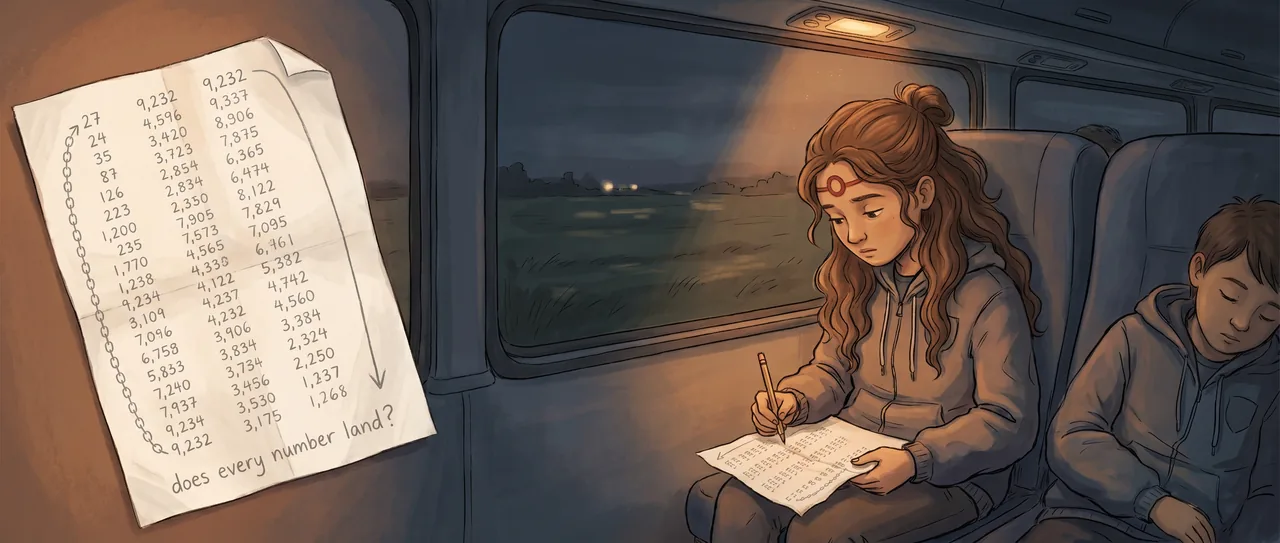
Twelve fell fast. Fifteen made a mess, climbing up to a hundred and sixty before it gave up. Twenty-seven was a monster. Twenty-seven went up and up, past a hundred, past two hundred, past three hundred. She filled the whole margin and turned the page. The girl beside her woke up, looked at the columns of numbers, and went back to sleep.
Twenty-seven climbed to nine thousand two hundred and thirty-two before it turned around.
And then it came down. All the way down. To one.
Maya put the pencil down and looked out the window at the dark fields going by.
Every number she tried landed on one. The ones that shot up high still came down. The ones that fell fast still ended in the same place. Sixteen, eight, four, two, one. Always that same little staircase at the bottom.
That was the part that started to bother her.
Because she could not see why. With the halving, sure, even numbers fall. But the odd rule made numbers bigger. Triple and add one. That should send things flying. Some numbers did fly, for a while. Twenty-seven flew for ages. And it still came home.
She tried to imagine a number that wouldn't. A number that climbed and climbed and never turned around. Or a number that fell into a loop somewhere else, some other little staircase that went round and round and never reached one.
She couldn't build one. Every time she chased a number, it landed.
But not being able to build one was not the same as knowing one couldn't exist. She knew the difference. She had checked maybe twenty numbers. There were more numbers than she could ever check. More than the bus could drive past. More than seats in every bus that had ever been built.
Somewhere out past all the numbers she had tried, there were numbers no one had ever fed into the rule. Numbers with forty digits. Numbers with a thousand digits. And the rule said the same thing to all of them. Even, halve. Odd, triple and add one.
Maya wrote at the bottom of the page: does every number land?
She stared at it. It looked like a small question. It looked like the kind of question that should have an answer in the back of a book.
When the bus stopped at a gas station, the coach walked down the aisle counting heads. He was a tired man who taught math at the high school and drove the bus on weekends. He saw her pages.
"What's all this," he said.
Maya showed him the rule. She showed him twenty-seven going up to nine thousand and coming back.
He smiled the way adults smile when they recognize something. "That's an old one," he said. "That's the Collatz problem. Hailstone numbers, some people call them. Because they go up and down like hail in a cloud before they fall."
"So what's the answer," Maya said. "Does every number land on one?"
The coach was quiet for a second. "Nobody knows," he said.
Maya looked at him.
"People have checked," he said. "With computers. Every number up past anything you could write down on this bus. Way past. Trillions and trillions. Every single one falls to one." He scratched his neck. "But checking isn't proving. Nobody has ever shown it has to happen. For all of them. Forever. There might be one out there that doesn't. We just haven't found it."
"You teach math," Maya said.
"I do."
"And nobody knows this."
"Some of the smartest people who ever lived have tried," the coach said. "One of them said this problem might be too hard for humans right now. He meant it as a compliment, I think." He tapped her page. "You found it on a bus with a golf pencil."
He went back to counting heads.
Maya looked at her two pages of falling numbers. She had thought she was at the bottom of something. A rule that simple, you should be able to see all the way to the floor of it.
But there was no floor. The rule was four words long and a child could follow it, and it ran out past every number anyone had ever checked, into the dark where nobody had been, and nobody could promise what it did out there. The rule knew something it would not tell. It had been keeping the secret since before she was born, and it would keep it after the bus got home, sitting in plain sight inside numbers everybody already had.
The bus pulled back onto the highway. Maya turned to a clean page and picked a number she was sure no one else had tried tonight.
She started halving.
Read the interactive version, listen to the narration, and earn a gold star →
A science-verified short story for curious kids · Curiosity Land