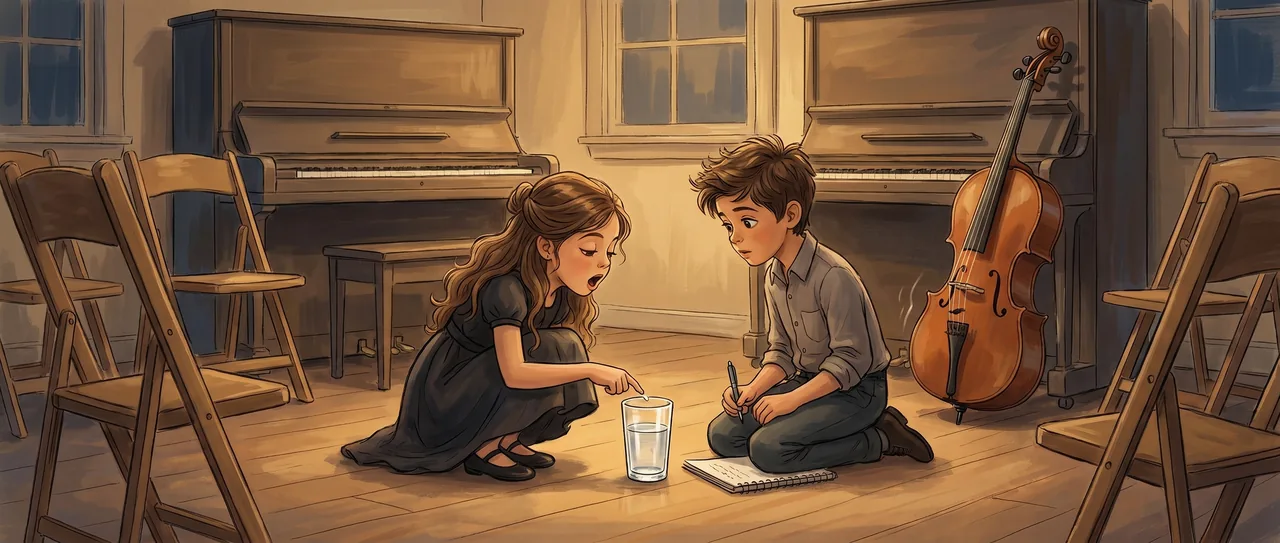
The Note That Wasn't There
The concert was over and everyone had gone home except the two of them, because Maya's mom was conducting the cleanup and Soren's dad had the keys.
The music room was full of folding chairs and one cello somebody had left leaning against the piano, still humming faintly every time a door slammed in the hall.
"Did you hear that?" Maya said.
"Hear what?"
"The cello. It made a sound. Nobody touched it."
Soren walked over and looked at it the way he looked at things that were behaving wrong. "Strings don't play themselves."
"This one did." Maya plucked the lowest string, let it ring, then stopped it with her palm. "Slam the door again."
Soren slammed it. The cello was silent.
"Hm," said Maya.
They stood there. Soren took out his notebook and wrote the time at the top of a clean page.
"Okay," he said. "The first time, the door slam made it sing. The second time, nothing. What changed?"
"I touched it in between."
"So the door isn't doing it directly." He tapped the pen against his teeth. "Play the low string again. Don't stop it this time."
Maya plucked it. The note hung in the air, deep and slow. Soren leaned close to the body of the cello, not touching, just listening.
"Sing the same note," he said.
"I can't, it's too low."
"Try."
Maya hummed, sliding her voice down until it matched the string. The moment the two pitches lined up, she felt something change in her chest, a kind of fullness, and Soren grabbed her arm.
"Stop humming."
She stopped. The string was still going. Faintly, but going. Singing on its own, exactly the note she had hummed.
Maya stared at it. "I gave it my voice."
"You gave it the right voice." Soren wrote fast now. "The door slam has every sound in it all mashed together. So somewhere inside that mess is the cello's note. The string ignores everything except its own note and pulls that one out."
"Like the string is listening for itself."
"Like it can only hear itself." He looked up. "That's why the second door slam did nothing. Your hand was still damping it the moment before. The energy had nowhere to collect."
Maya was already across the room, hunting through the recycling bin. She came back with an empty water glass.
"Wine glass trick," she said. "You've seen the videos. Somebody sings and the glass shatters."
"That's the same thing."
"That is exactly the same thing." She flicked the rim with her fingernail. It went ting, a high clear note. "It has one note it loves. You feed it that note, over and over, and the glass takes the push every single time at the exact moment it's already moving."
"Like pushing somebody on a swing," said Soren. "If you push at the wrong time you slow them down. If you push every time they swing back, they go higher and higher with hardly any effort."
"And the glass swings until it can't anymore." Maya set the glass down very carefully, as if it might decide to break out of principle.
Soren had stopped writing. He was looking at the wall, where there was a poster of the human heart left over from health class.
"My grandmother had a scan last month," he said. "The big tube. The machine that bangs. She said it was the loudest thing she'd ever been inside, like standing next to a jackhammer for half an hour."
"An MRI."
"They didn't cut her open. They didn't even touch her. But they got a picture of the inside of her knee." He frowned. "I never understood how. A camera can't see through a person."
Maya picked up the cello again. She didn't play it. She just held it, thinking.
"What if it's the same trick," she said slowly. "What if you're full of strings."
Soren turned.
"Not real strings," Maya said. "But the little pieces of you. The water in you. Billions of tiny things, and every one of them has a note. Its own note, the one it can only hear."
"And the machine sings it." Soren's pen was moving again without him looking at the page. "The banging is the machine pushing at exactly the right frequency. Pushing the swing. And the little pieces start swinging together."
"And then the machine stops."
"And listens." He looked up at her. "Like you listened to the cello. The pieces keep singing for a moment after, the way the string kept going after you stopped humming. And the machine hears where the singing came from."
Maya felt the fullness in her chest again, even though she wasn't humming now.
"That's how they see inside her," she said. "They don't look. They listen for the note coming back."
"From every part of her at once," Soren said. "Knee, and heart, and brain. Every piece told the machine where it was by singing back."
They were quiet. The cello hummed faintly, settling.
"It's all one thing," Maya said. "The door and the glass and the bridge that fell down because the soldiers marched in step, and your grandmother's knee. It's the same thing."
"Resonance," said Soren. He wrote the word and then sat looking at it. "The soldiers gave the bridge its note. By accident. Step, step, step, push the swing, push the swing, until the bridge swung itself apart."
"And the machine does it on purpose, so gentle it doesn't hurt anybody, and it makes a picture instead of breaking a bridge."
"Same push." Soren shook his head slowly. "Same exact push. You can knock a building down with it or you can find a crack in somebody's bone, and it's the same push."
Maya put the cello down. She walked over to the wine glass and crouched until her eyes were level with the rim.
"Everything has a note," she said. "The glass. The bridge. You. Me. There's a sound that's only mine, and if you sang it I'd hum back without meaning to."
"You wouldn't be able to stop yourself," Soren said.
Maya flicked the rim of the glass one more time. The note rose, thin and pure, and she opened her mouth and found it with her voice, and held the two sounds together until the glass began, very slightly, to ring back at her on its own.
Read the interactive version, listen to the narration, and earn a gold star →
A science-verified short story for curious kids · Curiosity Land