The Loop That Was Lying
Soren was supposed to be making a paper chain. Forty loops, his aunt had said, enough to drape over the porch rail for Tomas, who was turning four and liked anything shiny.
He had cut the strips already. Long ones, because he wanted the chain to look generous. He taped the ends of the first strip together and reached for the second.
The first loop sat wrong on the table.
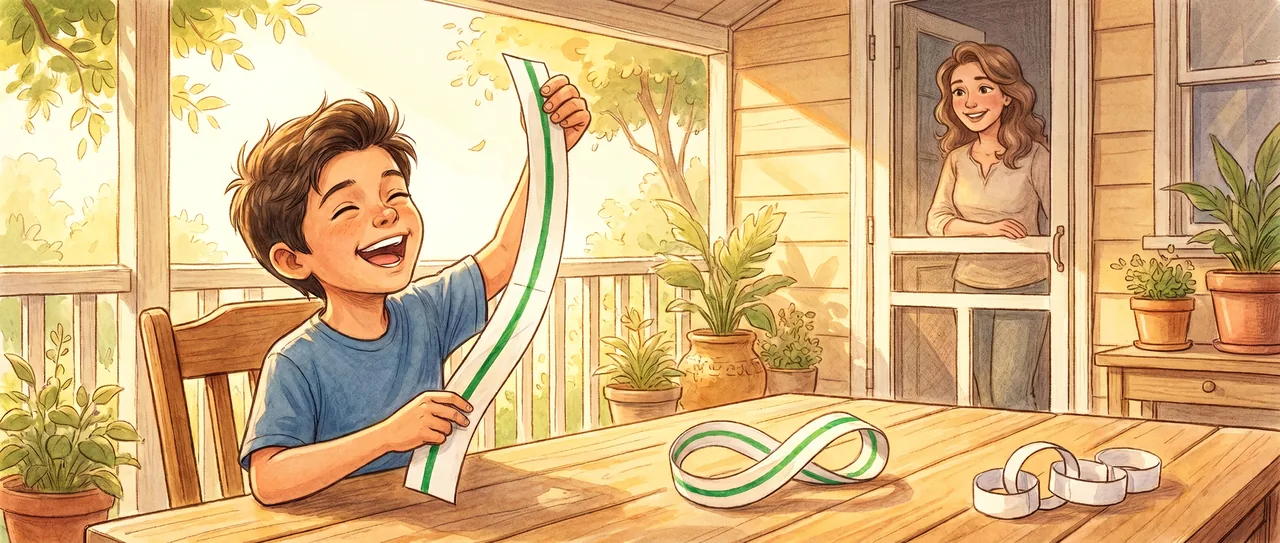
He could not have said how. A loop is a loop. But this one lay flat instead of standing up like a hoop, and the paper twisted somewhere along its length so that the loop seemed to be ducking under itself. He had taped the ends together with a half turn in the strip without noticing.
He almost untaped it. Then he didn't.
There was a green marker on the table from labeling the gift. Soren uncapped it and set the tip in the middle of the loop, halfway between the two edges of the paper. He wanted to draw a line all the way around so he could see where the twist confused things.
He started pulling the loop along under the marker.
The line went around the outside. Fine. Then the paper curved and the line was on the inside, where he had not put it. He frowned and kept going, expecting to come up short, expecting the marker to reach the spot where he would have to lift it and cross to the other face to finish the job.
The lift never came.
The green line ran on and on. Outside, inside, outside again. His hand kept moving. He was waiting the whole time for the moment where the marker would arrive at an edge, where one side ended and the other began, and he would have to pick the tip up off the paper.
The tip of the marker arrived back at the green dot where he had started.
Soren held the loop still. He had not lifted the marker. Not once. He turned the loop slowly in his hands, looking for the place where the line skipped from one face to the other.
There was no place. The line was continuous. It ran along what should have been the front of the paper and what should have been the back of the paper, and it had done both without ever crossing the edge, because there was no front and no back to cross between.
He set the loop down and put a finger on it and started tracing, not the marker line this time, but the edge. The cut edge of the paper, the part that should have been the rim of the hoop. He followed it with his fingertip.
The edge climbed. It went around, and it sloped, and it came back, and it was still going. He waited for it to close into a circle the way an edge is supposed to. His finger kept traveling. It went around again, twice the distance he expected, and then it stopped under his finger at the start.
One edge. The whole loop had one edge. His finger had walked the entire rim of the thing in a single trip, and the trip had been twice as long as it had any right to be.
He sat very still for a moment. Then he picked up scissors.
A loop, if you cut it down the middle, falls into two thinner loops. He knew that the way he knew his own address. He put the scissor blade into the green line and cut along it, following his own marker all the way around, and he braced for the moment when the paper would drop into two separate rings.
It did not drop into two rings.
It opened into one ring. One single loop, twice as long, twice as twisted, hanging off his hand and turning slowly in the porch air. He had cut the thing straight down its middle and it had refused to become two things. It had stayed one thing.
Soren laughed out loud, alone on the porch, which he almost never did.
He made another. Half a turn, tape, marker line, cut. One ring again. He made a third and cut it a third of the way in from the edge instead of down the middle, and this time it came apart into two loops, but they were linked, hooked through each other like a tiny chain he had not put together.
He lined them up on the table. The flat loop that hid its own twist. The doubled ring. The two loops holding hands that he had never joined.
His aunt leaned out the screen door. "Forty loops?"
"Not yet," Soren said.
"What are you doing?"
He looked at the strip of paper waiting on the table, plain and rectangular, with two faces and two edges, ordinary, before he touched it. Half a turn was all it took. Half a turn and the two faces became one face and the two edges became one edge and the paper started telling a different kind of truth than the truth it told lying flat.
"The paper has two sides," he said. "Until it doesn't."
His aunt waited for more. He did not have more yet. She let the screen door fall shut.
Soren reached for his notebook and drew the loop, and beside it he wrote the word inside, and then he drew an arrow from inside to outside because on this loop they were the same word.
He taped one end of a fresh strip. He held the other end and looked at the small gap between his two hands where the half turn would go or wouldn't, where the paper would decide to have one side or two depending entirely on what he did in the next second.
He gave it the half turn and pressed the ends together.
Read the interactive version, listen to the narration, and earn a gold star →
A science-verified short story for curious kids · Curiosity Land