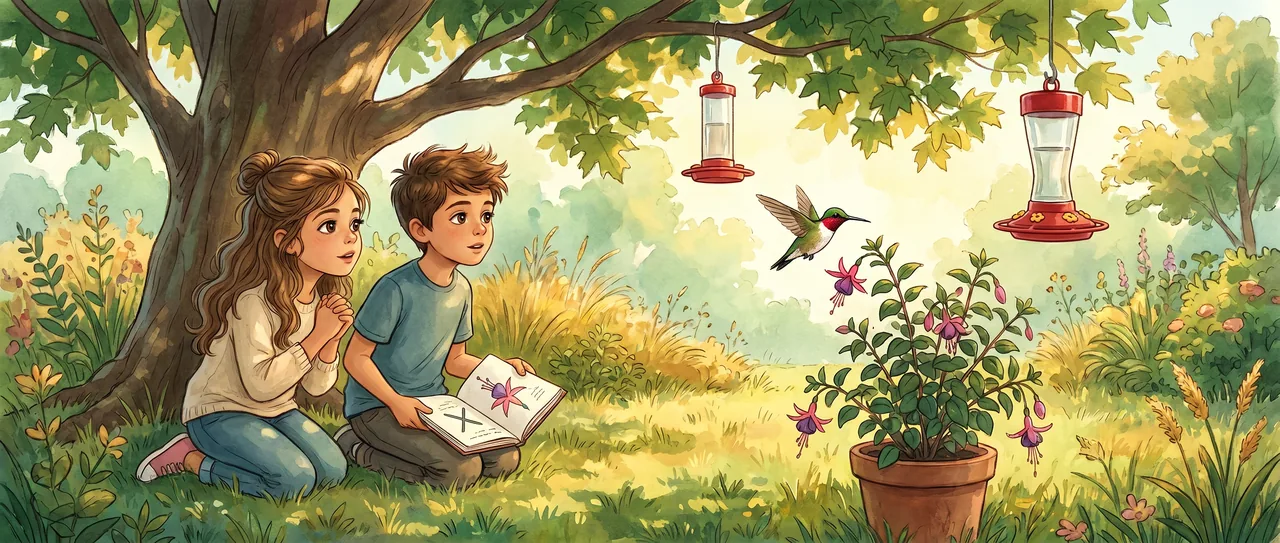
The Dimmer Switch
Soren's grandmother kept two feeders. One she filled with the ordinary nectar mix. The other she had been making sweeter and sweeter all summer, a little experiment she said she could not explain yet.
"The hummingbirds fight over the sweet one," Maya said. She was crouched under the maple, watching. "Watch. They won't even land on the normal one anymore."
"They used to," Soren said. He had Grandma Iris's notebook open on his knee. "Look. June fourth. Both feeders, equal traffic. Then she keeps bumping the sugar up. By July the normal feeder is basically empty all day."
"So sweeter is better. Birds like sweet."
"That's what I thought too." He turned a page. "But she wrote something weird at the bottom. Quote. They are not happier. They are hungrier."
Maya stopped watching the birds and looked at him.
"Say that again."
"They are not happier. They are hungrier." Soren tapped the page. "And there's a little drawing. A flower. With an X through it."
A hummingbird buzzed the sweet feeder, drank, zipped off, came back nine seconds later. Then again. It would not leave.
"That one," Maya said. "It's not eating. It's checking. Over and over."
"Maybe it's just thirsty."
"No." She shook her head, slow. "Thirsty stops when you drink. That bird drank. It didn't stop."
Soren wrote the time in the margin. The same bird hit the feeder four times in under a minute.
"Okay," he said. "Try this. What if the sweet feeder is doing something to it. Not just feeding it. Changing it."
"Changing it how. It's nectar."
"I don't know yet." He flipped further. "Wait. Grandma did a thing. August second. She moved a real flower, a fuchsia, full of regular nectar, right next to the sweet feeder. To see if they'd take the flower."
"And?"
"They ignored the flower." He looked up. "Maya, these are hummingbirds. A flower is the whole reason they exist. And they flew past it to hit the feeder again."
Maya sat down in the grass. "So the flower stopped being good enough," she said.
"The flower didn't change. The flower is exactly as sweet as it was in June."
"So the bird changed." She said it carefully, like setting a cup on a high shelf. "The bird's idea of good enough went up. The sweet feeder kept being sweeter, and the bird's, like, line for what counts as a treat moved up to match it. And the flower fell under the line."
Soren stopped writing.
"Say that one more time. The line moved up."
"The line for pleasure," Maya said. "It's not a wall. It's a dimmer switch. The feeder kept turning the brightness up, so now the room looks dark even though the flower is the same flower."
They both looked at the fuchsia. A perfect, untouched, ordinary flower.
"That's a real thing," Soren said quietly. "I think that's a real thing that happens in brains. My uncle's a nurse. He talks about it. There's a chemical, dopamine, that's basically the brain saying yes, that, do that again. And if something blasts way too much yes, way too often, the brain pulls back. It actually removes some of the catchers that listen for the yes."
"Removes them."
"Turns some off. Fewer catchers. So now ordinary good things, a flower, a hug, a normal song, they don't get heard as loud anymore. They fall under the line. And the only thing big enough to still ring the bell is the thing that broke the bell."
Maya was very still. Then she said, "That's the scariest sentence I've ever heard."
"Why?"
"Because it means a person isn't being weak. The flower really is dimmer to them. They're not pretending. Their actual room got darker."
The checking bird came back a fifth time. Drank. Left. Returned.
"Grandma knew," Soren said. "That's why she wrote hungrier, not happier. The bird isn't getting more joy. It's chasing the same joy that keeps moving away from it."
"Can it come back?" Maya asked. "The catchers. Can the dimmer switch go back down?"
Soren paged to the end of the notebook. The last entry was three days old.
"She stopped sweetening it," he read. "August nineteenth. Sweet feeder back to normal mix. Day one, fights at the empty-tasting feeder. Day two, fights. Day three." He stopped.
"Day three what."
"Day three. One bird visited the fuchsia." He looked up, and something in his face had opened. "She circled it. Twice."
Maya scrambled to her knees and looked at the real flower, the ordinary one, the one that had been losing all summer.
"So it's slow," she said. "The room doesn't get bright again in a day. The catchers come back slow. But they come back."
"That's what one circled flower means," Soren said. "The line is coming back down. Slowly. The flower is starting to count again."
They didn't move for a while. The sweet feeder, the normal feeder, the small loud birds deciding with their whole bodies what was worth flying to.
"My cousin," Maya said suddenly. "Everyone says he just needs to want to stop. Like it's a switch he won't flip." She watched the fuchsia. "But it's not his switch. It's the dimmer. And the dimmer is stuck up high and it has to crawl back down on its own time, while everything good looks dark to him."
"He's not lazy," Soren said. "His room got dark."
"And it can get bright again." She said it like she was holding it carefully, the way you hold something that might be true. "Just slow. One circled flower at a time."
Soren wrote one line in the margin and turned the page back to his grandmother's drawing, the flower with the X through it, and set his pencil down beside it.
The checking bird came in fast and hard toward the sweet feeder. Halfway there it swerved. It hovered over the fuchsia, the ordinary one, the same one all summer.
It landed on the flower.
Read the interactive version, listen to the narration, and earn a gold star →
A science-verified short story for curious kids · Curiosity Land