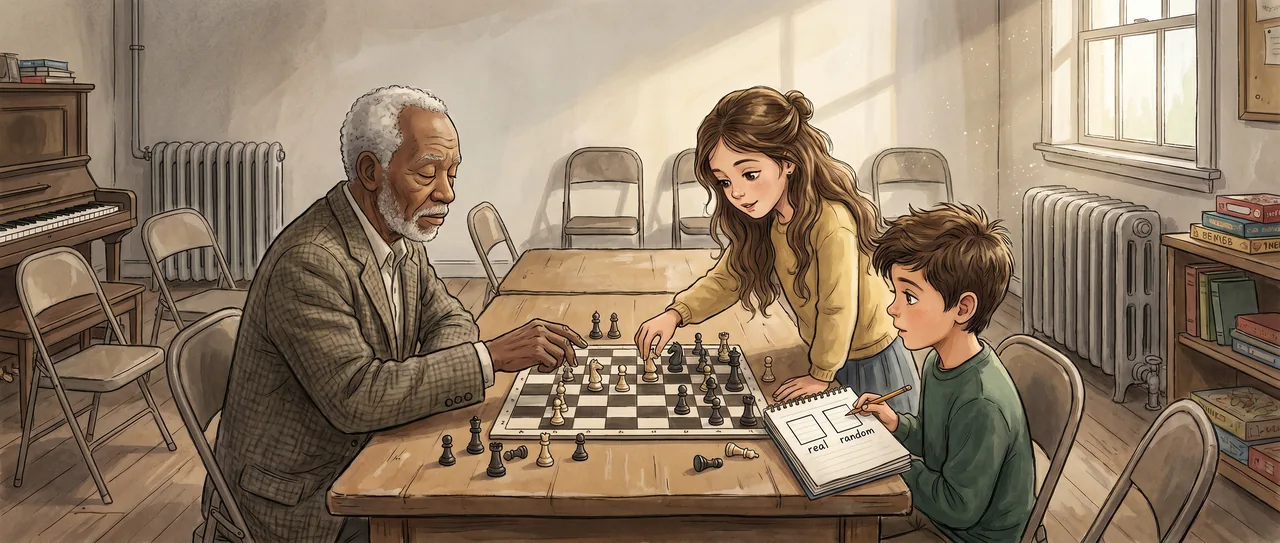
The Boy Who Saw Too Many Pieces
The tournament was over and the room smelled like cold coffee and folding chairs. Maya was stacking the captured pieces into their boxes. Soren was matching kings to their right colors.
At the far table, the old man had not left. His name was Mr. Adeyemi, and he ran the Tuesday club. There was a board in front of him with pieces scattered across it, mid-game, abandoned by whoever had lost.
"Look at this for five seconds," he said, not turning around. "Then I'll put it away and you tell me where everything was."
"Which one of us," Maya asked.
"Both. Race."
They looked. Five seconds. A white queen near the middle. A knot of pawns. Kings tucked in corners. Then he swept his hand over the board and the pieces vanished into his palm.
Maya got four pieces right. Soren got six. Mr. Adeyemi laughed at both of them.
"Set it up again," Soren said. "I want to try once more."
He did. This time Soren stared harder, like he was photographing it. Five pawns here, a bishop there, the queen on a dark square. He tried to hold each one in place separately. When the board was swept clean he got five. One worse than before.
"You looked harder and did worse," Maya said.
"I know. That's annoying."
Mr. Adeyemi set up a third board. But this one was different. The pieces were in a real position, the kind that happens halfway through a careful game, everything defending something.
"Now," he said. "Five seconds."
This time the old man closed his own eyes while they looked. Then he opened them and rebuilt the entire board from memory, every piece, without a single mistake. Twenty-some pieces. Perfect.
Maya narrowed her eyes. "Do that again. But put them somewhere stupid."
"Stupid?"
"Random. Put them where no real game would ever put them."
He shrugged and scattered pieces across the board with no logic, queens crammed against pawns, knights in corners that meant nothing. He looked for five seconds. Then he rebuilt it.
He got nine. Out of twenty-some.
The same old man. The same five seconds. The same eyes.
"Wait," Soren said, and reached for his notebook. He drew two squares. Over one he wrote a real game. Over the other he wrote random. "On the real one you remembered all of them. On the random one you remembered the same amount as us."
"Less than you, on a bad day," Mr. Adeyemi said.
Maya was already somewhere ahead. "It's not the pieces. You're not even seeing the pieces."
"Of course I see them."
"No." She picked up a knight and a pair of pawns and set them in a little defensive cluster. "When it's a real game, this isn't three things to you. It's one thing. A shape you already know."
Soren looked up from the notebook. "That's why looking harder made me worse. I was trying to hold twenty things. He's holding five."
"Five chunks," Maya said. "Each chunk is four or five pieces that go together."
Mr. Adeyemi stopped smiling, which on him was the same as paying attention.
"And the random board breaks it," Soren said, talking fast now. "Because the shapes aren't there. There's nothing to clump. So your brain has to count individual pieces, same as ours, and twenty is too many for anybody."
"Set up the random one once more," Maya said. "I want to test the other direction."
Mr. Adeyemi scattered the pieces again, randomly. But Maya stepped in before he could look.
"Now I move three of them." She slid a knight, two pawns, and a bishop until, by accident on purpose, they formed a little pattern she recognized from her own beginner games, a pawn chain with a knight behind it. "There. I made one corner make sense."
He looked. Five seconds. Eyes closed. Rebuilt.
He got the made-sense corner perfectly, all four pieces. The rest of the board he barely managed.
Nobody said anything for a second. The radiator ticked.
"So forty years of chess," Soren said slowly, "didn't give you a better memory. It gave you a different eye. You don't see what we see and then think faster. You see something else entirely."
"There is a word your science people use," Mr. Adeyemi said. "Chunking. A grandmaster does not see thirty-two pieces. He sees maybe six ideas. The board talks to him in sentences. To a beginner it is letters."
Maya wasn't listening to the word. She was looking at the room.
"It's not just chess," she said.
Soren followed her eyes. The piano in the corner. The bird feeder out the window where a man on the bench was naming sparrows without a guidebook. The whole stack of folding chairs.
"A musician hears a chord," Soren said. "We hear three notes. Same air hitting the same ears. Different thing arriving."
"So everyone who's really good at anything," Maya said "is walking around seeing a different world than us. A bird person doesn't see a brown bird. They see a song sparrow doing something a little weird today."
"You can't just look at what they see," Soren said. "You'd have to grow the eye first. Years of it."
"But you can grow it." Maya turned back to the board. "That's the part. He wasn't born with the sentence-eye. He made it. One game at a time. Until the shapes just showed up on their own."
Mr. Adeyemi pushed the box of pieces across the table to them.
"You want to see what I see," he said. "Then you have to play badly for about ten years first."
Maya took the box. She set up a board, a real one, pieces where real pieces go.
Then she looked at it for five seconds, the way you'd look at a sentence in a language you were just starting to learn, and slid a single pawn forward.
Read the interactive version, listen to the narration, and earn a gold star →
A science-verified short story for curious kids · Curiosity Land