Fifteen Ways to Disappear
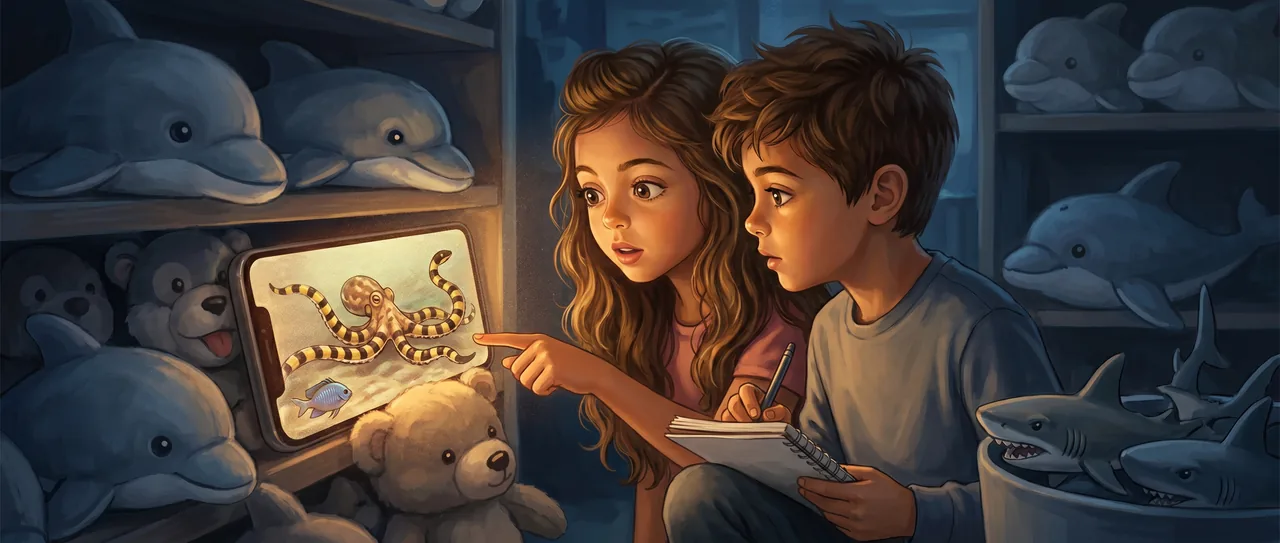
The gift shop smelled like cold air and plush toys. Maya had the phone propped against a shelf of stuffed dolphins, and the video was grainy, shot by some diver in shallow brown water off Indonesia.
"Watch this part again," Maya said. "Go back ten seconds."
Soren dragged the bar with his thumb. On screen, something flat and striped rippled across the sand like a leaf caught in current.
"That's a flounder," he said. "It swims like a flounder. Both eyes up, body flat, that little wobble."
"Keep watching."
The flat thing reached a hole in the sand. Then it wasn't flat anymore. Two arms shot straight out in opposite directions and went rigid, banded yellow and black, weaving slow.
"That's a sea snake," Soren said. He stopped the video. He started it again. "That is a sea snake. The exact one. The venomous one with the bands."
"Same animal," Maya said. "It's the same animal, Soren."
He didn't argue with her. He just frowned at the screen the way he frowned when something refused to behave. "Play it from the start."
They played it from the start four times. Each time the animal did something different. It spread itself thin and trailed venomous-looking arms above it like a lionfish hanging in the water. It tucked its arms and pulsed along the bottom soft and round, almost a jellyfish. It pressed flat again and became the leaf, the flounder, the nothing.
"Okay." Soren put the phone down. "Most animals that copy something copy one thing. A fly that looks like a wasp. A snake that looks like a worse snake. You pick your disguise before you're born and you wear it your whole life."
"This one's changing its mind," Maya said.
"It can't change its mind. It's an octopus."
"It's changing something."
The marine educator was shelving keychains nearby, a woman with a lanyard and the careful patience of someone who had answered the same question two hundred times. She glanced over.
"Mimic octopus," she said. "Lovely, isn't it. Camouflage is one of the great tricks of the reef."
"It's not camouflage," Maya said, before she could stop herself.
The woman smiled. "Same idea. Hiding from things that want to eat you."
"No." Maya tapped the dark screen. "Camouflage is hiding. This isn't hiding. A flounder isn't hiding. A sea snake isn't hiding. You can see them. It wants to be seen. It just wants to be seen as something else."
The educator paused, keychains in hand. "That's a fair point," she said, and went back to her shelf, and the conversation went with the children, because she had a cart to empty.
Soren had picked the phone back up. "Run it again. I want to see what makes it choose."
"Choose what?"
"It does flounder, then snake, then lionfish. There has to be an order. Or a reason." He leaned close. "Watch the edge of the frame, not the octopus."
Maya watched the edge of the frame.
There. Just before the octopus became the sea snake, a thin shape crossed the corner of the picture. A small fish, aggressive, darting.
"A damselfish," Soren said slowly. "They get eaten by sea snakes. Right before it does the snake, a damselfish shows up."
Maya went very quiet. Then she grabbed the phone out of his hand.
"Do it again. The lionfish part."
They found the lionfish part. They watched the edges. Something larger had drifted in from the left, something with the broad blunt head of a predator, and the octopus had stretched itself into the one shape on the reef that says do not touch me, I am full of venom.
"It's looking at who's coming," Maya said. "It's not picking a disguise. It's picking a disguise for that specific thing. The snake is for whatever's scared of snakes. The lionfish is for whatever's scared of lionfish."
"Fifteen," Soren said. "The article said at least fifteen species. Fifteen different costumes." He had his notebook open now, the pen moving. "And it knows which one is the right answer for each predator. It's reading the thing that wants to eat it and answering, you don't want to eat me, you want to run from me."
Maya sat down on the floor of the gift shop, between the plush dolphins and a bin of rubber sharks. "It has to know fifteen animals well enough to be them. Which means it knows them well enough to know what's afraid of them."
"It's carrying a map," Soren said. "Of who eats who. The whole reef. Who's dangerous to who." He stopped writing. "In its arms."
They both looked at the dark phone.
"Everybody told me the octopus was hiding," Maya said. "It's the opposite. It's the only thing out here that's paying attention to everyone at once. It can't afford to just be one thing. The reef's too complicated. So it learned to be the answer to whoever shows up."
Soren turned to a fresh page. "There's an animal," he said, "that survives by being more curious about its enemies than its enemies are about it."
Maya didn't say anything for a second. She was looking at the rubber sharks, all the same gray, all identical in their bin.
"It would be exhausting," she said quietly. "Being fifteen things. Reading the room every second." Then she half smiled. "Worth it, though. Look what you get to be."
The educator wheeled her empty cart past them toward the back. "You two finding everything okay?"
"Yeah," Maya said.
Soren tilted the phone up and pressed play one more time. On the small bright screen the octopus pressed itself flat to the sand, two eyes up, wobbling like a leaf, and a shadow it had already named slid across the corner of the frame.
Read the interactive version, listen to the narration, and earn a gold star →
A science-verified short story for curious kids · Curiosity Land