The Year the Ground Counted
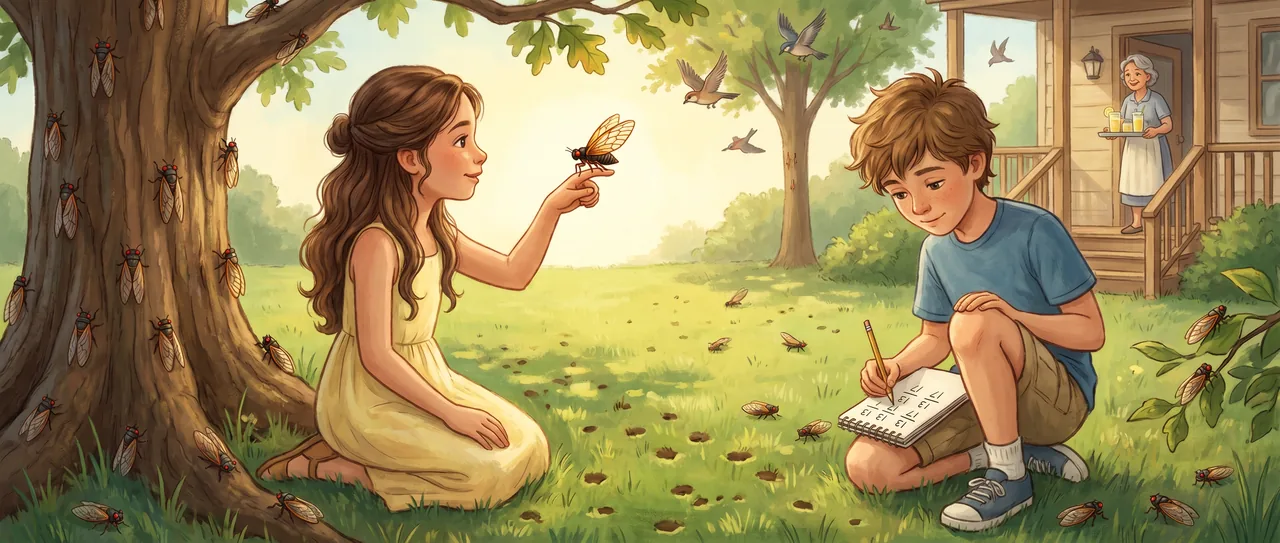
The whole yard was screaming, and Maya loved it.
"They're everywhere," she said. She was holding one in her cupped hands, watching it dry its wings. "Soren. There are holes everywhere. Look at the ground."
Soren was already looking at the ground. The dirt under Grandma Rey's oak was punched full of little round openings, each one exactly the width of a thumb, like the lawn had been breathing through a thousand straws.
"Grandma says the last time was when Mom was in high school," Soren said.
"How long ago is that?"
"Seventeen years."
Maya set her cicada on the bark and watched it climb. "Seventeen," she said. "That's a weird number."
"It's a number."
"It's a weird number. It doesn't go into anything. You can't split it. Seventeen is just seventeen."
Grandma Rey called from the porch that there was lemonade if they wanted to come in and stop letting bugs walk on them. They did not want to come in.
Soren crouched by one of the holes and put his ear close, like the dirt might say something. "Why would they wait seventeen years," he said. "That's the part I can't do. If you're a bug and you live under there, why not come up every year? Why not every two?"
"Because of the birds," Maya said. She said it fast, before she knew why she'd said it. Then she stopped, because she'd surprised herself.
"What about the birds?"
"I don't know yet. Give me a second." She turned in a slow circle. The screaming was so loud it had a texture, like standing inside a sound instead of next to one. Birds were diving through it, fat and happy, grabbing cicadas out of the air and off the trees. "There's a million of them," she said. "The birds can't eat all of them. There's too many."
"So they come all at once on purpose," Soren said. "Okay. That part I get. Safety in numbers. But that doesn't need seventeen. That works with any year."
He was right, and Maya hated when the easy answer ran out of road. She sat down in the grass. A cicada landed on her knee and she let it.
"Say you're a bird," she said slowly.
"I'm a bird."
"And your favorite food is cicadas. The best year of your whole life is a cicada year. So you have lots of babies that year, because there's so much food."
"Sure."
"So the next year there's tons of birds. All hungry." Maya stopped. Her hands had gone out in front of her like she was holding the idea in the air. "But there's no cicadas the next year. So the extra birds are stuck. They don't have the big food."
Soren stood up. "Do it again. Say there's a kind of bird that booms every two years. Lots of them, then few, then lots again. Every even year is a bird year."
"Then the cicadas should not come on even years," Maya said. "Ever. Because the birds would be waiting."
"What if the bird booms every three years."
"Then don't come on threes."
Soren had his notebook out. His pencil moved down the page. "Twelve," he said. "What lines up with twelve?"
"Two does. And three. And four. And six."
"So if you came up every twelve years, a two-year bird would be waiting, and a three-year bird, and a four-year bird, and a six-year bird. Twelve's a trap. Everybody can find you on twelve." He wrote the numbers in a little row and drew lines down from them. "What about seventeen."
Maya leaned over the page. The yard kept screaming.
"Two doesn't go in," she said. "Three doesn't go in. Four, no. Five, no." She was running her finger down his list and her finger started to go faster. "Nothing goes in. Soren. Nothing goes into seventeen except one and seventeen."
"So a two-year bird," Soren said.
"Has to wait until both its booms and the cicadas land on the same year. Which only happens every two times seventeen. Thirty-four years."
"A three-year bird waits fifty-one."
"A bird that booms every five years waits eighty-five." Maya's voice had gone quiet under the noise. "No bird lives that long. No bird remembers. By the time the cicadas come back, all those extra birds starved a long time ago."
Soren looked at his row of numbers. Then he looked at the holes in the ground, all those thumb-width holes, more than they could count.
"The number is the defense," he said. "Not the bug. The number."
Maya picked up the cicada that had been sitting on her knee. It was a clumsy, harmless thing, red eyes, wings like wet stained glass, no fangs, no poison, no speed. It could not fight anything. It could barely fly straight.
"It can't protect itself at all," she said. "It's the softest animal in the whole yard." She held it up so its eyes caught the light. "It protects itself with seventeen."
They were both quiet for a second. "How does it know," Soren said finally. "That's the part. It's underground. It can't see a calendar. How does it count to seventeen and come up the exact right summer with all the others."
"I don't know," Maya said.
"Nobody fully knows," said Grandma Rey from the porch. She'd come down off the steps with two glasses, and she was looking at the ground like she'd never quite stopped being surprised by it either. "Scientists have ideas. Something about the tree roots, the seasons changing the sap. They argue about it. But how the counting works, all the way down, the very last piece, that one's still open." She handed them the lemonade. "Your mom and I stood right here and wondered the same thing. Seventeen years ago."
Maya did the math without trying. The next time the ground did this, she would be twenty-eight.
She looked down at the holes. Under the grass, under her sneakers, right now, in the dark, there was already a new batch of them. Eggs about to become things that would crawl down into the dirt and begin, somehow, to count. They would still be counting when she was in high school. When she could drive. When she came back here, grown, and stood on this exact patch of lawn.
She pressed her ear to one of the holes, the way Soren had, and listened to the dirt that was busy keeping perfect time.
Read the interactive version, listen to the narration, and earn a gold star →
A science-verified short story for curious kids · Curiosity Land