The Tape That Wouldn't Reach
The metal tape measure had a survey marker stamped into the dock at one end, a little brass disk worn smooth.
"Read it again," Maya said.
Soren held the tape against the second piling. "Twelve point oh three meters."
"That's not what your uncle's chart says."
"My uncle's chart says twelve point oh one. From four years ago." Soren let the tape snap back into its case. "Two centimeters. We probably hooked it wrong."
Maya lay flat on the warm boards and looked sideways down the length of the dock, the way you check if a shelf is straight. "We didn't hook it wrong twice."
They had measured it twice. Both times the brass disk and the far piling were two centimeters farther apart than the old chart wanted them to be.
"Things don't just get longer," Soren said.
"The dock didn't get longer. The ground did." Maya sat up. "Where's the part of your uncle's chart with the picture of the bottom."
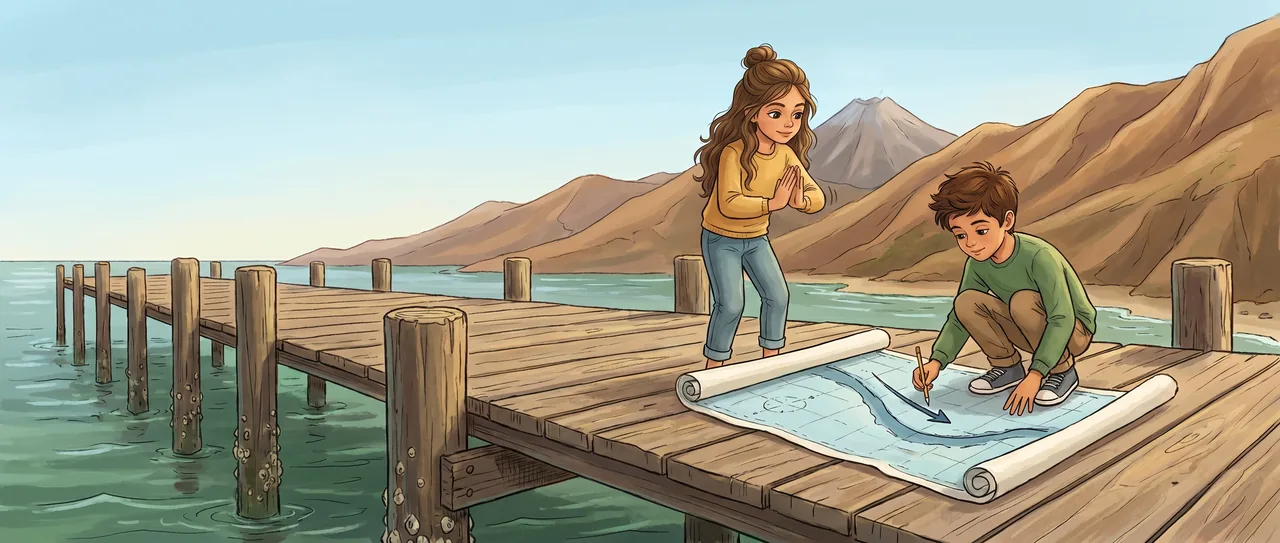
Soren unrolled it on the planks and weighted the corners with their shoes. It was a nautical chart, depth numbers scattered across the blue like freckles. Out past the harbor mouth the numbers got bigger fast. Forty. Two hundred. Then a line of numbers in the thousands, marching in a long curved trench that ran parallel to the coast.
"That's deep," Maya said. "That's stupidly deep. Right there, close to shore."
"It's a trench." Soren put his finger on the curve of huge numbers. "My uncle calls it the deep. He won't drop pots near it. He says the bottom drops out."
"Why is the deepest part next to the land and not in the middle of the ocean?"
Soren opened his mouth and found he had no answer ready. He liked that better than having one. He pulled the notebook out of his back pocket and copied the curve of numbers, the trench close to shore, the mountains marked on the land behind it.
"Look," he said, and his pencil went still over the page. "The mountains run the same shape as the trench. Same curve. Trench in the water, mountains on the land, both bending the same way."
Maya leaned over. "And the volcano. The one we can see on a clear day." She tapped the land side of the chart. "It's in the row of mountains."
"So a deep trench and a line of volcanoes, lined up, running together down the whole coast." Soren said it slowly, like he was checking each word for weight. "That can't be a coincidence."
"Things that line up aren't coincidences," Maya said. "They're the same thing seen twice."
A gull landed on the far piling. Maya watched it without really watching it.
"Okay," she said. "What if the ocean floor is moving toward the land."
"Floors don't move."
"Our floor moved two centimeters in four years." She held up the tape case. "Slow. But it moved."
Soren wrote two centimeters and four years and looked at them. "If the sea floor is sliding toward the coast, and it hits the land, where does it go? It can't pile up forever. There'd be a wall."
"There isn't a wall. There's a trench. The opposite of a wall." Maya stood up and walked to the edge of the dock and looked down at the green water, thinking with her whole body, rocking a little on her feet. "What if it goes under."
"Under the land."
"The heavy ocean floor slides down under the lighter land. That's your trench. That's the deepest part being right next to the shore. It's the place where the floor bends down and dives." She turned around. "It's not piling up. It's going back in."
Soren stared at the curve of huge numbers. He drew an arrow on the trench, pointing down and inward, the ocean floor sliding beneath the coast. "Then the volcanoes," he said. "If the floor goes down deep enough, it gets hot. Hot enough to melt. And melted rock comes back up."
"Behind the trench."
"In a line. A line of volcanoes, set back from the coast, exactly matching the trench." He looked at his own drawing and felt the cold go up his arms. "That's why they line up. The trench and the volcanoes are the same machine. Front door and chimney."
Maya wasn't smiling exactly. She had the look she got when something true was bigger than she'd planned for. "So the whole ocean floor is being eaten," she said. "Slowly. Right here. Going down under our feet and melting and coming back up as a mountain."
"It's recycling the bottom of the sea," Soren said. "The bottom of the whole ocean is being pulled back into the inside of the planet and made into something new."
They were both quiet. The tide was the kind of quiet that is actually full of small noises, water against pilings, the tape case ticking as the metal cooled.
"The two centimeters," Maya said. "It didn't move smoothly. It can't have."
"Why not?"
"Because the floor is dragging the land with it. Sticking. Pulling." She pressed her two hands together flat and pushed, and her top hand juddered forward in little jumps instead of sliding. "It catches. It bends. It holds." Her hands stuck, strained, then jerked. "And then it lets go all at once."
Soren did not write anything. He was looking at his own two hands now, holding them the way she held hers, pressing, feeling the want to slip.
"That's an earthquake," he said quietly. "The let-go."
"All the bending we measured. Two centimeters. The land's holding it." Maya looked down through the green water toward a bottom she couldn't see, toward the trench out past the harbor mouth where the numbers fell off the edge of the chart. "It's holding it right now."
Soren laid his palms flat against the warm boards of the dock and felt nothing move at all. .
Read the interactive version, listen to the narration, and earn a gold star →
A science-verified short story for curious kids · Curiosity Land