The Smell of Spring on Mars
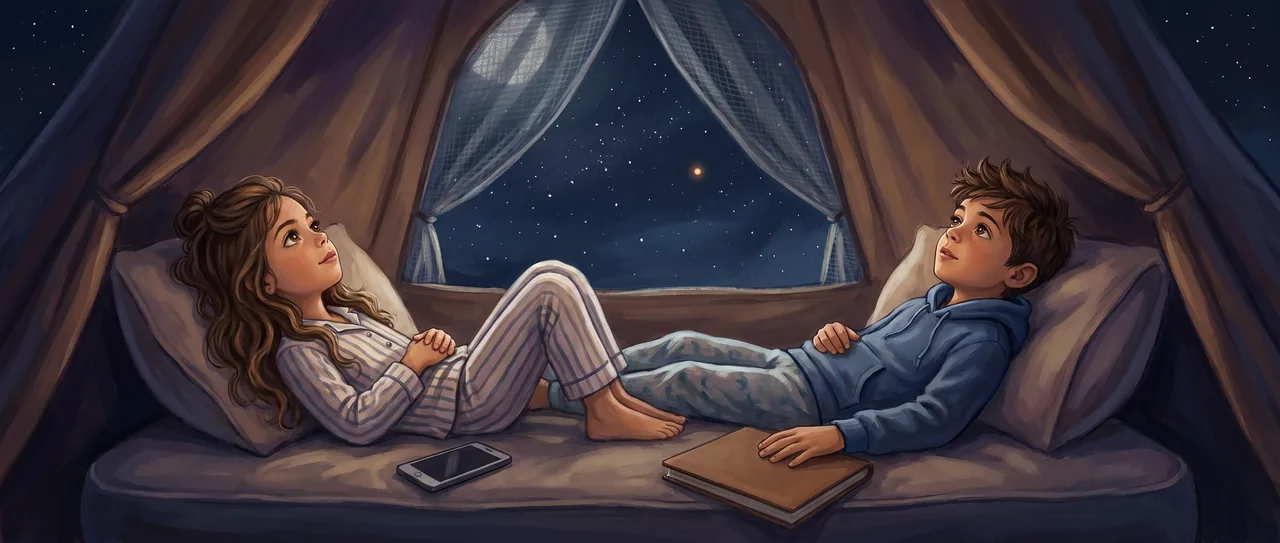
The barbecue smell was still in the tent, woven into the sleeping bags, when Maya put the phone down on the air mattress and said, "That's wrong."
"What's wrong," said Soren. He had been almost asleep.
"This article. It says the methane on Mars goes up in summer and down in winter. Every year. Then it says nobody knows why."
"So nobody knows why. That happens."
"No." Maya sat up. The phone lit her face from below. "It goes up in summer. Things go up in summer here. Grass. Bugs. The smell of the lake. Summer is when stuff wakes up."
Soren found his notebook in the dark by feel and pulled it onto his knees. "Read me the actual numbers."
"It's tiny. Like, a few parts in a billion. The Curiosity rover sniffs it right above the ground in Gale Crater. Low in the cold season. Higher when it warms up."
"A few parts in a billion of what?"
"Methane. The barbecue gas. The cow-burp gas." She tapped the screen. "That's the part I can't get past. Read this part. On Earth almost all the methane, like ninety-something percent, is made by living things. Bacteria. Swamps. Stomachs."
Soren wrote ninety-something percent and then living things and then drew a line under both.
"Okay," he said. "But almost isn't all. There's a not-living way to make it. Hot rocks and water. Some chemistry deep down."
"Serpent-something."
"Serpentinization. Water seeps into certain rocks and out comes methane, no life needed." He kept writing. "So Mars could be doing that."
"Then why does it care what season it is?" Maya said. "Rocks underground don't know it's summer up top. The deep ground stays the same all year. You taught me that. The cave thing."
"Caves stay one temperature year round. Yeah." Soren stopped writing. "So if it's coming from deep down, the amount shouldn't swing with the seasons."
"And it swings."
"And it swings," he agreed, slowly.
They sat with that. Outside, a moth kept hitting the side of the tent, soft and stupid and patient.
"Okay, I'll fight you," said Soren, because that was how they did it. "Maybe the seasons don't make the methane. Maybe they just let it out. In summer the ground warms up, cracks open a little, ice in the soil melts, and old methane that was already trapped down there gets released. The cold season seals it back in."
Maya was quiet for a second. "That's good," she said. "That's actually good. The summer doesn't make it. The summer is a door."
"Right."
"But you still have to make it somewhere. Sometime. The methane had to come from something before it got trapped." She pulled her knees up. "And the article says there's another problem. Sunlight should be wrecking it."
"Wrecking it how?"
"Up in the Mars air, the sun breaks methane apart. It says any methane should be gone in a few hundred years. So whatever they're smelling, it's not ancient leftover. Something put it there recently. Like, geologically recently."
Soren wrote a few hundred years and then must be refilled and put the pen down because his hand had gone cold.
"Say that again," he said.
"Something has to keep making it. New. Now. Or there wouldn't be any left to smell."
The moth hit the tent. Hit it again.
"On Earth," Soren said carefully, "if you found a planet, and the air had methane in it, and the methane kept coming back, and it changed with the seasons like something breathing, what would you say did it?"
Maya didn't answer right away. That was rare for her.
"I'd say something's alive," she said. "On Earth I'd just say that. I wouldn't even think about it."
"So why don't we say it about Mars."
"Because we're not sure." She picked the phone back up, scrolled, read out loud now, slow. "It says it could be life. Tiny bacteria under the ground, the kind that make methane in the dark with no sun, the kind we have here in deep rock and under the sea floor. It says it could also be the rock chemistry. It says both are possible. It says nobody has been able to prove which one."
"So they don't know."
"They don't know." Maya put the phone face down so the tent went dark again. "That's the whole thing, Soren. That's why I couldn't sleep. It's not that there's no answer. It's that there's two answers and one of them is just rocks and the other one is that there is something alive on another planet right now, breathing out a little gas every Mars summer, and the smartest people we have looked at the exact same numbers we just looked at and could not tell which."
Neither of them said anything.
"They sent a whole new rover for this," Maya said. "To sniff it more. To catch it in the act."
"And?"
"And one orbiter went looking for the methane from up high and could barely find any. And the rover on the ground keeps finding it. So now they can't even agree it's there." She laughed, but not because it was funny. "Two robots on the same planet. Different answers."
Soren lay back. Through the mesh window at the top of the tent there were stars, and one of them, low and steady and faintly orange, was not a star.
"That's it," Maya said, following his eyes. "That's actually Mars. That orange one."
"I know," said Soren.
They both looked at it. The barbecue smell was still in the tent. Somewhere on the orange dot, if Maya was right, it was getting to be summer, and the ground was warming, and a door was opening, and something underneath was letting out a breath that nobody on two planets could yet explain.
Soren reached for the notebook, then stopped, and left his hand flat on the closed cover, and kept watching the orange one not twinkle.
Read the interactive version, listen to the narration, and earn a gold star →
A science-verified short story for curious kids · Curiosity Land