The Same Sentence
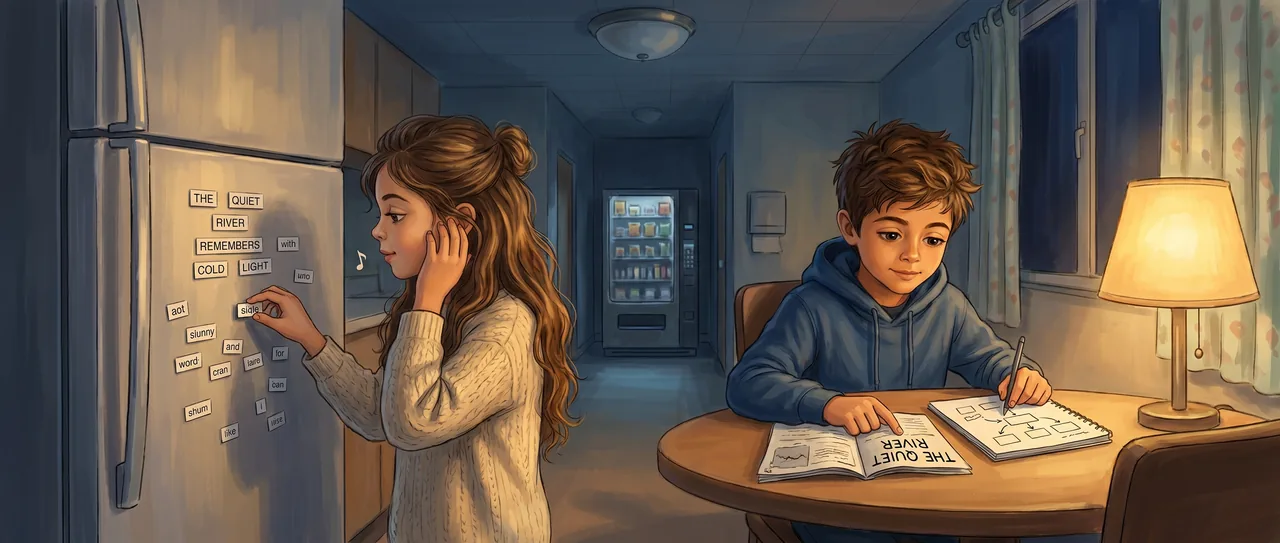
The family room had a fridge with nothing in it but ice trays and a box of magnetic poetry words somebody had donated years ago. Maya had already built three sentences. Soren was reading a battered zine called WHAT YOUR CELLS ARE DOING RIGHT NOW that the nurse left on the table.
"Listen to this," Soren said. "It says humans have about twenty thousand genes. But our bodies make way more than twenty thousand proteins. Hundreds of thousands."
"So the math is wrong," Maya said.
"The math is not wrong. That's the part that's weird."
Maya stopped pushing magnets around. "One gene. More than one protein."
"That's what it's saying. It calls it alternative splicing."
"Read it slower."
Soren read it slower. "A gene is like a sentence. But before the cell uses it, it cuts out some pieces and stitches the rest back together. And it doesn't always cut the same pieces."
Maya looked at her magnetic sentence on the fridge. THE QUIET RIVER REMEMBERS COLD LIGHT.
"Okay," she said. "Watch."
She slid two words out of the middle. THE RIVER COLD LIGHT. Then she put those back and pulled different ones. THE QUIET REMEMBERS LIGHT.
"Same words on the fridge," she said. "Different sentence depending on what you take out."
Soren leaned forward. "Do it again. Don't tell me which ones."
She rearranged. THE QUIET RIVER COLD.
"That one barely makes sense," he said.
"Right. So some of the splices are junk. But some of them are whole new meanings. From the exact same line." She pushed the words back into the full sentence. "My aunt has the same gene in her skin cells and her brain cells. Same one. But her skin isn't her brain."
"Because the splicing is different in different places," Soren said. He had the zine open flat now, one finger holding the page. "It says the gene for a single protein in your ear, in the part that hears, gets spliced into a whole row of slightly different versions. And each version is tuned to a different pitch."
Maya turned around fully. "Say that part again."
"One gene. Spliced a bunch of different ways. And the different versions sit in different spots in your ear, and each one is tuned to hear a different note." He looked up. "That's how you hear a piano. Not different genes for different notes. The same gene, cut into a scale."
Neither of them said anything for a second. Down the hall a monitor beeped in its steady patient way.
"So when I hum," Maya said slowly, "and I go up"and she hummed low, then high"that's me running across, what, a row of the same protein, sliced thinner and thinner?"
"Spliced different, not sliced thinner. But yeah." Soren actually laughed, quiet. "You're playing a keyboard made of one sentence read a dozen ways."
Maya hummed the low note again and pressed her fingers near her own ear like she could feel the scale sitting in there. "That's the most ridiculous thing I've ever heard."
"It's in here twice. They double-checked it."
She came over and sat down and pulled the zine halfway toward herself so they were both holding it. "Okay but think about this. You and me. We have the gene that does this. Right now."
"Everybody does."
"No, listen." She tapped the page. "My aunt is asleep down the hall and her cells are sitting there with twenty thousand sentences, and every single cell is reading them differently. Her liver is reading a sentence one way. Her bones are reading the same sentence another way. Nobody told them which way. They just" She stopped.
"They just know where to cut," Soren said.
"How do they know where to cut?"
Soren went still and read ahead, his finger moving. Then he looked up and there was something careful in his face. "It doesn't say."
"What do you mean it doesn't say."
"I mean it explains what splicing does. It says the cell uses little machines to find the cut points. But how the same machine cuts one way in your ear and a different way three inches over in your jaw" He turned the page. Turned it back. "It doesn't say. I don't think they fully know."
Maya looked at the fridge, at her sentence sitting there with all its words in place.
"So somebody could figure that out," she said. "Like, that's a thing nobody has finished knowing."
"Apparently."
She got up. She slid one word out of THE QUIET RIVER REMEMBERS COLD LIGHT, then put it back, then slid out a different one, watching the sentence become a new sentence and then itself again.
"Soren. There are people whose whole job is figuring out why a cell cuts here and not there."
"There are."
"And if you understood the rule" she pulled out two words and the line went strange and then she pushed them back "you could tell a cell which sentence to read. You could fix one that's reading it wrong."
Soren reached into his jacket and got out the notebook and uncapped the pen. He drew a single line of boxes across the page, then drew arrows leaving from different boxes, each arrow ending in a different small shape.
"One line," he said, drawing. "And look how many places it can go."
Maya wasn't looking at the notebook. She was at the fridge with both hands in the magnets, building the same words into one sentence, then another, then another, faster, the little plastic tiles clicking as she went.
"Try to hum a note that isn't in your ear," she said.
"What?"
"You can't. There's no slice for it. The notes you can hear are only the slices you have." She turned around. "So somewhere there's an animal with different splices than us. Hearing notes we don't have a sentence for."
Down the hall, the monitor kept its small steady beep, and Maya tipped her head toward it, listening, working out which slice of her was catching it.
Read the interactive version, listen to the narration, and earn a gold star →
A science-verified short story for curious kids · Curiosity Land