The Map That Grows
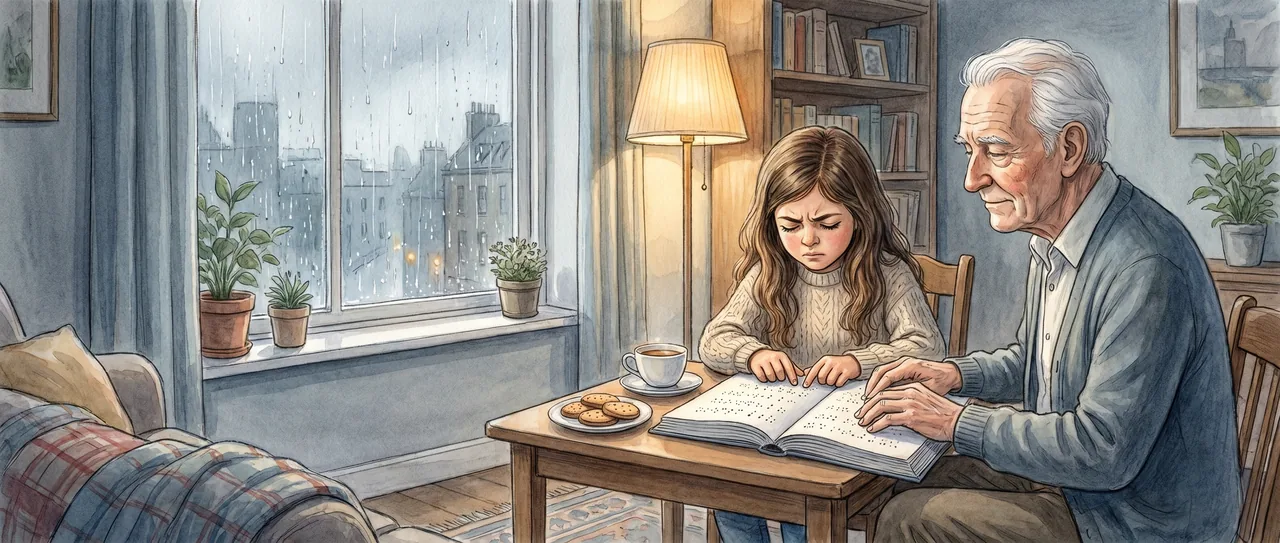
Rain came down the window in long crooked rivers. Maya watched them race and lose.
Great-Uncle Per sat across the little table with his fingers moving over a sheet of thick paper. The paper was covered in raised bumps, rows and rows of them, and his fingertips went along the rows the way her own eyes went along a sentence. Quick. Not hunting. Reading.
He had been blind for three years. He had been a London taxi driver for forty.
"You read faster than my mum," Maya said.
"With my eyes I read slower than your mum," Per said. "Now I read with these." He held up two fingers and wiggled them. "They learned a new job."
Maya leaned closer. The bumps under his fingers looked like nothing. Sand thrown on a page. But his fingers found edges in them, corners, little gates of meaning, and his voice followed along reading her a story about a lighthouse.
She touched the page herself. It felt like rough paper with crumbs on it. That was all.
"How do you feel the difference," she asked, "between that one and that one?"
Per smiled at the wall, because he did not aim his face at people anymore. "I asked the doctor the same thing. She said something happened inside my head. The part that used to look at things, the seeing part at the back, it went quiet when my eyes stopped working. So it took up touching instead. And hearing. It got rented out."
Maya stopped. The rain blurred.
"The looking part of your brain," she said slowly, "is feeling the bumps."
"That is what she told me. I do not feel it happening. I only feel that the world got louder and my fingers got cleverer."
Maya put her own two fingers back on the page and closed her eyes, because that seemed fair. Now there was only the texture. She made herself stay there. The crumbs began to come apart into a one and a one and then a little family of them clustered together, and then she lost it, and it was sand again.
"It moved," she whispered.
"What moved."
"Nothing moved. I started feeling more of it. Just from trying."
Per laughed, a big surprised bark. "Forty years I drove that city," he said. "You know what they did, the science people? They put cabbies in a machine and photographed our brains. And there is a piece in there, in the middle, shaped like a little seahorse, that holds maps. Where things are. How to get from the river to the hospital. Mine had grown. Bigger than a person who does not drive. All those streets had pushed it out like a muscle."
"Streets made part of your brain bigger."
"Twenty-five thousand streets. We had to learn them all before they would let us drive. Years of it, on a little scooter with a map clipped to the front, riding every road until it was inside me. And inside me it built something. I could feel it building, I think. I would dream the streets. I would lie down and the map would lay itself out behind my eyes."
The rain ran down. Maya was very still. "So your brain is a different shape than other people's," she said. "Because of what you did."
"Everybody's is," Per said. "Yours too. Right now. Sitting there feeling my book."
Maya looked down at her own hand on the bumpy page. Her own ordinary hand. And she thought about how it had been useless on the paper one minute ago and now it was finding ones, little clusters, gates.
"Wait," she said. "Wait. Do it again." She pulled a fresh page across, one she had not touched. She shut her eyes and laid her fingers down.
Sand. Crumbs. Nothing.
Then, slowly, the way a photograph comes up in a tray, less nothing. A bump. A bump beside it. A gap. Her finger could tell the gap now. The gap had not been there before, except it had been there the whole time, and the thing that had changed was her.
"It's already starting," she breathed. "Already. In a few minutes."
"Fast at your age," said Per. "Your head is hungry. It rents things out the moment you knock."
Maya kept her eyes shut and kept her fingers moving and felt the page get clearer, not because the page changed, the page was dead paper, but because somewhere behind her own forehead, in the dark, something she would never see and never feel directly was quietly reaching toward her fingertips and taking up the work. The seeing part of her, maybe. The part watching the rain a minute ago. Learning a new job because she had asked it to.
"Per," she said. "If I did this every day. For years. Like your streets."
"Then it would build something," he said simply. "It does not know how to refuse. It only knows how to grow toward what you keep doing."
Maya thought about everything she kept doing. The lists she kept in her head. The questions she would not put down. The way she turned things over and over until they came apart into ones and gaps and gates. All of it, all this time, building something behind her eyes she had never once thanked it for, a shape no one else had, growing toward whatever she could not stop wondering about.
She opened her eyes. The rivers on the window had found new paths down the glass.
Per had gone back to his lighthouse story, fingers gliding, the seeing part of him reading in the dark. Maya pulled her chair in close and put both hands flat on a page of her own.
She shut her eyes and started knocking.
Under her fingertips the sand began, very faintly, to separate into words.
Read the interactive version, listen to the narration, and earn a gold star →
A science-verified short story for curious kids · Curiosity Land