The Cells That Eat Themselves to Stay Alive
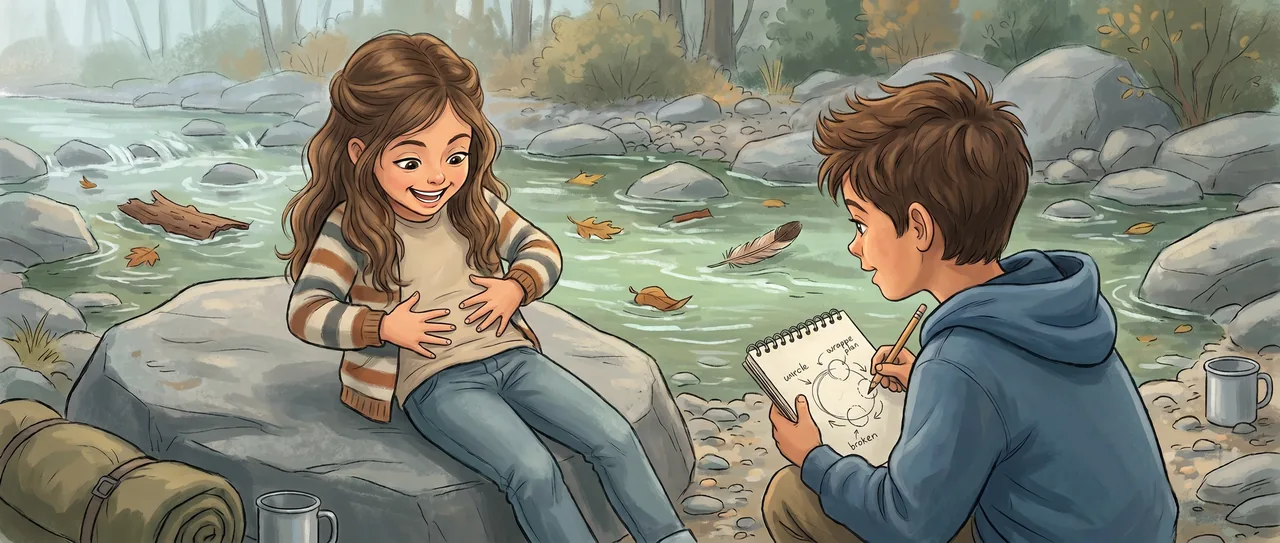
The cooler had tipped in the night and floated everything soggy, so breakfast was a sad bag of nothing while Maya's uncle drove back to the store. Maya sat on a flat rock by the creek with her stomach making opinions.
"I'm so hungry my cells are eating themselves," she said.
Soren was poking a stick into the water. "That's actually true."
"What is?"
"Your cells. Right now. They're eating themselves." He didn't look up. "I read it. When you stop getting food, the cells start breaking down their own broken parts and recycling them. There's a name. Auto-something."
Maya turned to look at him. "My cells are eating their own parts because I skipped breakfast."
"Their old parts. The worn-out ones. Bent proteins, broken little engines." Soren pulled the stick out and watched it drip. "They wrap garbage up in a bag and dissolve it and use the pieces again."
"That's disgusting. Keep talking."
"There was a guy who watched it happen. In yeast. He starved the yeast and looked under a microscope and saw little bags forming inside the cells, full of stuff being taken apart." Soren frowned at the water. "He got a Nobel Prize for it. For watching cells clean house."
Maya was already up off the rock. "Wait. So being hungry is when it turns on."
"Mostly. Hunger. Exercise. When the food stops, the cleanup starts."
"So when there's plenty, the cleanup is slow."
"I guess. Why does that matter to you. You look like it matters."
"Because that's backwards," Maya said. "That's completely backwards from what you'd guess."
Soren put the stick down. "Say it."
"You'd guess that food is when good things happen. Food in, body builds, body fixes itself. Right? You feed a thing and it gets better." She was walking a small circle on the rocks. "But this is the opposite. The fixing happens when the food stops."
"The fixing happens when you're empty," Soren said slowly.
"The fixing happens when you're empty." Maya stopped circling. "Why would a body work like that? Why would you build a thing that only cleans itself when it's starving?"
Soren picked up a smooth stone and turned it over, which is what he did when he was building an answer. "Think about a long time ago. Before stores. Before my uncle driving to get bagels."
"Before any of it."
"Right. So food wasn't always there. There were stretches with nothing. Days, maybe." He turned the stone. "If you were empty, you couldn't go get new materials. So what do you do."
"You use what you already have." Maya's eyes went wide. "Oh. You eat your own broken parts because there's nothing else to eat, and that means the leftover good pieces get used to keep the important stuff running."
"The empty time isn't the body waiting," Soren said. "The empty time is the body working."
They looked at each other.
"Soren." Maya's voice dropped. "Every animal that ever went hungry. For millions of years. Every single one that survived a long winter or a bad hunt."
"Was cleaning house the whole time."
"They had to be. The ones who could recycle their own junk when the food ran out, those are the ones who didn't die." She sat back down on the rock, hard. "So we're descended from the cells that got good at being empty."
Soren took out his notebook and wrote, the pencil moving fast, the page filling with a shaky diagram of a cell wrapping a bag around its own broken pieces.
"Read me the part again," Maya said. "The bag part."
"It makes a little bubble around the trash. A membrane. Then it pulls the bubble to the part of the cell that's full of dissolving stuff, and the bag gets emptied out, and the pieces float back into the cell to be reused." Soren looked up. "It's happening in both of us right now. While we're talking. Because the cooler flooded."
Maya pressed her hand flat against her own stomach, not because it hurt, but to feel the place where it was true.
"And when it goes wrong," Soren said, quieter, reading from somewhere in his memory, "the article said that's part of it. Old brains. When the cleanup stops working, the garbage builds up. The bent proteins pile up and don't get cleared and that's tangled up with the diseases where people forget things."
"So the cleanup is the thing protecting us," Maya said. "The whole time. Quietly. We never feel it."
"We never feel it," Soren agreed. "We just feel hungry and think nothing good is happening."
Maya looked at the creek. The water was carrying leaves and bits of bark and a feather, taking the broken parts of the forest downstream and somewhere turning them into soil, into the next thing.
"Soren. The same trick is inside everything. The creek's doing it. The forest does it with dead leaves. And our cells figured out how to do it inside themselves, with their own bodies, so small you need the best microscope in the world to even see the little bags."
"And the guy who saw the bags," Soren said, "spent years just watching yeast be hungry. Everyone else thought the garbage part of the cell was boring. He thought the garbage part was the secret."
Maya laughed, the kind that comes out when something is too big to hold politely.
"He looked at the part nobody looks at," she said. "The taking-apart. The empty part."
"Yeah."
"That's the part with the Nobel Prize in it."
Up the dirt road came the sound of the truck returning, tires on gravel, a bag of food on the seat. Maya didn't get up.
"Don't tell my uncle to hurry," she said.
Soren raised an eyebrow.
"Five more minutes of this," Maya said, and put both hands on her empty stomach, and grinned at it like it was finally doing something interesting.
The truck door slammed. Inside the two of them, in the dark, the little bags went on quietly forming.
Read the interactive version, listen to the narration, and earn a gold star →
A science-verified short story for curious kids · Curiosity Land